


This is Part II of what I expect to be a four-part series. Part I was Price Discovery Under Unequal Constraints: What Plea Bargaining Has in Common with Markets.
In Part I, I argued that plea bargaining is better understood as price discovery than negotiation — a process that draws to a conclusion under pressure rather than persuasion. That way of understanding it explains why outcomes change even when facts do not, and why agreement is finally reached without anyone being convinced.
What that account only hints at, however, is time.
Time is not a neutral backdrop in criminal cases. It is not an empty container in which decisions happen. Time is a cost. And like all costs, it is not evenly borne.
Every continuance, every reset date, every week of waiting reshapes the environment in which the decision is finally made. It’s not because information is uncovered or added to the discussion, although that may happen. Nor is it by clarifying truth — whatever that might mean. It happens by redistributing pressure.
Some participants experience time as strategy. Others experience it as punishment. Or at least an increase in apprehension (or even fear).
That difference is not accidental. It is structural.
When we say that a case “takes too long,” or that someone is “dragging it out,” we are usually misdescribing what is happening. Delay is not a deviation from the system. It is one of the system’s primary mechanisms.
Time does much of the negotiating long before anyone speaks.
In what follows, I want to be precise about how time functions — how calendars, detention, and institutional patience work to quietly move outcomes, even when no one intends them to do so.
Time as Cost, Not Duration
Time in criminal cases is usually thought of as if it were neutral — days passing, calendars filling, continuances stacking up. But time does not merely pass. It accrues.
For the system, time is administrative. For institutions, it is measured in docket management, staffing, and throughput. For individuals, it is experienced as cost.
That cost is not abstract.
It shows up as lost work, missed rent, suspended licenses, frayed family ties, untreated medical needs, and the slow fade of emotional reserves. Even for someone out of custody, delay has consequences. For someone detained, time adds to those consequences daily.
Like compounded interest — only in reverse.
But what matters is not simply how much time passes, but who pays for it.
Prosecutors do not experience delay the way defendants do. Judges do not experience it the way detained people do. Even we defense lawyers — professionals with calendars of our own — experience time differently from the people we represent.
This is why delay changes outcomes even when nothing else changes.
No new evidence needs to emerge. No argument needs to improve. No one needs to be persuaded. The decision milieu (if you will) shifts because the price of waiting rises for some parties and barely moves for others.
That asymmetry is not incidental. It is built into the structure.
When time is treated as duration, delay looks inefficient. When time is treated as cost, delay becomes leverage.
And once leverage enters the picture, how “agreement” arises is no longer mysterious.
The Fiction of Voluntariness
Courts insist that guilty pleas be voluntary. The language is familiar. It appears in plea forms and colloquies across jurisdictions: the plea is entered “freely and voluntarily,” without threats, without coercion, without fear.
Everyone in the room knows this is not true.
The threat is not subtle. It is right out there: accept this disposition, or face exponentially greater punishment if you do not. Probation versus prison. A determinate (specific number of months or years) term versus a life tail (such as 25-years-to-life). A fixed risk versus an unbounded one.
I am not making this up. I once defended someone in a case where the offer was “straight probation without any jail or prison time”. The victim of the threat — my client — would have to register as a sex offender. Turn down the offer? The prosecutor promised to amend the charges so that he would get life in prison if the case was lost at trial.
Surprising me and my investigator, the client turned down the offer.
The bigger surprise? On the day of trial, the case was dismissed.
Prosecutors will deny that this sort of “offer” is coercion. They will say, correctly in a narrow sense, that no one is forced to plead. The offer can be rejected. Trial remains available. Rights remain formally intact.
After all, the client I just told you about did it.
But let’s be frank: it takes a lot of cojones or outright crazy to reject that offer when you have two kids willing to tell a jury what the kids here had supposedly told the police. (It was a lie, by the way, and we knew it was. No doubt my client’s lack of experience with and misplaced faith in the system made him think the truth would come out.)
The prosecutorial response — shared by their brethren in robes — confuses the absence of physical compulsion with the absence of pressure. Just because no one literally beats up the accused to force him to plead doesn’t mean he’s not been — for all practical intents and purposes — forced to plead.
What makes the pressure effective is not menace or bad faith. It is asymmetry. One side controls the charging instruments, the enhancements, the sequencing, and the timing. The other side absorbs the risk.
This is where time reenters the picture.
The longer a case stretches on, the more expensive resistance becomes. Not just financially, but psychologically and existentially. The plea offer does not merely resolve uncertainty; it caps it. It places a “lid” on risk at the precise moment when waiting has made a lid feel indispensable.
That is why plea forms must insist on the pretense of voluntariness. The system requires the denial. The fiction is not incidental; it is functional. It lets everyone pretend that the choices really exist where only coerced pleas do.
If coercion were openly acknowledged, the structure would be harder to defend. So it is reframed as choice. A choice made freely. A choice made calmly. A choice made without fear — even when fear is doing almost all of the work.
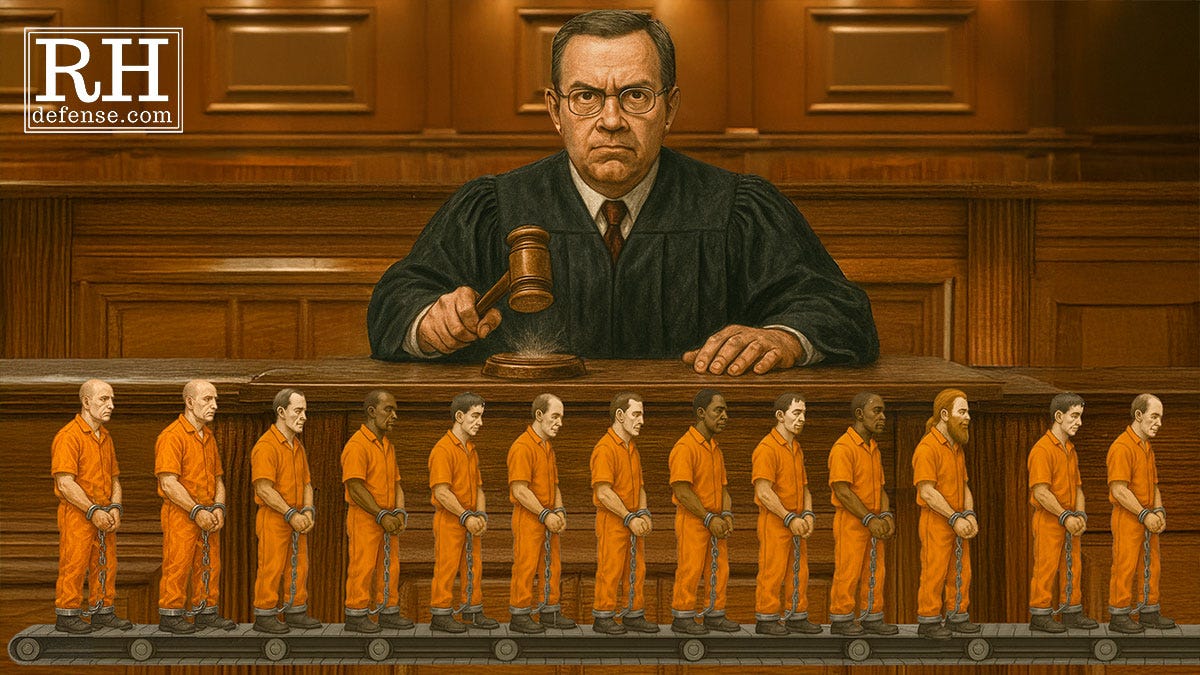
Judges do not need to threaten anyone for this to function. The machinery is already in motion by the time the plea is taken. The role of the court is not to create the pressure, but to certify its disappearance.
Once that certification occurs, the pressure becomes invisible. It is retroactively erased.
Time did the negotiating. Like candlesticks on a market chart, the plea simply records the result.
Detention as Acceleration
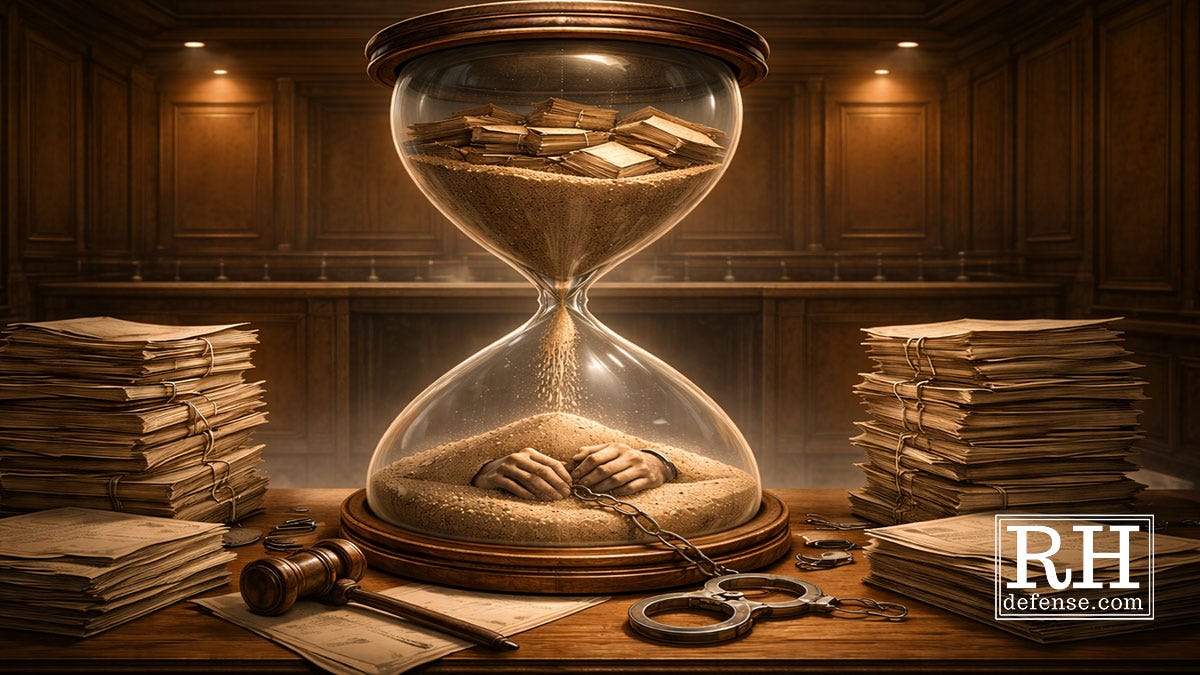
If time is leverage in criminal cases, pretrial detention is leverage turned up to maximum volume.
Detention does not merely restrain a person’s movement, their freedom, their liberty. It radically alters how time is experienced. What might otherwise be tolerable delay becomes something closer to continuous harm.
During the pendency of a case, a day on the outside is a unit of inconvenience. A day inside is a unit of punishment.
Courts insist that pretrial detention is not punishment. It is administrative. Preventive. Regulatory. And, after all, it’s necessary for the safety of the public that people who have been convicted of no crimes — whose guilt has not yet been adjudicated — be locked up.
Even if, once they agree to a plea, they’ll be released on probation.
But the distinctions between punishment and administrative, preventive, regulatory crap collapse at the level that matters — lived experience. A person in custody is already paying part of the sentence before guilt has been established.
And if he ends up acquitted, or the case dismissed? The lost time — the lost job, months or years away from family, even lost homes because the primary breadwinner was locked up — is just a case of “too bad…so sad”.
This is not incidental. It is the accelerant.
Detention compresses decision-making timelines by making waiting unbearable. Every additional day magnifies loss. The question stops being “Can I win?” and becomes “How much more of this can I take?”
That shift has nothing to do with truth-seeking.
Evidence does not improve because someone is locked up. Legal arguments do not sharpen. Witnesses do not become more reliable. What improves is the prosecution’s bargaining position.
Time outside custody exerts pressure gradually. Time inside custody exerts it immediately and relentlessly.
This is why detention changes plea outcomes even in weak cases. Even when the accused person and the accuser know the accused is actually innocent.
A person who might rationally contest an accusation at liberty may rationally surrender under confinement. Not because innocence has become less likely, but because the cost of maintaining it has become intolerable.
This is also why plea offers so often include immediate release. The offer does not just resolve risk; it ends suffering. That relief carries enormous weight — weight that has nothing to do with culpability.
Prosecutors understand this. Judges understand it. Defense lawyers understand it. No one needs to say it out loud.
A plea that promises “time served” is not merely a sentencing recommendation. It is an escape hatch. A costly “get out of jail” card in the governmentally-administered monopoly game. (I deliberately did not capitalize that — I’m talking about a real monopoly here.)
And once detention enters the equation, voluntariness becomes even harder to take seriously. When the alternative to pleading guilty is continued confinement with no fixed end date, the idea of free choice is a fiction.
Detention does not force a plea by itself. It does more subtle and effective. It makes delay so costly resistance collapses.
Time accelerates. In the confined person’s mind, risk balloons. Convergence becomes predictable.
The market clears faster — not because the price is right, but because the buyer is running out of oxygen.
Where This Leaves Us
None of this requires bad actors.
Prosecutors do not need to be cruel, though some are. Judges do not need to be indifferent, though many are. Defense lawyers do not need to be complicit, though too many are. Even in the absence of that, the system works exactly as it would when rational people respond rationally to unequal constraints.
Time makes resistance expensive. Detention makes it unbearable. Voluntariness supplies the necessary legal fiction to certify the outcome.
By the time a plea is entered, the relevant work has already been done. Not by persuasion. Not by truth-finding. But by pressure accumulating unevenly over time.
That pressure does not disappear when the plea is taken. It is merely declared irrelevant. The record reflects a choice. The machinery that produced it fades from view.
This is why plea outcomes can feel inevitable even when facts are contested, defenses are viable, and guilt is genuinely uncertain. The system does not need certainty. It needs convergence.
In Part III, I will turn to the next mechanism that drives that convergence: information — who controls it, when it appears, and how fear and risk distort what “choice” can mean under conditions like these.
For now, it is enough to see this much clearly.
Time did the negotiating. Detention accelerated it. The plea only recorded the result.
Other Parts of This Series
Part I

Part III

Part IV

I know this really bears no relation to your post, but I recently finished John Grisham’s book “The Widow” and it leaves me thankful for criminal lawyers who take on cases that seem impossible. ❤️