


Plea bargaining is usually seen as negotiation — a back-and-forth conversation in which two sides gradually move toward a fair resolution. That description is comforting. It’s also slightly misleading.
Over the last couple of months, as I’ve paid closer attention to how markets work while thinking about retirement and long-term planning, I’m amazed by how familiar what I see happening in the markets feels. Markets don’t resolve by persuasion. They resolve through testing, waiting, pressure, and constraint.
Once I realized that, I immediately thought, “this is just like plea bargaining”. I saw the same structure at work. It made sense right away because, after all, the market is a multi-person negotiation.
And so, as I’ll show, is plea bargaining. Both are games, in a sense, that involve two parties — a buyer and a seller — whose goals and choices are not independent either of one another or of other parties and constraints.
And, in both, you learn the game by playing it.
“The game taught me the game.” — Jesse Livermore
This is the first part of a short series. The subject is deeper than can be handled cleanly in a single essay, and the pieces may not appear consecutively. My ADHD and the amount of time it’s going to take to write all this — it took me hours just to draw up an outline — makes it a virtual certainty that other articles will appear between the four I have planned for this series.
Each of the four parts will stand on its own, but together they will explore plea bargaining as a process rather than a moral dialogue. When the series is complete, the pieces will be cross-linked, listing all four articles at the bottom of each article.
Plea Bargaining and Price Discovery
In markets, price discovery describes the process by which an outcome emerges over time rather than being agreed upon in advance. No one decides what the “right” price is. Participants test levels, resist them, retreat, try again, and respond to pressure as constraints tighten or loosen.
That process doesn’t require agreement, persuasion, or even clarity. It just requires interaction in an environment of scarcity.
Plea bargaining works the same way.
Offers are made, rejected, adjusted, and revisited. Positions harden, soften, or simply wait. Information arrives unevenly. Time passes. Pressure accumulates. Eventually, an outcome appears — not because anyone was convinced, but because the system converged on something that could no longer be resisted.
That is price discovery.
Calling this “negotiation” suggests a symmetry that usually does not exist. It implies that both sides are equally free to wait, equally informed, and equally insulated from risk. In reality, constraints are uneven from the start, and they rarely remain static.
Understanding plea bargaining as price discovery under unequal constraints is not cynical. It is descriptive. And it explains a great deal of behavior that otherwise gets misread as obstinacy, delay, or bad faith.
Unequal Constraints
Calling plea bargaining “negotiation” suggests a symmetry that rarely exists. It implies that both sides are equally free to wait, equally informed, and equally insulated from risk.
That is almost never the case.
From the start, participants in a criminal case operate under very different constraints. Some people can wait. Others cannot. Some can absorb uncertainty. Others experience it as punishment. Some control information. Others react to it as it arrives, often too late to matter.
Those asymmetries are not incidental. They shape outcomes.
In markets, price discovery is driven less by who wants what than by who can afford to wait. Plea bargaining is no different. Outcomes shift not because someone becomes persuaded, but because pressure tightens unevenly.
Want an even greater irony? This asymmetry favors the prosecution in virtually every case and therefore leads many truly innocent people to plead guilty.
There is also reason to believe that plea bargaining exacerbates the problem of innocent defendants pleading guilty. The power that plea bargaining gives to prosecutors allows them to offer plea deals that no rational defendant would turn down. A rational defendant would accept any plea bargain in which her expected punishment is less than the punishment she will receive after trial. So, for example, an innocent defendant who is facing a sentence of five years if convicted at trial should accept a plea offer of less than six months if she believes there is a 10% chance she will be convicted at trial. And an innocent defendant who is facing any jail time at all if convicted should rationally accept an offer of diversion or probation. That plea bargaining leads to innocent people pleading guilty is not merely an abstract concept. There is ample evidence suggesting that a nontrivial number of innocent people plead guilty.
— Carissa Byrne Hessick, The Real Problem with Plea Bargaining, 101 Tex. L. Rev. Online 123, 128 (2023)
It Takes Many to Tango
Plea bargaining is often described as a conversation between two parties. In reality, it is a multi-party interaction.
Prosecutors, defendants, defense lawyers, judges, victims, families, witnesses, law enforcement agencies, and institutions all participate in shaping the terrain. Each brings different incentives, tolerances, and timelines. Each adds friction or pressure in different ways.
To give just one example, California law requires prosecutors to consider — though around here, most do so simply by saying, “I considered and it’s a no” — immigration consequences when engaging in plea negotiations. In Padilla v. Kentucky, the U.S. Supreme Court said defense attorneys must not only advise clients about the potential immigration consequences of a plea, but might even engage in creative bargaining to help them avoid them. This functions as one of the many constraints that can impact plea bargaining, though this one usually is of little consequence.
More importantly,
Although not explicitly stated in Padilla, such creative bargaining involves not just the defense attorney and his client but also the prosecutor and the judge who agree to allow the plea to proceed. The Court was and is certainly aware of this. Indeed, in companion cases that followed Padilla—Missouri v. Frye and Lafler v. Cooper—the Court noted the many benefits that plea bargains afford the parties including the resources saved by the prosecutor and courts. Justice Stevens, then, was not speaking only to defense attorneys in calling for creative bargains; he was also encouraging prosecutors and judges to accept these pleas.
— Thea Johnson, Fictional Pleas, 94 IND. L.J. 855, 868 (2019)
While creative fictional pleas require the cooperation of various parties, judges, in particular, function as boundary conditions in other ways. Their patience, calendars, and tolerance for delay define how long testing can continue before resolution is forced. Victims and families amplify pressure in some cases and dampen it in others. Institutions prioritize efficiency, risk management, and throughput, often invisibly.
No one really controls the dance. But everyone contributes to the rhythm.
That is why outcomes can change without anyone “changing their mind.”
Testing, Resistance, and Consolidation
Our world, indeed our universe, operations on a system of cycles. The earth, along with her sister planets, orbits around the sun. A complete orbit completes a cycle, which we refer to as a “year".”
Predictable weather patterns create four seasons within that year, each with its own cycle. Tides flow in and out on exact cycles. Humans and all living creatures experience cycles of life, including birth, childhood, puberty, adulthood, and passing on.
— Toni Turner, A Beginner’s Guide to Short-Term Trading 61 (2d ed. 2008) (Amazon Affiliate link)
In markets, movement rarely happens in a straight line. Periods of advance are often followed by consolidation — pauses where prices compress, resistance is tested, and participants reassess. Candlestick traders have names for these pauses. The names matter less than the function.
Consolidation is how systems discover what will hold. Stocks “trade sideways” in a kind of “holding pattern” signaling “indecision” while various market participants catch their breath and reassess their positions.
What is often labeled “delay” in plea bargaining serves the same function. Early positions are tested. Resistance is encountered. Information trickles in. Emotional intensity cools or flares. Constraints reveal themselves over time.
This is not stalling for its own sake. It is consolidation.
Seen this way, accusations that one side or the other is “dragging the case” often miss what is actually happening. The system is determining which positions are sustainable and which are not.
A Note on Pretrial Detention
Time does much of the negotiating in plea bargaining. Pretrial detention dramatically alters how that time is experienced.
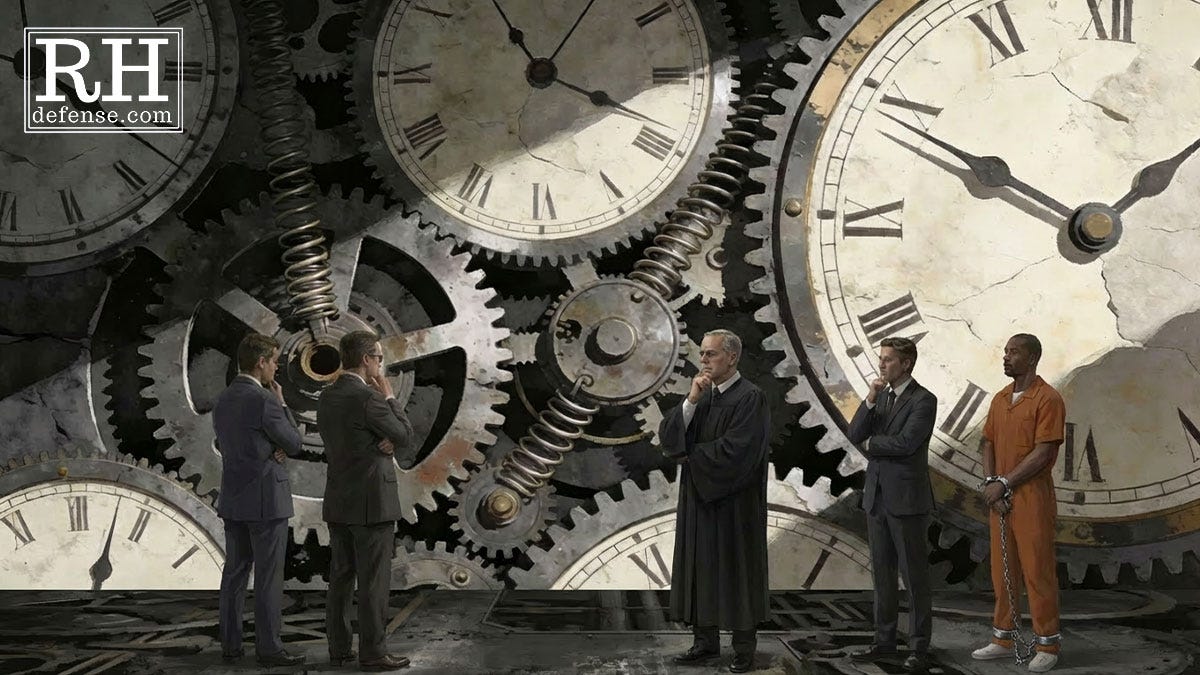
Detention tightens constraints on the accused in ways that are difficult to overstate. It accelerates pressure. It reshapes risk tolerance. It makes waiting costly in ways that are not shared equally by other participants.
[D]etained individuals may lose bargaining power to the prosecutor because of the costs of being detained, and they face stronger incentives to plead guilty, even if they are innocent.
—Emily Leslie & Nolan G. Pope, The Unintended Impact of Pretrial Detention on Case Outcomes: Evidence from New York City Arraignments, 60 J.L. & Econ. 529, 530 (2017)
Whatever its stated justification in a given case, pretrial detention functions structurally as a pressure multiplier. It predictably shifts the terms on which outcomes become acceptable.
Any account of plea bargaining that ignores this dynamic is incomplete.
Checking the Idea
After this way of seeing plea bargaining occurred to me, I went looking to see whether anyone else had noticed something similar.
They had.
An article in the Georgetown Washington Law Review describes plea bargaining as a kind of market exchange, emphasizing power imbalance, coercion, and asymmetry. In that sense, it overlaps substantially with what I’m describing here.
Where my approach differs is in emphasis. That article treats the market analogy primarily as critique — a way of showing what is troubling about plea bargaining.
Most significantly, examination of the primary influences on plea prices undermines claims by defenders of plea bargaining that the system is “fair” simply because both sides “voluntarily” enter into plea bargains when permitted to do so. The primary factors in determining plea prices—expected sentences, probability of conviction, and cost of litigation—all are, and have been, subject to manipulation by the government. As such, the deck is stacked to ensure that prosecutors usually get what they want (convictions accompanied by substantial punishment) without giving up any real bargaining concessions.
[…]
In short, examining the impact of the major trends in criminal justice through the lens of price theory reveals how the state has managed to manipulate the plea bargaining market to achieve precisely the ends it wants while maintaining the illusion of a system of mutually voluntary choices by individual defendants.
— Russell D. Covey, Plea Bargaining and Price Theory, 84 Geo. Wash. L. Rev. 920 (July 2016)
My aim is more basic. I am trying to describe how the system actually works, before deciding what to think about it.
Markets and plea bargaining behave similarly not because markets are bad, but because both are multi-party systems operating under scarcity, uncertainty, time pressure, and unequal constraints. The same psychology appears wherever those conditions exist.
This series starts from that premise.
Other Parts of This Series
Part II

Part III

Part IV

Looking forward to reading the rest of this series. I love sharing the insight I get from reading your articles with people not well versed in the law - especially criminal law.