

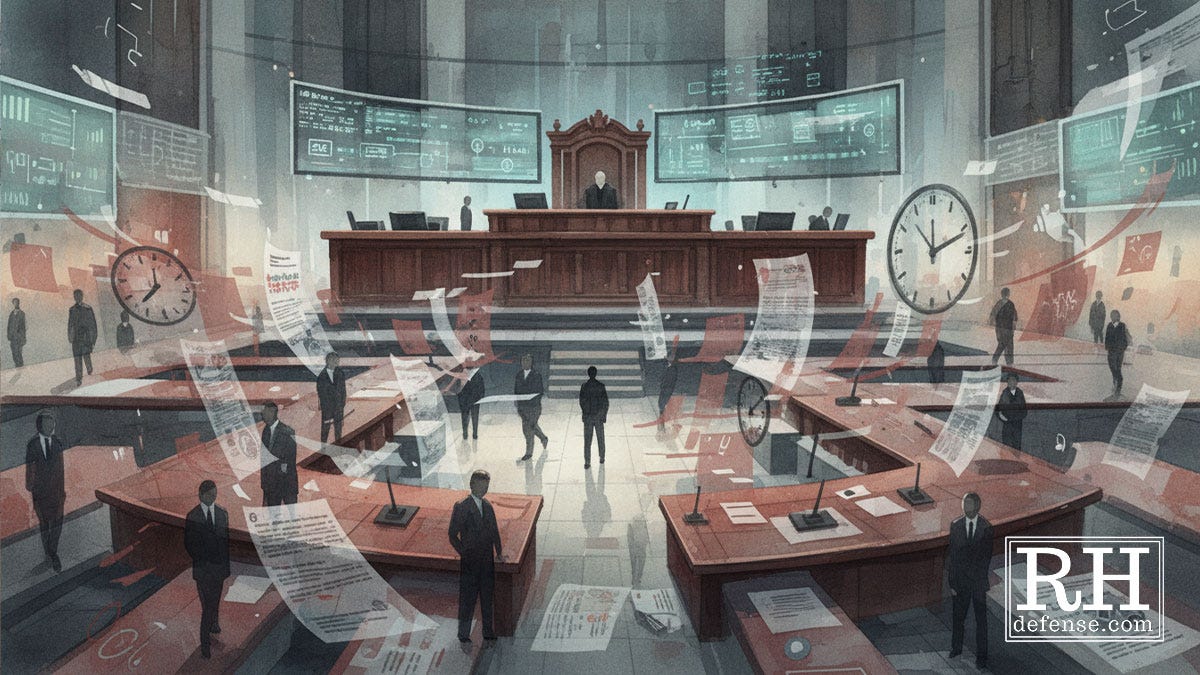
Every plea form contains a paragraph like this one:
I am entering this plea freely and voluntarily. No one has threatened me, forced me, or promised me anything other than what is written here.
Judicial Council of Cal., Plea Form, with Explanations and Waiver of Rights—Felony (Criminal) (Judicial Council Form CR-101, rev. July 1, 2025), at 5
The language may vary slightly by jurisdiction, but the idea is always the same. It’s boilerplate. Everyone in the courtroom has seen it a thousand times. The judge reads it. The defendant answers “yes.” The transcript records consent. The system moves on.
One day, during a plea colloquy, I interrupted that rhythm.
We had reached that paragraph — the one where my client was required to state, under penalty of perjury, that no one had threatened him or coerced him into pleading. And I said, out loud, in open court, that this wasn’t really true.
Not in the way the form pretended it was true.
Because my client had been told — clearly, explicitly, and more than once — that if he did not accept the plea that day, the prosecutor would add charges and enhancements. His exposure would increase dramatically. The threat wasn’t subtle. It wasn’t hypothetical. It was the offer.
And now, on top of that, he was being required to say — again under penalty of perjury — that no one was threatening him.
I pointed out the contradiction.
The judge reacted immediately. He was angry. He warned me that he would tear up the plea agreement if I continued. The courtroom got tense. My client looked panicked — not because what I said was wrong, but because it was right in a way that endangered him.
I had just done something dangerous: I had disrupted the fiction that allows the system to proceed.
From the system’s point of view, nothing improper had happened. Prosecutors are allowed to file additional charges. They are allowed to threaten lawful action. Judges are allowed to insist on a clean record of voluntariness. Everyone was acting “by the rules.”
But from inside the moment, it felt different.
Part of the reason that difference is so easy to dismiss is that plea bargaining is almost always discussed after the fact — once an outcome exists and uncertainty has collapsed into a story about choice. As one scholar puts it:
It is easy to overlook the problem of uncertainty because most commentary views the plea-bargaining dynamic in hindsight… For defendants deciding whether to agree to a plea offer, however, uncertainty is key.
— Andrew Manuel Crespo, Plea Bargaining’s Uncertainty Problem, 58 Am. Crim. L. Rev. 571, 573 (2021)
That distinction matters, because what the record later calls a “decision” was made inside a fog of risk, incomplete information, and escalating exposure — not from a position of calm knowledge or equal footing.
It felt like being asked to execute a trade under pressure — with the price moving against you — and then being required to certify, on the record, that you acted freely, without coercion, and with full information. As if the ladder had not been climbing. As if the downside had not been made explicit. As if refusing the trade would not immediately worsen your position.
In markets, we have a word for that kind of situation. It’s not choice. It’s forced liquidity. Sometimes it looks like a margin call. Sometimes it looks like a short squeeze — where the position itself isn’t proven wrong, but time, pressure, and escalating exposure make holding it impossible. You don’t exit because the thesis failed. You exit because survival requires it.

The criminal legal system doesn’t use that language. It uses moral language instead. Voluntary. Knowing. Intelligent. Free.
And that’s where the discomfort begins.
When you step back from the ritual, what’s happening looks much closer to this:
Some uncertainty is, of course, unavoidable. But sometimes, there is so much uncertainty in evaluating a plea offer that the defendant’s decision resembles a high-stakes gamble, not an informed choice… In certain scenarios, defendants are forced to stake their lives on propositions no more predictable than the spin of a roulette wheel. Such a dynamic is toxic to any rational system of justice.
— Andrew Manuel Crespo, Plea Bargaining’s Uncertainty Problem, 58 Am. Crim. L. Rev. 571, 547 (2021)
That is not the language of misconduct. It is the language of structure.
And when someone points out that the tape tells a different story than the one the plea form records, the system doesn’t argue back. It tightens. It threatens collapse. It insists the fiction be completed — cleanly, quietly, and on the record — so that everyone can move on pretending the choice was freely made.
Finally, I give you Part IV of my four-part series which began with Part I at the start of January. (All of the other parts are linked at the end of this article. And I will go back and link each of the articles to the other articles.)
The Moment the Market Must Clear
The reason the interruption mattered — the reason the judge reacted the way he did — has nothing to do with me, or with my client, or even with that particular plea.
It had to do with clearing. With closing the candle. Printing the trade. Because until then, nothing is defined.
Up to that moment, the system was operating the way it always does during price discovery. Positions were open. Exposure was known but not yet realized. The parties had been living with uncertainty because uncertainty was still doing useful work. Offers could be floated without commitment. Threats could be implied without being triggered. Everyone could wait — or at least pretend they could.
That’s the phase the system tolerates.
The plea colloquy is different. It is not part of discovery. It is the clearing event. As I said, we print the closing price of the candlestick.
Once the court entertains the plea, the system no longer tests positions. Its work now is closing them. The open exposure that’s been driving behavior up to that point has to collapse into a final print — something legible, stable, and no longer subject to revision.
And that means uncertainty disappears.
Not factual uncertainty — no one expects truth to be fully known at that point; truth was never the point; the market merely needs to keep moving — so it’s procedural uncertainty at this point. The kind that allows the position to be reopened. The kind that would let anyone later say: this exit wasn’t voluntary; it was forced by pressure we all understood at the time. A short seller got squeezed.
That’s why the record suddenly becomes so brittle.
What the system needs at that moment is not an explanation of how the trade was executed, but a certification that it was clean. No coercion. No pressure. No external force. We stamp the ticket and move the trade off the books.
The narrative that follows — the defendant chose, freely, knowingly, voluntarily — is not descriptive. It’s settlement confirmation.
It replaces the messy mechanics of how the position became untenable with a single, tidy representation: consent. And like all such representations, it must be absolute. Anything less would leave residual risk in the system.
That’s why naming the pressure as I did is destabilizing. It keeps open the threat of a fakeout.
A fakeout occurs when a trader anticipates a transaction signal or price movement that does not materialize, resulting in a move in the opposite direction.
—Lucas Downey, Spotting Fakeouts: Key Strategies in Technical Analysis (December 28, 2025)
The judge reacted to what I did not (just) because it is improper — everyone involved understands exactly how the position was constrained — but because acknowledging it at the clearing moment, as I said, defeats the function of the ritual. It is the equivalent of announcing, during settlement, that the seller exited only because margin requirements were raised mid-day and liquidation became unavoidable.
That may be true. It may even be obvious. But it cannot be said if the system is to move on.
Finality only works if the exit looks voluntary.
For insiders, this isn’t controversial. Prosecutors understand that escalating exposure changes behavior. Judges know that time and detention accelerated the convergence. Defense lawyers get that refusing the offer is not a neutral act but a decision to absorb additional risk immediately.
None of that’s hidden.
What’s hidden is the fact that the system can’t acknowledge forced liquidity without undermining its own legitimacy. So the pressure has to vanish at the moment of execution.
The defendant must swear that what everyone understands to be true is, for purposes of the record, not true. Under penalty of perjury (that’s really what galls me the most — the system that is supposed to punish lies insists on a lie to close the deal). The judge must accept that answer without probing. The transcript must reflect a clean exit. The position must. Be. Closed.
And once it is closed, the conditions that produced it don’t matter anymore. Not because they were resolved, but because they have been priced in and erased.
Print the next candle, please!
This is why the reaction was immediate. I didn’t accuse anyone of misconduct. I didn’t challenge the legality of the offer. I didn’t ask the court to refuse the plea.
I introduced counter-evidence at the moment the system needed certainty.
That was enough.
Because the system doesn’t require the clearing story to be accurate. It requires it to be uncontested. (Under penalty of perjury.)
Once the fiction is completed — once the exit is certified as voluntary — the pressure that made holding the position impossible disappears from the record. It isn’t remedied. It’s not justified. It’s just written out of existence.
That erasure isn’t an accident. It’s how the system stabilizes itself after doing exactly what it was designed to do.

Who Holds the Risk After the Trade Prints
Once the position is closed, the system’s primary concern is no longer accuracy. It’s allocation.
Every market has to decide, after the candle prints, who bears the risk if the price turns out to be wrong. In functioning markets, that allocation is explicit. Losses fall where they fall. Margin rules are enforced prospectively, not retroactively. You don’t reopen settled trades because the pressure that caused the exit later looks unfair.
The criminal legal system works the same way — except it pretends it doesn’t.
Once the plea is entered and accepted, all remaining risk is pushed onto the defendant. Not just sentencing risk, but epistemic risk. If later evidence emerges. If a witness collapses. If a forensic claim turns out to be junk. If a legal theory that drove the plea is later rejected. None of that matters in the same way it would have mattered before the trade cleared.
The system has already printed the price.
To use an economic analogy, plea bargaining establishes a “going rate.” The anticipated sentence is the central concern in the negotiation. The problem, however, is that both innocent and guilty defendants are placed in the same pot and the goal is to achieve the appearance of justice, not the realization of it.
John L. Kane, Plea Bargaining and the Innocent, The Marshall Project (Dec. 26, 2014)
This is why voluntariness matters so much after the fact. It is not about whether the decision was free in any meaningful, lived sense. It is about whether the system can disclaim responsibility for the conditions under which the decision was made.
A “voluntary” plea reallocates all residual risk to the person who entered it. It converts structural pressure into personal choice. If the outcome is later revealed to be wrong, unjust, or deeply distorted by uncertainty, the answer is ready-made: he chose. He was advised. He knew the risks.
That answer only works if coercion is erased from the record.
In market terms, this is the equivalent of declaring that every forced liquidation was the trader’s independent strategy decision — and then using that declaration to bar any later claim that the exit was compelled by changing margin requirements, liquidity constraints, or asymmetric exposure.
The fiction isn’t just convenient. It is load-bearing.
Appeals doctrine depends on it. Habeas doctrine depends on it. Finality doctrine depends on it. The system cannot afford to reopen trades every time it becomes clear that the price printed under pressure was not an accurate reflection of underlying value.
So the law does what markets do when they want stability: it treats settlement as conclusive, and it treats the conditions that produced settlement as irrelevant once the position is closed.
Defendants are risk averse and prefer the certainty of a year in prison to a 50/50 or 90/10 chance of a longer term. For many defendants the rights afforded by rules of criminal procedure have little value at trial but considerable value in trade; they can sell their rights back to prosecutors by dealing for shorter sentences through a guilty plea.
— Frank H. Easterbrook, Plea Bargaining is a Shadow Market 51 Duq. L. Rev. 551, 552 (2013)
This is why voluntariness is assessed retroactively, through a transcript, rather than contemporaneously, through a serious examination of pressure. It is why the standard is not “free of coercive leverage,” but merely “free of unlawful threats.” It is why lawful escalation is invisible, while unlawful coercion is treated as exceptional.
The Court held that the threat of a significantly more severe penalty (even the death penalty) upon conviction is not so coercive as to invalidate a guilty plea. Indeed, few governmental actions short of physical coercion would render a guilty plea involuntary.
Jenia I. Turner, Plea Bargaining, in 3 Reforming Criminal Justice 73, [pin cite needed] (Erik Luna ed., 2017)
The distinction is not moral. It is structural.
The system does not deny that pressure exists. It denies that pressure matters once the trade is done.
And that denial is enforced by language. “Knowing.” “Intelligent.” “Voluntary.”
Those words aren’t descriptions of what happened. They’re loss-allocation devices. They determine, once the candle prints, who is allowed to complain — and who is not.
There were times during my seventeen-year tenure on the federal bench that inquiring of a defendant as to the voluntariness of his guilty plea felt like a Kabuki ritual. “Has anyone coerced you to plead guilty,” I would ask, and I felt like adding, “like thumbscrews [sic] or waterboarding? Anything less than that — a threatened tripling of your sentence should you go to trial, for example — doesn’t count.”
— Nancy Gertner, Letter to the Editor, ‘Why the Innocent Plead Guilty’: An Exchange, N.Y. Rev. Books (Jan. 8, 2015)
Once the plea clears — Time & Sales prints — the system moves on. The trade is treated as settled, the books balanced, and any error in price discovery — any distortion produced by pressure, timing, or fear — is no longer the system’s problem. It belongs entirely to the trader who exited.
After the Trade Clears
Once the plea is entered and accepted, the system treats the matter as finished. The record’s closed, the outcome fixed, and the conditions that produced the decision are no longer examined in the same way they were before the plea was taken. Whatever uncertainty, pressure, or distortion shaped the result is treated as having been resolved by the act of pleading itself.
Calling the plea “voluntary” does not describe how the decision was made. It determines how responsibility is assigned once the decision can no longer be revisited. From that point forward, the risk does not belong to the system that structured the choice under escalating exposure. It belongs to the person who accepted the outcome — after affirming, under penalty of perjury, that no pressure existed at all.
That is how the system clears the trade. All that’s really left is to output the chart.
Sentencing will be every more ritualistic than was the recording of the trade.
The gavel falls. The next auction is about to begin.
If you’ve seen this from inside the system — as a lawyer, a defendant, a judge, or a trader — I want to hear what you recognized.
Other Parts of This Series
Part I

Part II

Part III

Damn. Another insightful and well-thought piece. I know you can't go into details, but what happened next with the judge?