

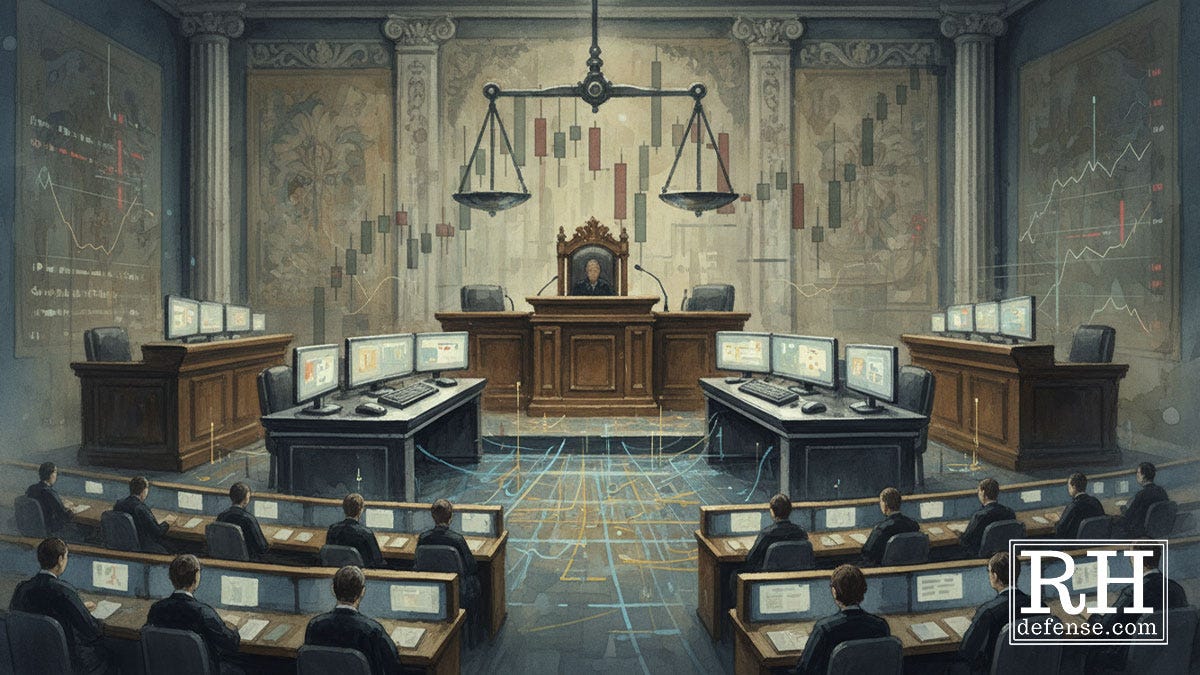
I’ve been writing a four-part series — currently interrupted, with only Part I and Part II published so far — using market metaphors and analogies to talk about criminal defense, and especially about plea bargaining.
I didn’t start out intending to do that. It happened because, back in November 2025, I began thinking seriously about retirement, started paying closer attention to my finances, and then — somewhat unexpectedly — got pulled into learning about markets and day trading.
And the metaphors won’t leave me alone.
What I’m seeing as I learn about markets, exchanges, volatility, and risk keep fitting. Not metaphorically in the loose, “this kind of reminds me of” sense, but in the way the deep structures that constrain the system actually look, feel, and work. They explained things I see every day in court better than the language we usually use to talk about them.
It’s frankly been kind of eye-opening. I knew these things. But I didn’t see them as starkly until the metaphors hit my brain like a rising VIX print.
I’ve tried to find others writing about criminal defense this way. Not about fraud or insider trading or financial crimes, but about the process itself — about pleas, pressure, time, risk, and decision-making — viewed through the lens of markets. I haven’t found much.
That absence surprised me at first. But then, I realized, I shouldn’t feel surprised.
Long before this series, I’d already been circling some of the same ideas from a different direction. In writing about pattern recognition — and the danger of mistaking coherence for truth — not long ago, I put it this way:
Certainty is anesthetic. It dulls the discomfort of doubt, the ache of ambiguity. You don’t have to wrestle with probabilities if someone else already has, or at least sounds like they have. The performance of confidence is often enough.
— Rick Horowitz, The Sound of Certainty: How We Mistake Confidence for Truth (November 10, 2025)
Markets taught me something that courtrooms had been trying to teach me for years: confidence and correctness are not just different things — they are often inversely related.
That recognition sharpened further when I wrote about a trading halt that felt unsettlingly familiar:
In markets, trading is halted when volatility gets too extreme — not because the system is broken, but because the system knows it can’t discover truth at that speed. The halts are triggered to give time for everyone to slow down, consider their positions, actually think about what they’re doing.
Criminal courts don’t have the safeguard of an automatic halt.
— Rick Horowitz, Halted: What a halted stock reminded me about momentum, exhaustion, and the discipline of restraint (January 8, 2026)
Those sentences could just as easily have been written about arraignments, bail hearings, or early plea negotiations conducted under pressure, with incomplete information, and very real consequences for getting it wrong.
Before I move on to Part III of the four-part series I promised, I want to pause here — not to justify the series, but to explain why this way of seeing the system keeps proving useful to me, why I think it matters, and perhaps why others might resist this way of seeing our criminal injustice system.
Not because law is a market.
But because, in important and uncomfortable ways, the criminal injustice system behaves like one.
These Are Not Trading Pieces
Let me be clear about something at the outset: this is not a trading series, and it’s not an argument that lawyers should “think like traders.”
I’m not importing market language into criminal defense because I admire markets, and I’m not doing it to dress up legal analysis with clever analogies. I’m doing it because market language is unusually honest about forces the criminal legal system often doesn’t recognize. And if it did recognize them, I fairly certain it would prefer not to.
See, markets don’t pretend to be moral. They don’t claim to be fair. They don’t tell stories about what’s deserved, virtue, or redemption. They talk openly about risk, pressure, liquidity, timing, leverage, asymmetry, and volatility. They assume unequal information as a starting condition, not a scandal. Incentives aren’t hidden; they’re the point.
The criminal legal system, by contrast, is saturated with moral language — justice, accountability, responsibility, rehabilitation — even as it operates through mechanisms that look nothing like moral reasoning in practice. Plea bargaining is not a search for truth; it is a price discovery process under constraint. Bail is not simply about safety; it is a liquidity problem imposed on human beings. Speed is not efficiency; it is pressure. And pressure changes outcomes.
Market metaphors don’t prettify this. They strip it bare.
They give names to things lawyers, judges, and clients all feel in court but are rarely encouraged to say out loud: when leverage shifts, when information is thin, when time is being used as a weapon, when movement is mistaken for progress, when restraint is punished and haste rewarded. None of that is captured by the language of “negotiation” or “resolution.” It is captured by the language of volatility, spreads, and forced trades.
So no — my articles about criminal defense which rely on market metaphors aren’t trading pieces.
It’s my attempt to describe a system that already behaves like a market, whether we acknowledge it or not, using a vocabulary that refuses to lie about how decisions are actually made.
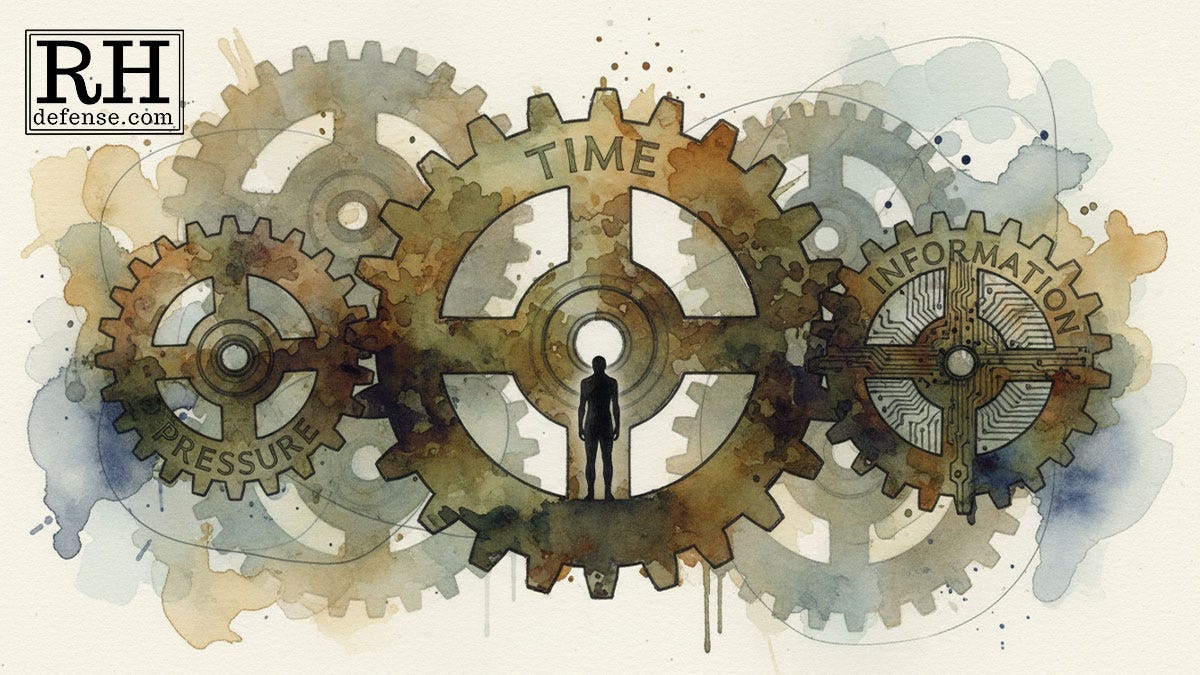
Why This Way of Seeing the System Keeps Working for Me
The simplest reason this framing keeps returning is that it has actually helped me see deeper into a system I’ve worked within — including my time as a certified law student — for nearly a quarter century.
And it disciplines me.
Markets punish fantasy quickly. They don’t care how strongly you believe a story, how fluent your explanation sounds, or how morally satisfying your position feels. If you’re early, overconfident, under-informed, or trading on hope instead of structure, the feedback is immediate. And it’s personal.
Courtrooms offer no such clarity.
In criminal defense, bad assumptions can survive for months. Sometimes years. A weak theory can limp along on momentum. A premature plea posture can feel productive because something is happening. A confident prosecutor can sound persuasive long before the facts justify it. The system rarely corrects these errors quickly — and when it does, it’s often too late to undo the damage.
Market thinking resists that drift.
It forces me to ask questions that legal language tends to soften or postpone: What do we actually know right now? What don’t we know yet? Who controls the timing of information? Where is the leverage really coming from? What is the cost of waiting — and who is paying it? What happens if we act now and turn out to be wrong?
Those questions don’t sound especially legal. They sound operational. Structural. Cold, even. But they are exactly the questions that determine outcomes in real cases.
Markets also teach restraint — not as virtue, but as survival.
Most trades are bad trades. Most moments are noise. Most movement is not opportunity. Knowing when not to act is not passivity; it’s judgment — resistance to action bias, the human tendency to mistake movement for wisdom. Judgment is built by tolerating discomfort — the discomfort of uncertainty, of waiting, of not having an answer yet when everyone around you wants one.
That lesson translates cleanly to criminal defense.
I’ve watched lawyers talk plea before they have discovery. Before investigation. Before they know whether the apparent pressure is real or just loud. I’ve watched cases harden prematurely because movement was mistaken for progress, and silence was mistaken for neglect. I’ve watched clients pushed into decisions because delay felt unbearable — not because resolution was actually wise.
Market thinking resists that urge. It treats waiting as a position. It treats restraint as information. It understands that acting too early is often worse than acting too late.
Most importantly, this way of seeing the system keeps me honest about uncertainty.
Markets never pretend that outcomes are deserved. They don’t reward effort. They don’t care about intention. They respond to structure, incentives, timing, and information — nothing else. Criminal courts pretend to operate on moral evaluation, but in practice they respond to many of the same forces.
Seeing that clearly doesn’t make me cynical. It makes me careful.
And that’s why this framing keeps proving useful — not because it’s clever, and not because it flatters me and makes me look intelligent, but because it keeps dragging me back to reality when the system itself would rather tell a different, cleaner, more moral story.
Why I Think I Haven’t Found Others Doing This
Once I stopped being surprised that I hadn’t found much writing about criminal defense in market terms, I felt like the reason was obvious.
This way of seeing the system is uncomfortable.
It doesn’t flatter the people who work inside it — including me. It doesn’t allow us to pretend that outcomes flow naturally from truth, or that process is neutral, or that pressure is incidental. It insists on talking about incentives, asymmetries, and constraints first, and moral language second — if at all.
Most legal writing runs in the opposite direction.
Before I ever thought about markets, I wrote about the danger of tidy stories and the human need for coherence. Returning again to Sound of Certainty, I put it this way:
We all crave order. When the world tilts toward chaos — whether it be politically, technologically, or personally — certainty feels like a handrail. A calm, authoritative voice can do more to settle nerves than any mountain of evidence. We trust the people who sound sure of themselves.
— Rick Horowitz, The Sound of Certainty: How We Mistake Confidence for Truth (November 10, 2025)
That craving doesn’t disappear in courtrooms. In fact, if anything, it intensifies.
Judges want cases to move. Prosecutors want narratives that land cleanly. Defense lawyers feel pressure to do something — to talk, to negotiate, to show progress — even when waiting would be wiser. Clients and families want reassurance, timelines, and answers that simply don’t exist yet.
Market language resists all of that. It refuses to turn uncertainty into comfort. It doesn’t offer a handrail.
Instead, it says: you don’t know yet. And if you act as if you do, you may make things worse. The market is littered with losers in a zero sum game who thought if they just gathered enough indicators, or let Level II tell them what and when to trade (it doesn’t work that way), or spotted a bullish harami they’d be on the yellow brick road to retirement.
We like to believe our laws work the same way. Feed in the facts, turn the crank, and out comes justice. And we can’t be blamed for that, because, after all, judges and prosecutors look at it that way. They tell us that’s how it works. It’s all objective, analytical, fair.
But that’s not how things work in the real world.
— Rick Horowitz, The Bronze Brain and the Criminal Law: What a corroded Greek computer can teach us about the danger of believing our systems are smarter than we are (October 24, 2025)
That’s not a popular message in a profession built around advocacy, persuasion, and confidence. Lawyers are trained to argue positions, not to sit with indeterminacy. It’s a dynamic I’ve written about elsewhere in a different context — including large language models — where fluency is mistaken for understanding and confidence is mistaken for truth. Courts reward the same performance, with far higher stakes.
And there’s also something more fundamental at work.
Markets are openly amoral. That doesn’t mean immoral; it means they don’t pretend to justify outcomes in human terms. Losses aren’t deserved. Gains aren’t virtuous. They simply happen. The system doesn’t apologize. It doesn’t need to.
The criminal legal system, by contrast, depends on moral narration to function. It needs to believe — and to have others believe — that outcomes reflect responsibility, blame, and “just desserts”. To talk too openly about leverage, pressure, and constraint would threaten that self-image. It risks exposing how often results turn on timing, resources, and tolerance for uncertainty rather than on truth alone.
I highlighted that point when I wrote:
When we say that a case “takes too long,” or that someone is “dragging it out,” we are usually misdescribing what is happening. Delay is not a deviation from the system. It is one of the system’s primary mechanisms.
— Rick Horowitz, Time Does the Negotiating: How Delay Becomes Leverage in Plea Bargaining (January 9, 2026)
So this language gets resisted. Not because it’s inaccurate, but because it destabilizes the stories the system tells about itself.
I don’t think that resistance is usually conscious. I don’t think most lawyers wake up in the morning intending to preserve comforting illusions. But I do think there’s a strong professional incentive not to look too closely at how decisions are actually made when the cost of being wrong is high and the information is incomplete.
I came to realize that market metaphors cut through that by accident. Markets don’t care about our intentions. They just describe the mechanics.
And once you start describing the mechanics honestly, it becomes much harder to go back to language that pretends those mechanics don’t matter.
The Tape Just Prints
I’m aware that all of this may sound like an elaborate way of refusing comfort.
That’s intentional.
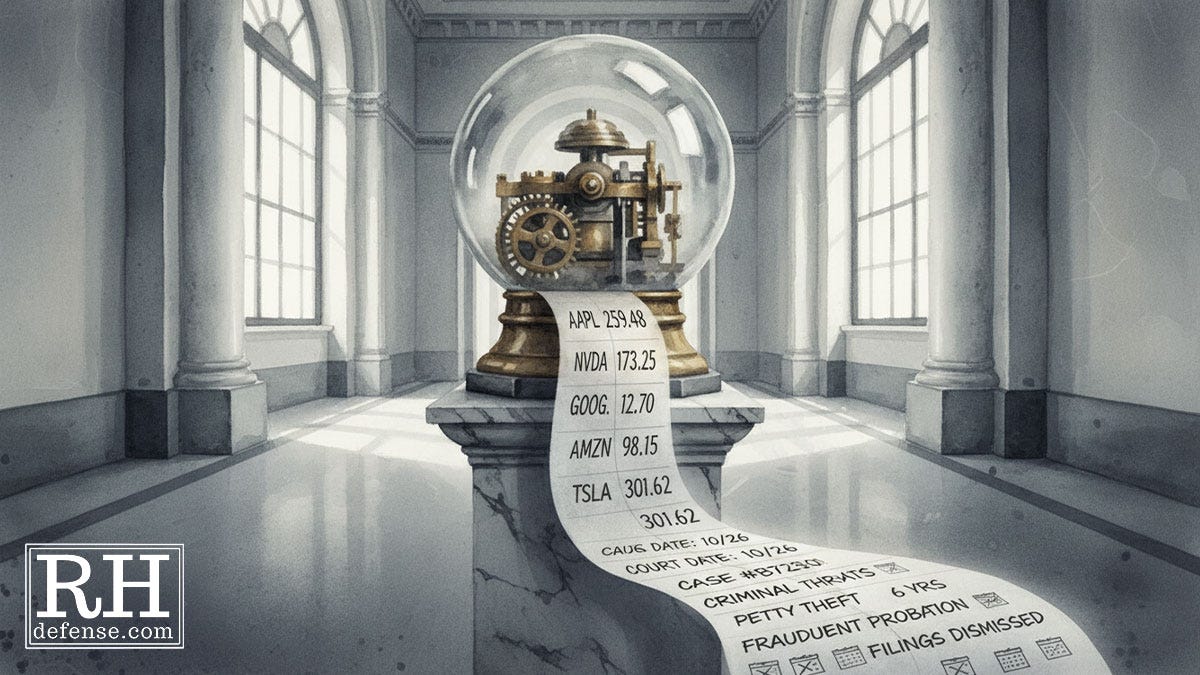
The criminal legal system runs on the promise that things will make sense soon — after the next hearing, after discovery, after negotiations, after the right explanation is given in the right tone. Market language keeps interrupting that promise. The candles don’t always print cleanly. They keep showing that uncertainty is not a temporary glitch but a structural condition. That pressure of the tape — Time & Sales — is not an aberration but a tool. That timing matters more than rhetoric, and that confidence is often just noise moving faster than understanding.
I wrote this article because I didn’t want to move on to Part III pretending I hadn’t learned that.
The series I started isn’t really about markets, and it isn’t really about plea bargaining in isolation. It’s about how decisions get made when the cost of being wrong is unbearable, the information is incomplete, and the system rewards motion over judgment. Market metaphors help me see that clearly because they refuse to tell me a comforting story about why an outcome happened. They only show me how. The tape just prints.
That way of seeing doesn’t make me detached. It makes me careful.
It slows me down when slowing down feels dangerous. It reminds me that waiting can be an act, that restraint can be a position, and that not every moment that demands action deserves it. In a system that confuses speed with justice and certainty with truth, that discipline matters.
After all, we do talk about “reading the tape” in markets. What I’ve been learning in thinking about all this is what every day trader either learns — or suffers from not having learned — the tape just prints. As “Larry Livingston” — a fictional character based on the real-life trader Jesse Livermore — puts it when talking about “the message of the tape”:
The fluctuations were from the first associated in my mind with upward or downward movements. Of course there is always a reason for fluctuation, but the tape does not concern itself with the why and wherefore. It doesn’t go into explanations. I didn’t ask the tape why when I was fourteen, and I don’t ask it to-day, at forty. The reason for what a certain stock does to-day may not be known for two or three days, or weeks, or months. But what the dickens does that matter? Your business with the tape is now—not to-morrow.
— Jon D. Markman, Reminiscences of a Stock Operator: With New Commentary and Insights on the Life and Times of Jesse Livermore 3 (John Wiley & Sons, Inc. 2010)
The tape just prints. It’s up to me to properly interpret how that should guide me.
I hope to complete Part III by tomorrow. If I succeed, we return to the series itself — to information, discovery, and how ignorance is managed, leveraged, and tolerated in criminal cases. This piece sits here because it had to. Because before going further, I needed to say why I’m looking at the system this way at all.
Not because it’s elegant or perfect or makes me look amazing (even if I’m not on a sammich).
But because it keeps proving true.
We should all practice the "delay" in our daily lives. Just might prevent some serious rash decisions!
There are many ways of explaining the concept of why lawyers delay. The marketplace explanation is usually the best way to explain. But Rick Horowitz does it so eloquently and understandably. At least for anyone with some understanding of the way markets operate. (Good luck to the rest. The rest are always going to ask: “Mr. Lawyer. What is going to happen?)
So. Salutes to Rick for boiling the meat off the bones here. He did it again.