

Welcome back.
In Part One, I laid out the architecture: the pattern-seeking machinery in our heads and the way it fools both traders and prosecutors. Now we shift from theory to consequences — what happens when those mental shortcuts harden into “evidence,” and jurors get asked to trust a story that only looks coherent from one angle.
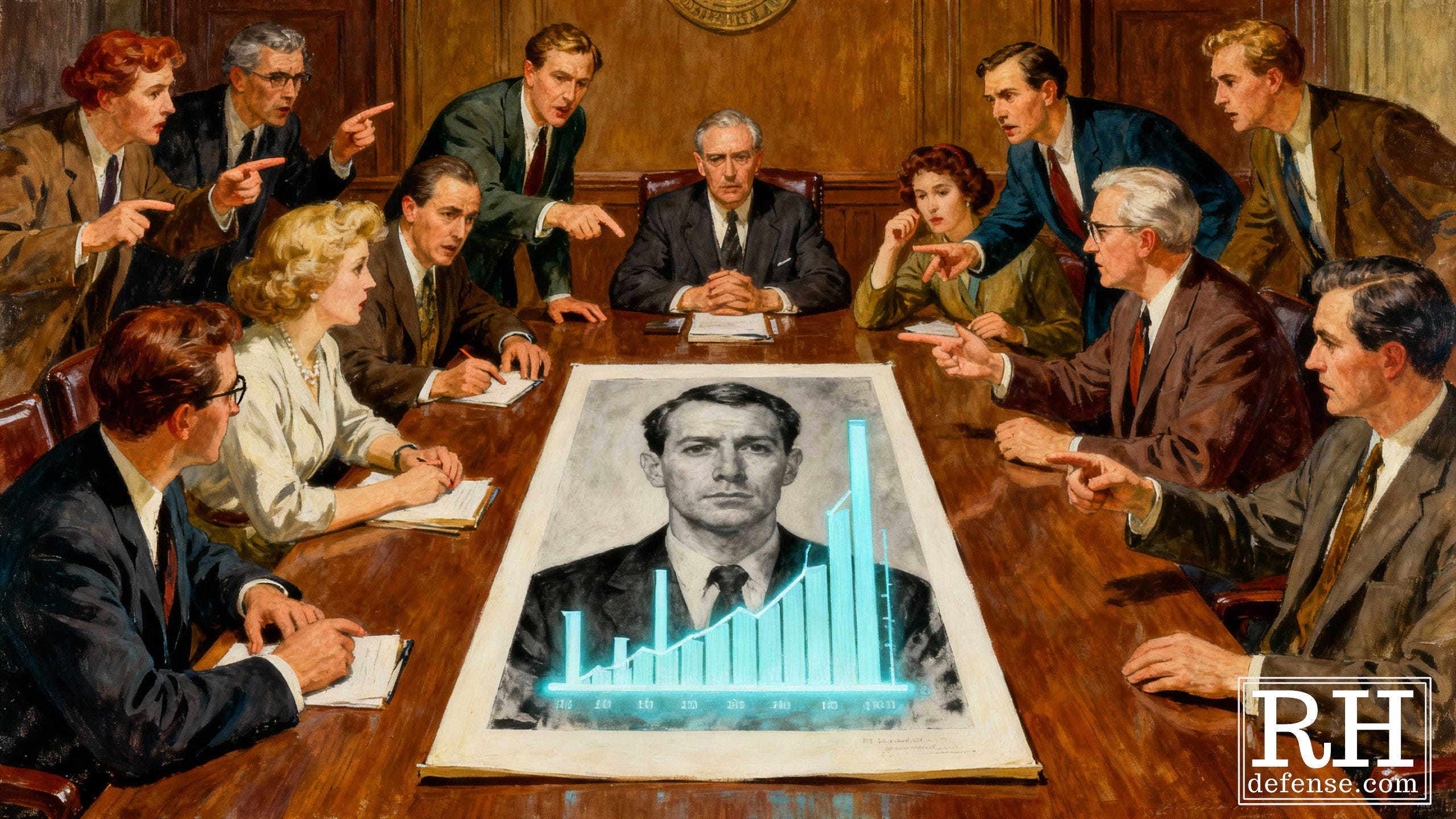
This is where pareidolia stops being a quirk and starts becoming a catastrophe.
Let’s pick up where we left off.
Wanna talk about pareidolia?
Eyewitness error is a leading cause of wrongful convictions. For instance, eyewitness error was involved in about 75% of the 312 DNA exonerations cases in the U.S. Gross and Shaffer conducted a detailed analysis of 873 cases in the National Registry of Exonerations, a joint project of Michigan’s and Northwestern’s law schools, and determined that eyewitness misidentifications occurred in 667 (76%) cases. Smith and Cutler analyzed 1198 cases of wrongful conviction and considered other factors relevant to the causes of wrongful convictions. They concluded “that about 50% of the cases of conviction of the innocent involved mistaken identification”. Moreover, the American Psychological Association estimates that about one of every three eyewitnesses makes an erroneous identification.
— Richard A. Wise et al., An Examination of the Causes and Solutions to Eyewitness Error, 5 Frontiers in Psychiatry 102, 102 (2014) (pdf)
Seeing a dark shape in the fog and deciding it was a bear, a skyrocketing stock, or a defendant before our brains catch up and admit it was just a bush, a bomb, or an innocent human being is the snap judgment that destroys. Traders, prosecutors, police — even witnesses — see a few shadows, fill in the rest, and suddenly you don’t have “data,” you have a story. A breakout pattern. A “pattern of criminal behavior.” A bear in the fog.
But it wasn’t a bear, but something unbearable, that grew from the tree of conviction.
Pattern clarity is a cognitive drug.
My Job as a Defense Attorney = My Job as a Disciplined Trader
As someone who wants to be a profitable day trader, its my job to learn to spot real patterns. To recognize when a “bull flag” is short a candlestick or never was a bull flag to start. As criminal defense lawyer, my job has long involved tearing apart false patterns.
Is that fact actually a fact?
Does that indicator actually measure what you think?
What alternative explanations fit the data?
What are you ignoring because it doesn’t fit the story you prefer?
Jurors are tasked with the job of determining guilt beyond a reasonable doubt or that what looked to the prosecution like guilt was just an ordinary tree.
But they’re not left without an aid in making that determination.
Just as their conscious mind takes the inference perhaps prematurely produced by the hidden brain, so do I — here, as a criminal defense lawyer — ask them to be conscious of contradictions in the prosecutor’s paltry presentation. The confabulated, if seductive, story.
Narrative Fallacy in Both Worlds
“This must be a cup-and-handle”, say many novice day traders who have not invested enough time in learning theory or practicing in simulators.
Cup-and-handle pareidolia is rampant. It’s the Rorschach test of chart patterns. People see it on everything from 1-minute noise to sideways consolidation. Misreading the T leaves the communication company’s stock is getting ready to climb. Beginning traders see what looks like a story arc, complete with decline, recovery, hesitation, and breakout. It seduces beginners into thinking they’ve spotted something profound. Most of the time, they’re just “seeing” three random bends in price movement.
This mirrors exactly what prosecutors do when they build a “pattern of behavior” from a couple of unrelated or ordinary life events.
For traders, it’s “ignore the fact that the ‘cup’ is three candles deep, the ‘handle’ is a breakdown, and nothing about the structure matches reality”.
For prosecutors, it’s “ignore the fact that ‘the defendant’ said he was running because he was late for work, knocking ‘the victim’ down was an accident, and that he doesn’t know anything about any wallet.” The wallet is missing. “‘The defendant’ admitted” knocking “the victim” off her feet, grabbing her stuff, and says he “doesn’t remember” if he even saw a wallet.
All innocent behaviors reinterpreted by law enforcement and the prosecutor as candlestick indicators of criminality, helped along, as I wrote in Help Yourself to a Conviction (November 4, 2009) by the innocent “defendant” who thought talking to police would clear him.
If you want a pattern badly enough — trading room, courtroom, or anywhere else — you’ll find one. Our brains are built for it.
But Why Convict Innocent People?
Traders and prosecutors both have incentives that feed their pareidolia, confirmation bias, and confabulation. Traders chase whatever emotion is strongest — fear, greed, desperation. Prosecutors — though none would ever admit it — are pushed by their own versions of fear, greed, and desperation.
Most prosecutors are elected. Elections are when they’re at their weakest, because they’re accountable to voters — and “voters,” in this context, is a tiny, unrepresentative slice of the county. In 2013, a bitterly contested primary in Kings County, New York drew barely 20% voter participation. In the 2012 general election in Cuyahoga County, Ohio, 34% of voters simply skipped the prosecutor’s race altogether.
Moreover, those who do vote tend to be wealthier, whiter and more suburban, while those who are prosecuted are disproportionately poor, minority and urban. Most cities, for example, are parts of bigger counties that include rings of wealthier suburbs. And these suburbs, as legal scholar William Stuntz has pointed out, tend to wield disproportionate power when it comes to prosecutor elections, even though crime is concentrated in the cities.
— John Pfaff, Why do prosecutors go after innocent people? (January 21, 2016)
Pfaff isn’t saying prosecutors consciously decide to convict the innocent. And in fact, I’m saying the exact opposite. The problem arises because of the joint operation of unconscious processes: pareidolia, confirmation bias, hidden brain — some call it System 1 — combine to produce an erroneous result. These processes are steering the ship long before anyone reaches a “decision.”
Prosecutors don’t think, “I’m okay putting an innocent person in prison.” (At least we hope they don’t. They think, “I see a pattern. I know the type. This fits.”
Like traders, they’re certain because the story feels coherent — not because it’s correct.
And there’s one more ingredient in this mess — the one almost nobody talks about: noise. Kahneman defined it simply:
Noise is unreliability… bias is the average error, and noise is the variability of error.
— Steven D. Levitt, Daniel Kahneman on Why Our Judgment Is Flawed — and What to Do About It, Episode 27, People I (Mostly) Admire (May 14, 2021)
In other words, even if every prosecutor, judge, and cop had perfect intentions, their judgments would still swing all over the map.
We’ve all heard versions of this: judges being harsher before lunch, or after a bad morning, or on days when they’re tired or irritated. Harsh here, lenient there. This happens not because of facts, not because of law, but because humans are noisy machines pretending to be calibrated instruments.
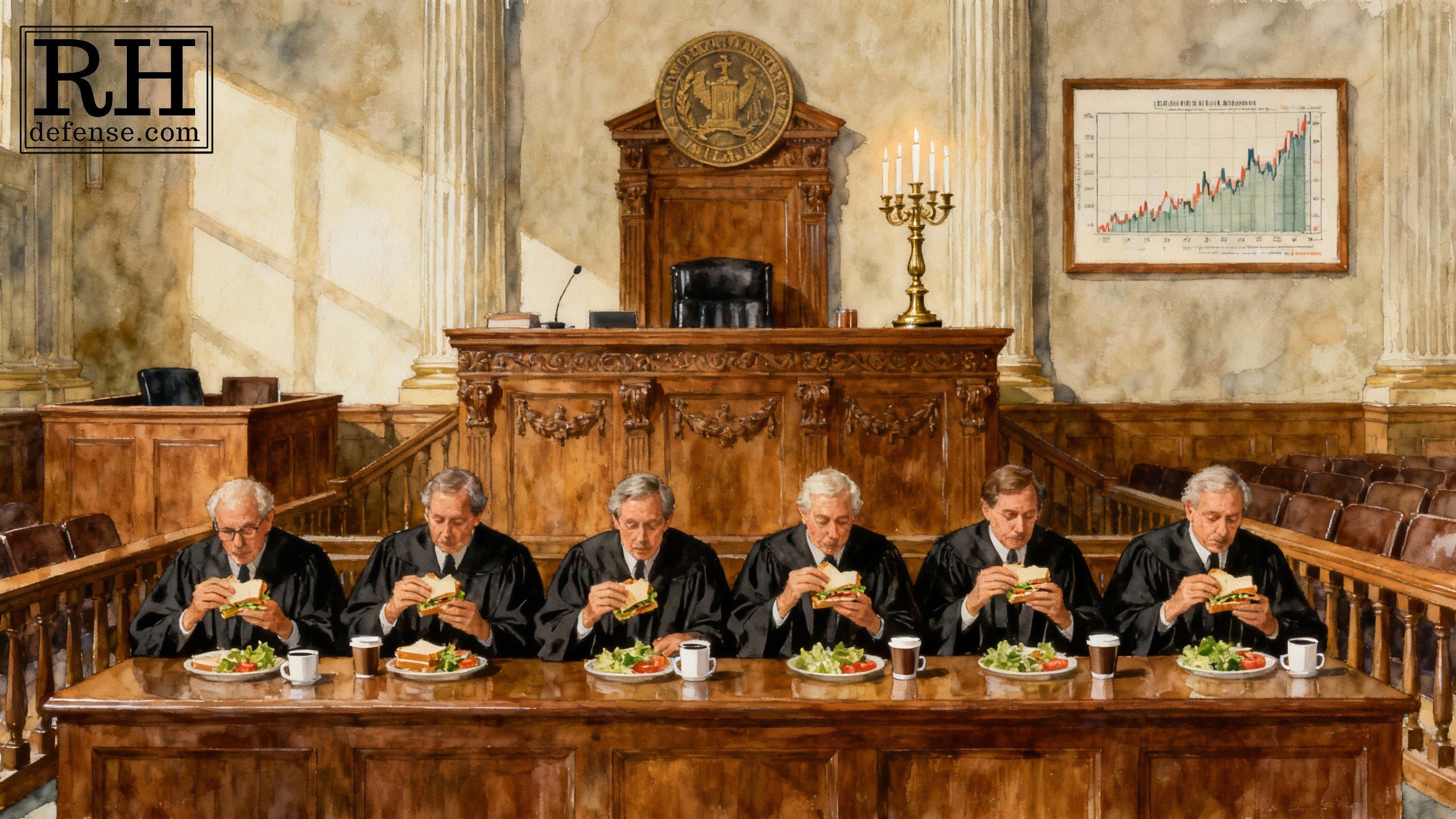
As Andrew Aziz notes,
I believe success in trading comes from mastering these five facets: Technical Knowledge, Risk Management, Nutrition, Sound Psychology and Sleep.
— Andrew Aziz, How to Day Trade for a Living: A Beginner’s Guide to Trading Tools and Tactics, Money Management, Discipline and Trading Psychology (CreateSpace Independent Publishing Platform 2016) (Kindle ed., at page 51 of 367)
Once noise gives that first shove, the system starts treating randomness as a pattern — exactly the way a rookie trader treats one out-of-range candle in a tight bull–bear standoff as a breakout. They don’t wait for the next candle to confirm. They jump. And once they’ve jumped, the price snaps back into the chop and leaves them trapped. Courtrooms work the same way.
That’s how innocent people get convicted: not malice, not intention — just bias, pareidolia, confirmation bias, the hidden brain, and plain old human noise masquerading as judgment.
The Job of Jurors: Disciplined Doubt
If prosecutors build stories and defense lawyers tear them down, jurors have the most uncomfortable job of all: deciding the true version of reality and delivering a judgment.
And this is where Kahneman’s work becomes more than academic.
Jurors are humans. Humans are noisy. Humans are biased. Humans suffer from the same mental shortcuts that push traders into bad trades and prosecutors into bad charges. System 1 — the fast, intuitive, “I know what I’m looking at” system — is the default operating mode of every juror who has ever lived. (That’s not a criticism.)
That’s why our justice system is adversarial by design.
It’s not a flaw; it’s a safeguard.
We force prosecutors to prove guilt beyond a reasonable doubt. They tell the story. Sometimes the defense tells a story, also. Other times, they just try to introduce jurors to doubt. (Remember, the defense never has to prove anything. Not innocence, lack of guilt, or anything else. The burden is on the person — the prosecutor — who says, “This is what happened” to prove it. Beyond a reasonable doubt.)
The job of jurors to listen to the prosecutor’s story and seriously consider the doubt. They don’t simply trust the story because it sounds coherent, because it makes sense, because a witness or the prosecutor is certain of the story.
Good prosecutors tell a seductive story. Good defense attorneys expose the seams in the story.
Jurors are supposed to hold both in their hands and maybe even come up with their own doubts. All the while, they must resist the urge to choose too quickly.
This is what Kahneman would call “decision hygiene”:
Break the problem into pieces.
Don’t trust your first impression.
Don’t let someone else’s conclusion substitute for your own reasoning.
Don’t let emotion, sympathy, or irritation fill in the gaps.
When jurors skip these steps and they collapse everything into a single snap judgment, they’re not choosing justice. They’re choosing the cognitive equivalent of the inexperienced stock trader spotting a chart pattern that isn’t really a pattern.
Every wrongful conviction I’ve ever seen has had the same structure: the prosecutor’s story “felt” right, the defense’s warnings “felt” technical or inconvenient, and the jurors trusted fluency or certainty over scrutiny.
That’s why I always tell jurors the same thing: Your job isn’t to decide who tells the better story. I don’t even have to tell a story. The prosecutor makes up the story. Your job is to decide whether the story survives scrutiny.
I’m learning this again in front of screens full of candlesticks.
When I trade, I can reset. A bad read on a “breakout” hurts my account, not my soul. I can close a position, walk away, rethink my rules. In court, there is no real reset.
Appeals are technically a reset — in the same way CPR is technically a reset. By the time you need it, something has already gone very wrong. Most wrongful convictions never get reversed. Even when they do, nobody gets their lost years, their kids’ childhoods, or their reputations back.
Jurors are the stop-loss on the system’s bad trades. If you don’t trigger, no one else will.
In day trading, failing to question the pattern empties your account.
In criminal court, it empties a life.
If you think I’m off, or missed something, add your 2¢ — a fair penny stock — to the comments. Jurors speak. Prosecutors speak. You can, too.
Regarding the topic of narrative fallacy, your insights on how our brains create flawed patterns are incrediblly sharp. I wonder if we could ever train AI to recognize these specific human cognitive biases in legal data, like a meta-pattern detector?