

Until this morning, I’d never heard of the Edelman Trust Barometer. I found out about it because I wanted to write a post like the one I’m writing now. I felt the need, as I always do when I write, to read up on what I planned to write about.
So I’ve been going through articles on various acts of violence, attitudes about it from all across the political spectrum, and…well, I ran across a story about the Edelman Trust Barometer’s “global survey”.
The annual global survey of more than 32,000 people in 28 countries found respondents have moved beyond polarization to what it describes as "aggressive advocacy for self-interest," a finding reinforced by the fact that many voted for populist candidates in elections this past year.
— Diane Brady, Global Study Shows Majority of 18–34 Year Olds Support Using Violence and Disinformation to Drive Change, Fortune (Jan. 19, 2025)
More than half of young adults 18-to-34 now say violence, property damage, or even deliberate disinformation are acceptable ways to drive change. Nearly a third of Gen Z go further — endorsing violence against people or property is cool, or, at least, appropriate.
These aren’t just abstract percentages.
More than half of young adults 18-to-34 now say violence, property damage, or even deliberate disinformation are acceptable ways to drive change.
In June, Minnesota state representative Melissa Hortman and her husband were murdered in their home. That same night, Senator John Hoffman and his wife were shot as well; they barely survived. The suspect impersonated a police officer to gain access. Then, on September 10 — just two days ago — Charlie Kirk, a nationally (internationally?) known conservative activist, was gunned down while talking at Utah Valley University.
The poll numbers, and these killings, point to a society that is increasingly comfortable with violence as an answer to those holding (and especially promoting) views they don’t like.
And if it’s true in the public square, it inevitably bleeds into the criminal justice system. Juries bring that same impatience with process into the box. Prosecutors ride the wave of “empathy be damned”, if not “violence is justified”, when pushing for harsher charges or sentences. Guards and police, already conditioned to see accused people as less than human, find new license in the culture’s coarse acceptance of force.
Since this is, after all, a criminal-defense-focused Substack, I want to talk about how this mindset seeps into the cases I handle every day. Whether we’re talking about the transformation of preliminary hearings to subvert their real purpose — weeding out weak cases — the transformation of the presumption of innocence to the presumption of guilt, or the Trial Tax levied for anyone who would dare to insist on their constitutional rights, the lack of empathy and a “damn the torpedoes” approach to not just the accused, but, by extension, our own society permeates and warps justice into injustice.
Every. Single. Day.
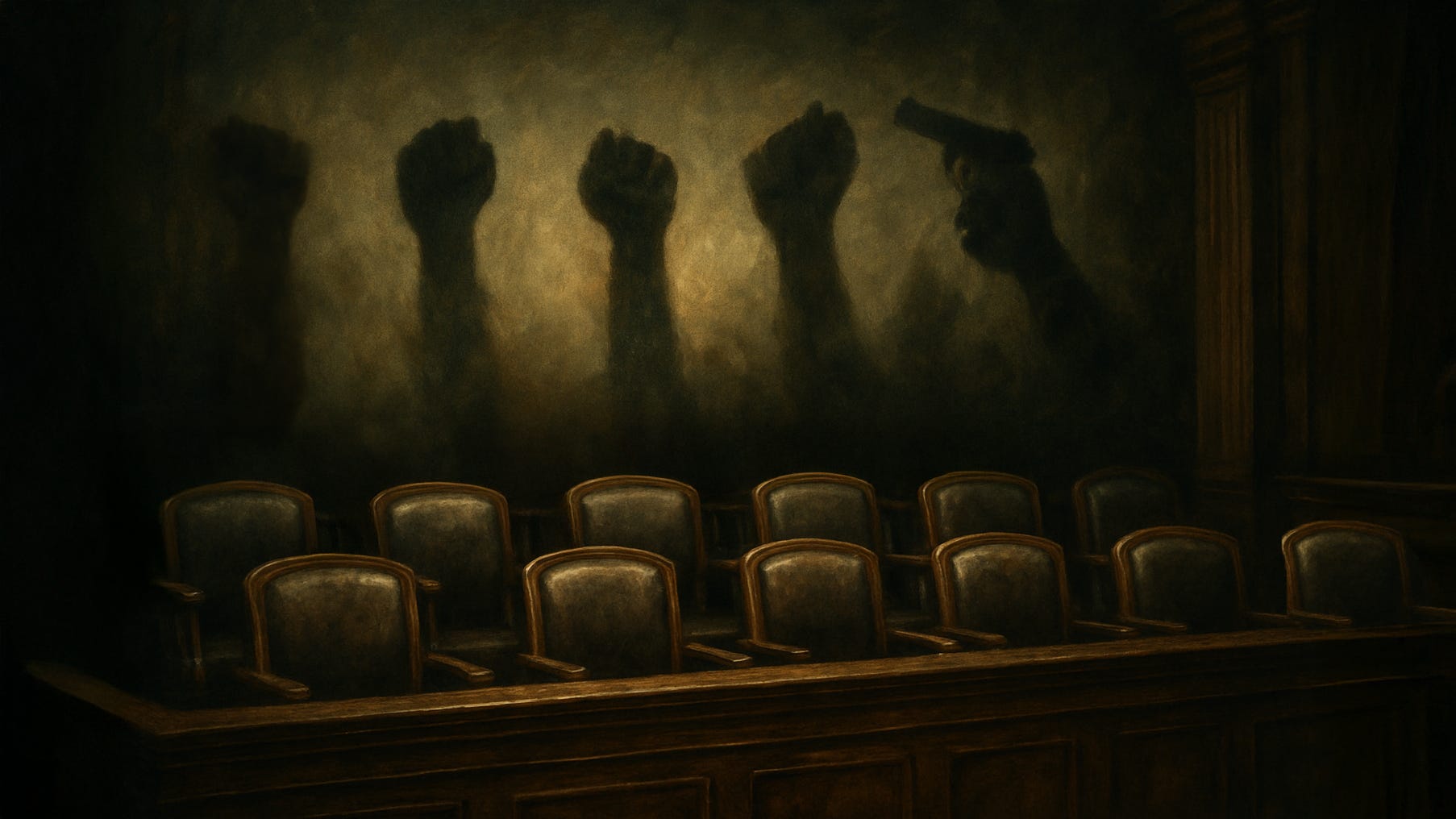
From Polarization to Permission Slips for Violence
Polarization isn’t new. We’ve been yelling at each other since long before Twitter was a gleam in Jack Dorsey’s eye. But polarization used to mean you voted red or blue, you watched Fox or MSNBC, you argued at Thanksgiving dinner. It meant disagreement — sometimes bitter, sometimes ugly — but still disagreement.
What Edelman is describing now is different. “Aggressive advocacy for self-interest” is the polite, sociological label. I’d call it something simpler: permission slips for violence. If you’ve already decided the other side isn’t just wrong but evil, then every insult, every push, every punch, every bullet starts to feel justified.
The Minnesota shootings and the killing of Charlie Kirk lay this wide open and naked as a Las Vegas hooker. In June, when Representative Melissa Hortman and her husband were murdered and Senator John Hoffman and his wife were shot, some people shrugged — or even suggested that the victims had it coming because of their politics. Two months later, when Charlie Kirk was assassinated in Utah, many of those same voices suddenly discovered that political violence was unacceptable.
If you’ve already decided the other side isn’t just wrong but evil, then every insult, every push, every punch, every bullet starts to feel justified.
Judging Violence by the Jersey
People who had no sympathy for Hortman or Hoffman — who dismissed their deaths as “collateral damage” in the culture wars — now mourn Kirk as a martyr, a hero silenced by the left.
Take Trump’s reaction to each of these acts of violence, for example:
Hortman was not mentioned in Trump's Sept. 10 address touching on several recent instances of political violence, including his own survived assassination attempt and the shooting Rep. Steve Scalise, R-Louisiana in 2017. He did not mention other attacks on Democrats including an arson attack at Pennsylvania Gov. Josh Shapiro’s house, a kidnapping plot against Michigan Gov. Gretchen Whitmer and an assault on former House Speaker Nancy Pelosi's husband in their home.
— Kinsey Crowley & C. A. Bridges, What Did Trump Say About the Political Killings of Melissa Hortman and Charlie Kirk?, USA Today (Sept. 11, 2025, updated Sept. 12, 2025, 6:52 AM ET)
What was most notable — and disturbing — in Trump’s video statement is that he sees himself as the avenger of Kirk’s killing. And though there’s no indication he had any insight into what motivated the shooter, while avoiding specifics, he telegraphed whom he holds responsible: “My administration will find each and every one of those who contributed to this atrocity and to other political violence, including the organizations that fund it and support it, as well as those who go after our judges, law enforcement officials and everyone else who brings order to our country.”
— Anthony L. Fisher, Trump Chose Wrath over Unity Following Charlie Kirk’s Killing, MSNBC Daily (Sept. 12, 2025, 3:00 AM PDT, updated Sept. 12, 2025, 6:05 AM PDT)
It’s the same act of violence, just judged differently depending on whose ox is being gored.
The politics of empathy have sociocultural significance. Although empathy (to some degree) is present across the political spectrum, the targets of empathy vary by political party.
— A.G. Martinez, Political Partisanship, Trait Empathy, and Social Justice Concerns in a Representative Sample of Californians, 5 Discov. Psychol. 21 (2025)
That’s what polarization does: it turns empathy into a partisan commodity. Violence is either “justice” or “tragedy,” not based on the act itself but on who pulls the trigger, and who falls.
When Violence Travels
That’s the danger of a culture that shrugs at violence as an acceptable tool. Polarization stops being a clash of ideas and becomes a clash within communities. And once you’ve written that permission slip — once you’ve told yourself it’s okay to silence an opponent with force — you don’t get to choose where it ends. The habit of violence doesn’t stay neatly in the political arena. It travels.
You see violence travel when police lean harder on force because restraint feels like weakness. You see it in jails where guards justify cruelty as “order.” You see it in jurors who arrive already convinced the accused must be guilty, because to them accusation itself signals danger. Once violence is normalized out there, it shows up in here.
And when it travels, it doesn’t just warp our politics. It warps our courts.
The justice system takes the abstract violence that floats in our politics and culture, and turns it into concrete practice.
Violence in the Courtroom
Courtrooms are supposed to be where violence stops. The promise of law is that we resolve disputes with evidence and arguments, not fists and bullets. But when a culture grows comfortable with violence, the courtroom doesn’t escape it. It absorbs it.
I hate to use an uncommon word here, but the courtroom — the entire criminal “justice” system — reifies it. In other words, the justice system takes the abstract violence that floats in our politics and culture, and turns it into concrete practice.
You see it first when judges and prosecutors stop seeing accused people as people. It starts with outrageous bail — numbers that no working family could possibly meet — and with trial courts casually brushing aside the higher courts’ rulings in the Humphrey line of cases, which were supposed to rein in that abuse. The message is clear: your liberty isn’t measured by justice, it’s measured by your bank account.
(The following video discusses what I’m saying about bail. The audio language is Spanish. If you understand Spanish, just play it here. But there are English subtitles if you watch it on YouTube and click on the “gear” icon.)
You see it next in the preliminary hearing. That hearing was designed as a safeguard, a chance to weed out weak cases before they ever reach a jury. In practice, it’s become little more than a speed bump. The state puts on just enough to scrape by, judges almost always hold the case over, and the defense is punished for daring to point out that the emperor has no clothes.
You see it again in the presumption of innocence. On paper, it’s still there. In the real world, jurors walk into courtrooms already convinced that if someone has been arrested, they must have done something wrong. That quiet shift — from “innocent until proven guilty” to “probably guilty, unless the lawyer can talk me out of it” — is its own form of violence.
Step by step, the system has turned protections into punishments, until the courtroom no longer shields people from violence but delivers it with the seal of law.
Lawyers like to quote an old English judge named William Blackstone, who wrote that it is better for ten guilty people to go free than for one innocent person to be punished. That “ratio” was meant to remind courts that the real danger isn’t someone slipping through the cracks — it’s the state doing violence against the wrong person.
Flipping Blackstone on Its Head
Blackstone’s ratio is simple: “It is better that ten guilty persons escape than that one innocent suffer.” For centuries, it has been the North Star of the Law, reminding us that the power of the state is so great, and the consequences of error so grave, that our system should tilt toward protecting the innocent, even if it means the guilty sometimes slip away.
But today, the ratio feels reversed. Our culture and our courts act as if it’s better that many innocents suffer some deprivation than that one guilty person go free. No less than the United States Supreme Court recently said so when it endorsed what anyone should recognize as clearly anti-American, unconstitutional round-ups of people who commit the crime of being non-white, appearing Hispanic, and then have the gall to go out in public!
In response to the concern that numerous American citizens will be swept up — essentially kidnapped — in the process, “Justice” Kavanaugh, a middle-aged multi-millionaire white man, writes,
The questioning in those circumstances is typically brief, and those individuals may promptly go free after making clear to the immigration officers that they are U.S. citizens or otherwise legally in the United States.
— Kristi Noem, Sec’y, Dep’t of Homeland Sec. v. Vasquez Perdomo, No. 25A169, 606 U.S. ___, 9 (2025) (Kavanaugh, J., concurring)
As one of my colleagues said, “Korematsu must be spinning in his grave.”
So now, Blackstone is out. Instead, we have outrageous bail “just in case”; rubber-stamp prelims to make sure nothing gets dismissed too early; trial penalties that punish anyone who dares to test the state’s evidence.
The effect is that protections meant to shield the innocent have become weapons to pressure them. What was once a rule of caution has been twisted into a rule of convenience: avoid the risk of letting someone guilty go, no matter how many innocent people get crushed along the way.
Blackstone’s caution told us to fear wrongful convictions more than wrongful acquittals. Today’s courts fear the opposite: that someone guilty might slip the net. And so the net tightens, even if it strangles the innocent.
The Trial Tax
If contemporary culture says violence is acceptable to silence your opponent, the courts say the same thing in their own way: plead guilty or we’ll hurt you worse. That’s the Trial Tax.
Before trial, the “deal” is laid out: take the plea, serve less time, maybe even go home soon. Refuse, and the state promises to swing harder. The exact same facts that once justified probation suddenly “require” life in prison. Concurrent time becomes consecutive time. Enhancements that were sitting on the shelf get dusted off and filed.
This isn’t persuasion. It’s punishment for insisting on your rights. It’s the state’s way of saying, “Do what we want, or we’ll make you bleed.” And while the bruises don’t show the way they do in a street fight, the threat is no less real.
When the courtroom adopts the same logic as the mob — when resistance itself becomes the reason for more force — we’ve moved from law to coercion. That’s violence dressed up in a black robe.
Where It Leaves Us
The Edelman numbers told us what our culture is starting to accept: violence as a legitimate answer to disagreement. The killings in Minnesota and Utah showed us what that looks like in the streets. And every day in court, I see what it looks like when the same mindset is dressed up as Law.
We like to think the courtroom is where violence stops. Too often, it’s just where violence changes clothes, trading the white robe for a black one and the red hat working man’s outfit for a suit.
If we don’t push back — if we don’t insist on Blackstone’s warning, if we don’t demand that courts act as shields instead of cudgels — then we’ll keep sliding down this slope where every disagreement is an excuse for force, and every accused person is just another target.
The courtroom should be the last place where violence is normalized. It should be the first place where it’s rejected.
Right on!
If all you know about the law and the courtroom only comes from television shows, then I suggest you start following Rick on Substack, YouTube, and Probable Cause and get ready to have your eyes opened and your mind blown.