

There’s been chatter for some time now. It’s the kind of chatter that starts on talk radio, seeps into cable news, and ends up sounding (almost) reasonable if you don’t listen too closely. It’s about how Donald Trump might get a third term.
The theory goes like this: he runs as Vice President, his running mate wins, and then “steps aside,” making Trump President again. Legal magic. Problem solved.
Except it isn’t magic, and it isn’t legal.
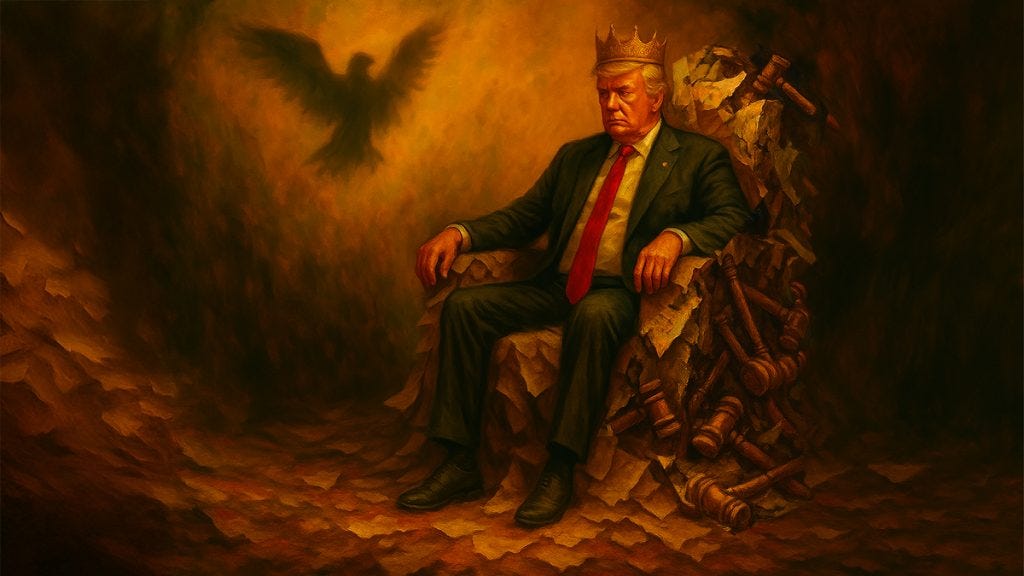
Trump himself apparently recently indicated that he’s barred from running for a third term. But I’m not at all sure he really cares about that. After all, he’s barred from a lot of things he’s doing right now. And what’s he’s found is that, while he may be barred by the law from doing those things, nobody is going to stop him.
Not Congress. Not the FUSA Supreme Court. (You can take the “F” in “FUSA” to mean “former” or whatever other F-word seems appropriate.)
As to what the law says, the Twenty-Second Amendment bars this bizarre “step-aside” plan. The Twelfth makes it absurd. And every civics teacher in America (well, if America had civics teachers) should be throwing chalk at the television.
But here we are — in a country where constitutional limits are treated like end-user license agreements: everyone clicks “accept” and nobody reads the fine print.
Not even the Supreme Court of the FUSA.
I wrote earlier this year that “when the law breaks, the safeguards all fall, and down comes the Republic.” That wasn’t prophecy. It was a lawyer’s reminder that a republic survives only as long as its officers obey the restraints they swore to uphold.
The current talk about a “third term” doesn’t merely test the limits of a presidency. It tests the tensile strength of the rule of law itself. It’s the same stress fracture I wrote about in When the Law Breaks, only now the crack runs straight through the Constitution’s spine: the Twenty-Second Amendment
So, in the end, what matters most isn’t whether this particular stunt would work. It’s that millions of people think it might. That’s the real story — the corrosion of belief in the idea that law, not clever tricks, governs power.
The Text and the Temptation
The Twenty-Second Amendment isn’t complicated.
No person shall be elected to the office of the President more than twice, and no person who has held the office of President, or acted as President, for more than two years of a term to which some other person was elected President shall be elected to the office of the President more than once.
— U.S. Const. amend. XXII, Constitution Annotated, Library of Congress, (last visited Nov. 1, 2025)
The word elected has become the hinge on which the new “third-term” theories swing.
The argument — if you can call it that — goes something like this: if the Constitution forbids being elected President again, then perhaps there’s a clever route that avoids an election. Maybe you slide into the Vice Presidency, win the ticket, and then succeed to the Presidency when your partner “steps aside.” Voilà. A constitutional conjuring trick.
But the Constitution doesn’t reward conjuring. The Twelfth Amendment closes the door that the Twenty-Second might appear to leave open:
[N]o person constitutionally ineligible to the office of President shall be eligible to that of Vice-President of the United States.
— U.S. Const. amend. XII, Constitution Annotated, Library of Congress, (last visited Nov. 1, 2025)
The plain meaning is unmistakable. If you can’t be President, you can’t be Vice President.
The courts have long rejected the notion that constitutional interpretation is a game of loopholes. The document is not a puzzle to be solved by cleverness; it’s a structure meant to restrain it. As Jamelle Bouie reminded readers recently, the drafters of the Twenty-Second Amendment weren’t worried about grammar. They were worried about power. Representative John Jennings said it out loud in 1947: only by adopting a two-term limit “can the people be assured that we shall never have a dictator in this land.”
They didn’t debate whether “elected” meant “installed,” or whether “holding” was different from “acting.” They worried about the danger of “a man of vaulting ambition,” backed by a compliant Congress and a friendly Court, sweeping away the safeguards of law. The purpose was to prevent that — not to invite the next generation of ambitious lawyers to outwit the plain text.
The temptation to read the Constitution as a game of words is old. But so is the law’s answer: meaning derives from purpose, not from the ingenuity of those seeking to evade it.
As if that were not enough, one of the clear rules of interpretation (for statutes and constitutions) is that no interpretation which makes any language “superfluous” is permitted. Were we to read the Twenty-Second Amendment as only forbidding a direct election of a President to a third term, but allow that the Conjurer’s Trick gets around that, doesn’t that make the language and intent of the Twenty-Second Amendment superfluous? And what of the Twelfth Amendment?
“Well, it’s not that he’s ‘constitutionally-ineligible’ for the office of President. It’s just that he’s ‘constitutionally-ineligible’ to being elected as President.”
Nice way to obviate the intent (and wording) of both the Twenty-Second and the Twelfth Amendments.
What happened to all those Original Intent assholes on the bench and in Congress?
The Mirage of Legality
But there’s another way, right? And “Representative” Andy Ogle — I put “Representative” in quotes because when you’re just a ring-kisser (I could have said something else) — you’re not really representing your constituents. You’re suggesting we do to the Constitution what the President has done to the East Wing.
On, and, by the way, why the East Wing? Could it have anything to do with putting women back in their places?
Anyway, the danger isn’t that someone will literally amend the Constitution overnight. It’s that people will stop believing the Constitution means anything fixed at all. Power doesn’t usually announce that it’s breaking the law; it insists it’s interpreting it. Every autocracy that ever wore a judicial robe began this way — not by shredding the text, but by explaining it differently.
That’s what makes Representative Andy Ogles’s proposal to amend the Twenty-Second Amendment so revealing. On its face, it’s an honest approach: he isn’t pretending there’s a loophole; he’s saying we should open one. But read his own justification — that a President “must be given the time necessary to accomplish his goal” — and the mask slips. Constitutional limits exist precisely so that no one man’s goals can override the structure of government itself. When “accomplishing the goal” becomes the measure of legitimacy, law becomes merely a procedural obstacle.
Bouie and Mystal both made this point in different keys: law is only as strong as our collective willingness to obey it. Once obedience becomes optional, legality becomes theater. And that’s exactly what I tried to warn about just this past April:
When the law breaks, we don’t need the Republic to collapse all at once to lose our freedoms. It’s enough that we allow it to break, rule by rule, ignoring each crack until nothing remains standing.
— Rick Horowitz, When the Law Breaks: The Rule of Law Will Fall & Down Comes Our Republic (April 6, 2025)
We are seeing that slow-motion rehearsal again. Legislators float “trial balloons.” Lawyers polish “novel theories.” Judges avert their eyes. Each step cloaks itself in the language of legality. But each one relies on the same sleight of hand: the assumption that because the Constitution can be reinterpreted, it can also be ignored.
The reality is simpler. The words haven’t changed; our tolerance has. The Twenty-Second Amendment still means what it says. The Twelfth still bars the workaround. What’s different is the willingness to pretend that maybe—just maybe—the law no longer needs to be followed.
And once that pretense becomes comfortable, the law doesn’t need to be rewritten at all. It just needs to be quietly set aside.
The Theater of Law
I’ve written before about this tendency to mistake ritual for reason. In Automation Cosplay, I called it “the dance of security theatre” — how our courts borrow the aesthetics of technology and procedure to disguise bias as objectivity.
Downstairs, they act out safety. Upstairs, they act out reason.
The actors change — judges instead of guards, probation officers instead of screeners — but the script is the same: follow the procedure, invoke the tool, claim neutrality.
And these days, we’re transforming everything into a game where skills are irrelevant, in order to sacrifice unarmed prisoners to gladiators and our dignity to a farce.
— Rick Horowitz, Automation Cosplay: How the Courts Borrow the Aesthetic of AI to Paper Over Human Bias (October 28, 2025)
What matters is never the outcome, but the appearance of order. The process becomes the proof. At the local level, it’s about pretending procedures matter while bringing as many people under the thumb as possible. At the federal level, it’s about the same — but also about enshrining a King.
The talk of “legal” paths to a third term, or “constitutional” reinterpretations of the obvious, is the same kind of cosplay. It’s not law; it’s the imitation of law — the same pageantry that lets rent-a-cops pretend their ritual protects us, or courts pretend that data sanctifies judgment.
Once again, the show matters more than the substance. And the audience, lulled by costumes and credentials, keeps applauding.
The Real Threat
What erodes a constitutional republic isn’t the moment someone breaks the law — it’s the moment no one believes the law will stop them.
That’s where we are. The debate over a “third term” isn’t about Trump; it’s about whether limits still limit, whether the text still binds, whether the rule of law is anything more than a ritual gesture.
The courts, the Congress, the press — not just the checks and balances expressly built into the Constitution of the FUSA, but all the institutions designed to say no — have learned to say not yet. Each delay, each rationalization, each new “interpretation” becomes an act in the same long-running play: perform legality, suspend accountability, and hope the audience confuses one for the other.
But law is not theater. It’s not an act you can fake convincingly enough to make it real. The Constitution does not enforce itself. It depends on people who still believe that words mean what they say.
And who are willing to risk something to make that belief matter.
If we reach the point where power only needs to sound lawful, then the Republic has already fallen. Quietly, politely, to applause.
I said before that when the law breaks, the safeguards all fall. The truth is more insidious: the law doesn’t have to shatter; it only has to bend, again and again, until we stop noticing the curve.
When the law breaks,
        the safeguards all fall,
And down comes the Republic,
        freedoms and all.
— Rick Horowitz, When the Law Breaks: The Rule of Law Will Fall & Down Comes Our Republic (April 6, 2025)
Regarding the topic of the article, this piece is wonderfully sharp. The comparison of constitutional limits to end-user license agreements is just brilliant. As a techer, I totally felt that bit about civics teachers throwing chalk. Who needs amendments when you have 'accept all' anyway, right?
To me, this is the most frightening aspect of the current administration. And the people in power who are allowing it to happen with not even a whimper of protest.