

The Rose Garden gleams under floodlights. The “garden” is stone now, not grass. The president called it an “improvement,” saying the tiled surface makes it easier for “women in high heels” to stand at attention during ceremonies.
And we all know how important “women in high heels” are to the President.
Cameras pan across the marble and light, framing perfection: symmetry, order, control.
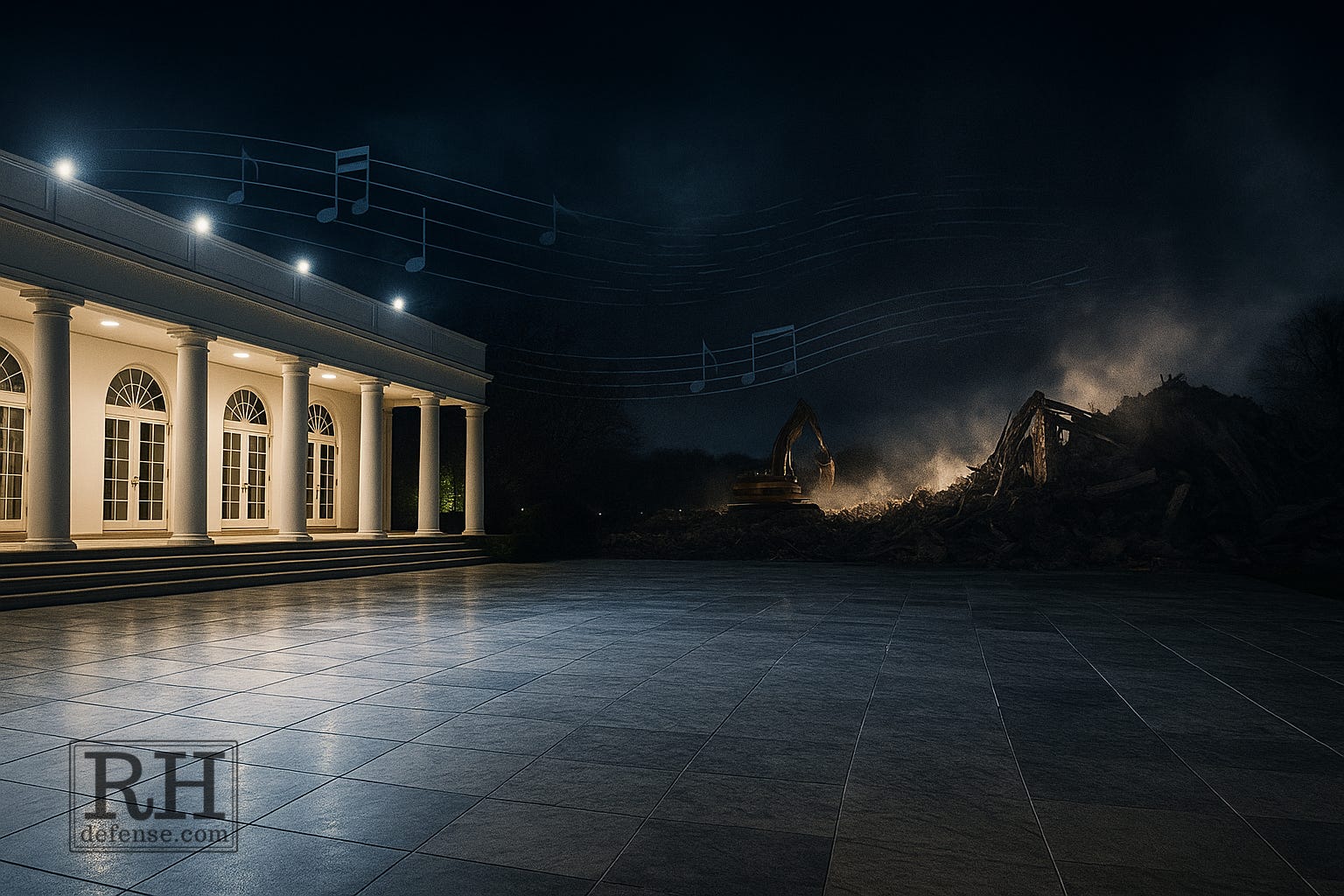
Yet a few hundred feet away, the East Wing is rubble. The offices that once held the First Lady’s staff, the press corps, and the daily hum of democratic work lie buried under twisted rebar and dust. Excavators move where aides once walked.
Two sounds define Washington now: the hush of performance and the grind of demolition. The first plays for the world; the second drowns out the republic.
“Listen to the beauty of that sound,” Trump said, grinning, as sirens wailed through the Rose Garden. “They’re not politically correct sirens.”
— Will Weistert and Jill Colvin, Trump’s push for law and order shows he’s no longer encumbered by government guardrails (October 16, 2025)
He was right — though not in the way he meant. What we’re hearing isn’t the music of law restored. It’s law reversed, replayed backward, its harmonies collapsing into noise.
It’s Trump ripping the heart and soul out of the United States, in order to remake it in his own sordid image.
[In] a saying famously attributed to Betty Ford: “If the West Wing is the mind of the nation, then the East Wing is the heart.”
— Roxanne Roberts, The East Wing is gone. Here’s why it’s been called ‘the heart’ of the nation (October 26, 2025)
The Sirens of Legality
If the East Wing was the heart, then the sirens are its arrhythmia — the sound of a government seizing its own pulse.
Trump calls it “music”. To him, law and order are not principles but percussion: the thud of a boot, the wail of a siren, the grind of a bulldozer tearing through what once held meaning. He hears harmony in the racket of force because he’s rewritten the score; his goal the replacement of the quiet authority of law with the noisy theater of control.
Every sound is staged. The sirens in the Rose Garden, the jackhammers outside the East Wing, the applause in the new “Rose Garden Club”. Each one serves the same function: to drown out dissent, to make the public spectacle of power seem like the rule of law itself.
It’s a familiar trick.. Legal authoritarianism doesn’t abolish the language of law; it performs it louder, until meaning itself distorts. Trials still occur, courts still sit, and presidents still sign memoranda with solemn phrases about “safety” and “order.” But the tone changes. Law becomes accompaniment, not constraint. The drumline keeps time for demolition.
And as the East Wing fell, he said he loved the sound of construction.
“That’s music to my ears,” said the president[.]
— Ivan Pereira and Sarah Beth Hensley Demolished East Wing, paved Rose Garden, proposed arch: How Trump is leaving his mark on Washington, October 22, 2025
Music? Yes. But this is not of creation. It’s the same rhythm heard in every regime that mistakes obedience for unity, silence for peace, and boot-licking for praise.
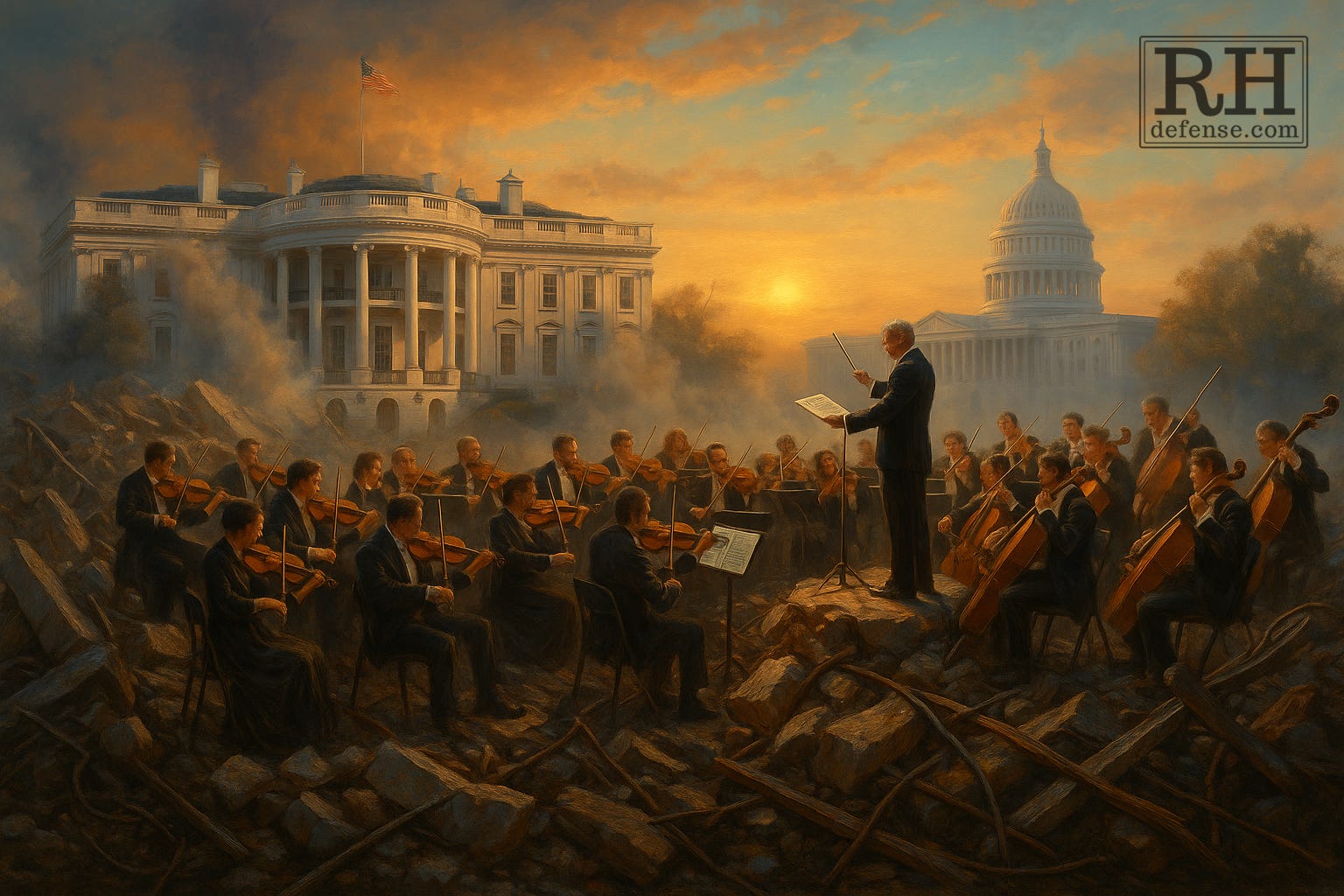
Politicians make the same mistake. The sound of subservience carries well in marble halls. Judges show it plays just as well within courthouse walls. That same symphony plays inside our courthouses — only the instruments change.
In Madera, it’s the metal detector. Upstairs, it’s the risk-assessment report. Both are ceremonies of compliance — the wand and the algorithm, the same prop in different acts.
As I wrote the other day,
The modern courtroom has turned performance into proof — in this case not of safety, but of fairness.
— Rick Horowitz, Automation Cosplay: How the Courts Borrow the Aesthetic of AI to Paper Over Human Bias (October 28, 2025)
That’s what happens when the language of law becomes sound design. We stop asking whether justice is done, and settle for whether it looks and sounds like it was.
And outside, as a ballroom rises from the rubble, we begin to understand: architecture can lie too.
The Architecture of Authority
The White House isn’t the only structure performing authority. Every courthouse in America has its own stage directions. The marble columns suggest permanence, the seal on the wall implies sanctity, and the judge’s bench towers just high enough to make obedience feel like order.
The geometry of power hasn’t changed; only the materials have. Stone and steel where we once had meaning.
Inside, we still pretend the words connect — justice, proof beyond a reasonable doubt, due process. But their translations have drifted. The prosecution speaks in data and risk. The defense still speaks in rights and truth. They share a courtroom, but not a language. The trial proceeds as if comprehension were guaranteed, when in fact, each side is speaking through its own algorithm.
I once called this automation cosplay — the performance of objectivity replacing the practice of judgment. The court borrows the aesthetic of technology the way the White House borrows the aesthetic of strength: marble, metal, and the illusion of incorruptibility.
The mindset isn’t unique to the court; it’s the same reflex that stops us from doing what defense lawyers do: testing whether the barrier still exists.
As one Texas writer recently put it:
The barrier was never real. The glass is gone. The lid is off. The bucket is tipped over. But you’re still not jumping.
— Bard-at-Arms, The Poverty You’ll Always Have With You (October 27, 2025)
In Washington, the barrier is different. And it’s built of ritual and marble instead of glass. But it works the same way. The People stop jumping long before the wall comes down.
But architecture can lie too. Its walls give shape to legitimacy long after legitimacy has left the building. The performance endures because it looks so familiar.
The United States is currently going through an existential crisis. The combination of coronavirus, a corrupt political system out of control, and cops who refuse to stop killing unarmed black men has, at times, made it appear we are a nation on our knees.
But it’s not that we’re deep in prayer. Hardly.
Something less than half of us are on our knees in obsequious adoration of an out-of-control egomaniac. Many of the rest are stunned and wondering if there will ever be an end to the outrage. Two disparate civilizations, and we are definitely not Darmok and Jalad at Tanagra.
— Rick Horowitz, Shaka, When the Walls Fell: On the Failure of Political and Legal Systems (October 10, 2020)
That was five years ago. The walls I spoke of then were metaphorical. Now they’re coming down for real — the East Wing, the walls of our democratic republic, and the walls of Law itself.
We were once a civilization that understood each other through a shared constitutional grammar. Now we have become Darmok and Jalad, not at Tanagra but at trial. And while we’re still fighting the beast, we’re no longer speaking the same tongue.
When the Walls Fell
The rubble doesn’t stop at the White House. It spills into every courtroom.
I’ve spent my career standing in the ruins, briefcase in hand, playing the same old tune called “reasonable doubt.” It’s not a protest song. It’s survival music. The rhythm section is fear and fatigue. The melody is a plea that someone still hears the difference between law and theater.
In The Criminal Defense Blues, I sang the lament that the high points are few — a dismissal here, a life salvaged there — but we keep playing because silence would mean the song is over.
Not long after I was sworn in, I ran across this quote from an old San Francisco lawyer named Vincent Hallinan (1896-1992):
     Lawyers make a good living off the misery of others….

Hallinan added:

           …and any lawyer that is not willing to go to jail
           for his client has no damned right being in the
           courtroom.

Both parts of this quote have stuck with me and guided me as I work towards building my criminal defense law practice. My criminal defense practice covers the Fresno, Tulare, Kings and (when I cannot escape it) even Madera counties. Anyone from around here can tell you that those four counties carry enough misery for the entire state.
— Rick Horowitz, Saving Starfish (December 31, 2009)
As for Hallinan, so for me: that wasn’t bravado; it was a chord struck in defiance of everything that wants to drown us out.
Because that’s what this has become — a contest of volume. The president loves the sound of sirens and bulldozers. Judges love the sound of “sustained.” Prosecutors love the sound of applause. And somewhere in the background, a defense lawyer tries to keep time with what’s left of justice, tapping out the beat of confrontation, of counsel, of the Constitution still whispering under the noise.
The walls have fallen before, many times. In Selma, in Stonewall, in every courtroom where power mistook ritual for righteousness, there’s been a momentary crumble.
But this time feels different, because the collapse is louder, longer, and cuts more deeply into both the physical and inchoate reifications of our deepest democratic principles.
The wrecking ball hums in bureaucratic tones: “validated instrument,” “evidence-based practice,” “standard operating procedure.” The melody of freedom rewritten in major chords of compliance.
I can’t rebuild the East Wing. I can’t make the sirens stop. But I can stand in what’s left of the courtroom and refuse to let the noise be mistaken for the law. That’s what criminal defense is, in the end. It’s not “the art of winning” — so much (not) winning! — but the discipline of not clapping for the wrong music.
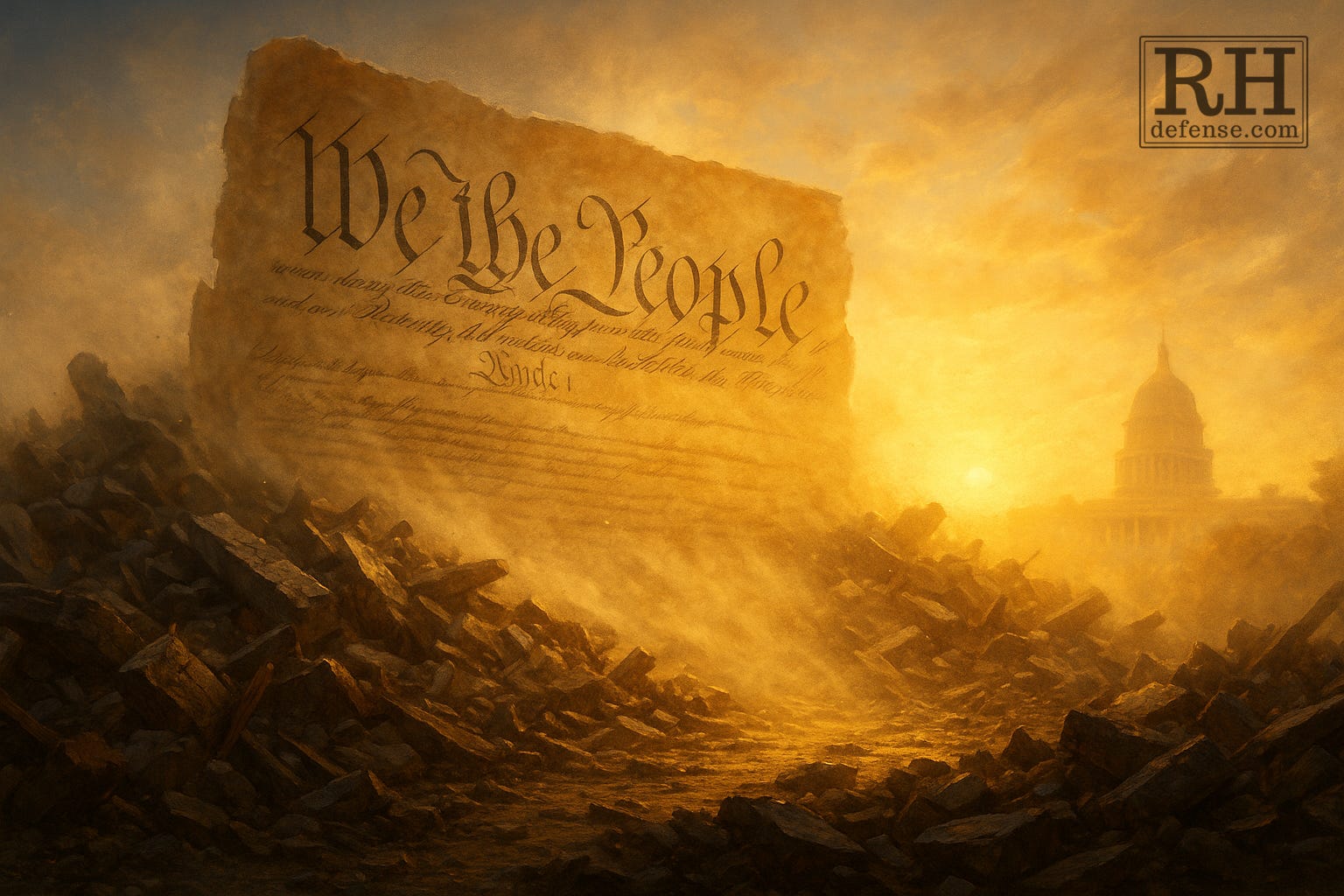
Yesterday morning, I read the Constitution. It took about thirty minutes. I read the Amendments the next day and I forgot to time it, but next time I will. It’s not nostalgia. It’s rehearsal — a way to remember the sound of law before it was drowned out. The Founders didn’t write it for kings or construction crews. They wrote it for the quiet moments when someone needs to stand up and say, “Objection.”
The walls will fall again. Or maybe this is their last hoorah. But as long as one lawyer stands in the dust and reads those words aloud, the silence that follows will still belong to the People.
And from the dust and debris of the heart of the United States of America — if not the East Wing — a democratic Republic may yet rise again.