

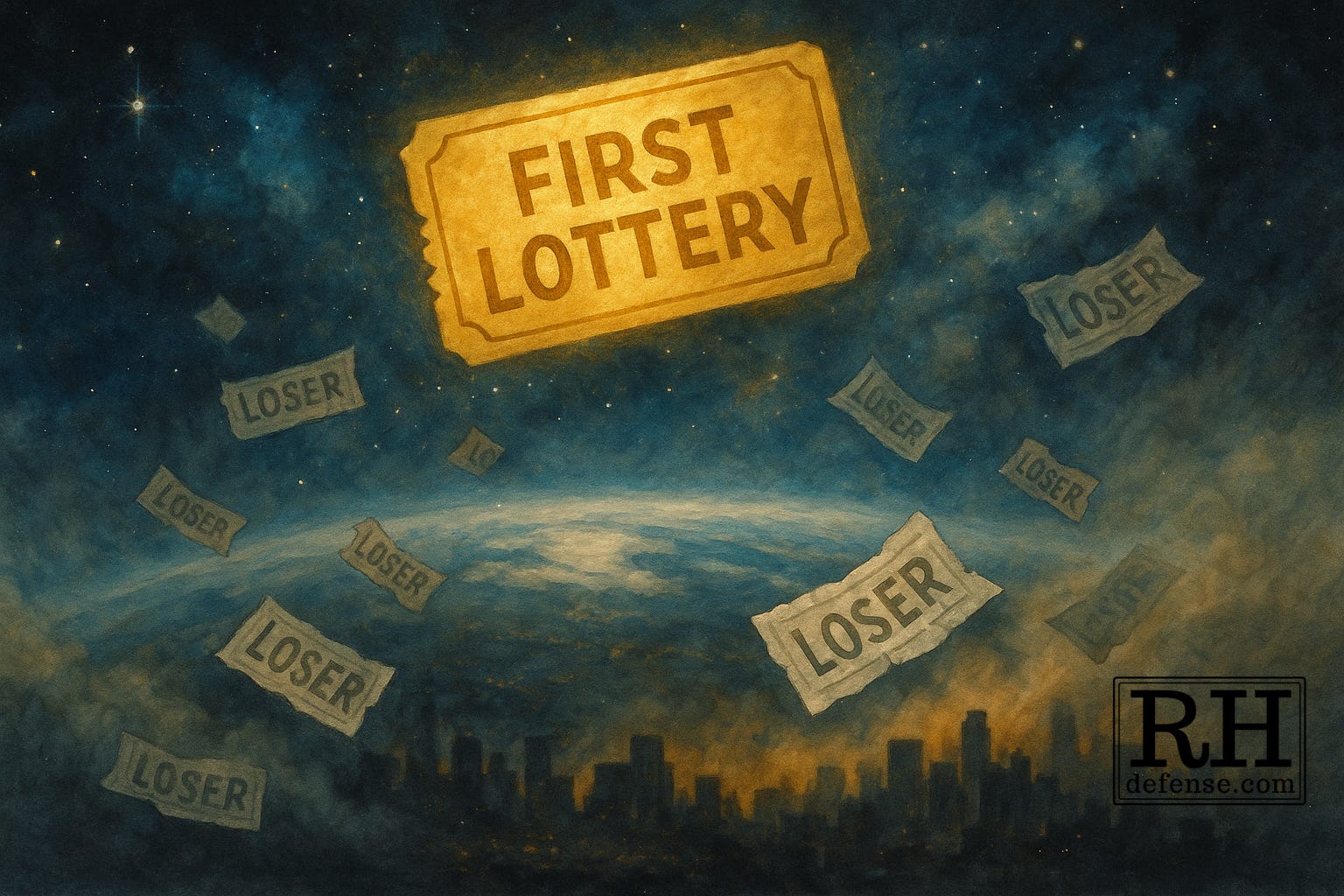
Tesla just made Elon Musk eligible for a trillion-dollar payday. Not million. Not billion. Trillion.
That number is so big it might as well be a punchline. Shareholders stood and cheered while Musk promised moon bases, self-driving cars, and robots that could perform surgery “with beyond-human precision.” The crowd applauded as if they, too, were about to collect.
That’s the fantasy at the heart of American life. Most of us believe that luck and genius are interchangeable, that if we admire the rich hard enough, protect them from paying their fair share to support a healthy society, we’ll join them one day at the top. It’s a kind of civic hypnosis. We see the one man who wins the cosmic lottery and tell ourselves it’s proof that anyone could. We forget that one of the biggest reasons we have a middle class is that we used to tax the rich.
“But taxes,” he emphasizes, “have been a principal engine of worsening economic inequality simply because the wealthy, thanks to their success in Congress, now have more money — to buy stocks, invest in real estate, build megayachts, blast off into space, and make campaign contributions to politicians so the cycle isn’t interrupted.”
— Sam Pizzigati, Tax the Rich? We Did That Once, Inequality.org (December 2, 2022)
Admittedly, a top rate of 91 percent, and taxing 66% on anyone over $200,000 (worth about 3.4 million today) could arguably be considered a little much, except in a communist state. On the other hand, less than one percent of Americans were in that bracket. And it’s unlikely they ever really paid at that rate.
How could it be that the tax code of the 1950s had a top marginal tax rate of 91 percent, but resulted in an effective tax rate of only 42 percent on the wealthiest taxpayers? In fact, the situation is even stranger. The 42.0 percent tax rate on the top 1 percent takes into account all taxes levied by federal, state, and local governments, including: income, payroll, corporate, excise, property, and estate taxes. When we look at income taxes specifically, the top 1 percent of taxpayers paid an average effective rate of only 16.9 percent in income taxes during the 1950s.
— Scott Greenberg, Taxes on the Rich Were Not That Much Higher in the 1950s, Tax Foundation (August 4, 2017)
As today, there were loopholes that account for these numbers looking a little wonky.
Today, the richest 400 families in the United States now pay a lower tax rate than the middle class.
Isn’t This a Criminal Defense Blog?
But this is a criminal defense blog, so why am I talking about rich people? What’s the deal about the Lottery Illusion?
It’s because the hands-off attitude of the middle class toward the ultra-rich owes its ongoing existence to the Lottery Illusion.
And there’s a connection between the harshness that says “Give up your health insurance or we won’t re-open the government” and the harshness that built and informs our current criminal injustice system.
Because we ignore that other lottery — the one that lands ordinary people in courtrooms and jails. The one most Americans assume they’ll never win, even though the odds are infinitely higher than winning a trillion-dollar salary and bonus package, or even becoming a billionaire.
The same faith that sanctifies billionaires also fuels the cruelty of our laws. People imagine they could be Musk, but never my clients.
The Second Lottery
Some call it “justice” or “law”, but I call it by its full real name of “the criminal injustice system”, but it’s really a lottery with no winners. The majority of people don’t buy a ticket; they’re born holding one. Some people get drawn by poverty. Some by race. Some by bad luck, bad company, or bad timing. Most by a combination of all three.
Just like any lottery, not every ticket holder “wins” — scare quotes because here “winning the lottery” is losing something. Reputation. Liberty. Maybe, in some Second Lottery jurisdictions, your life.
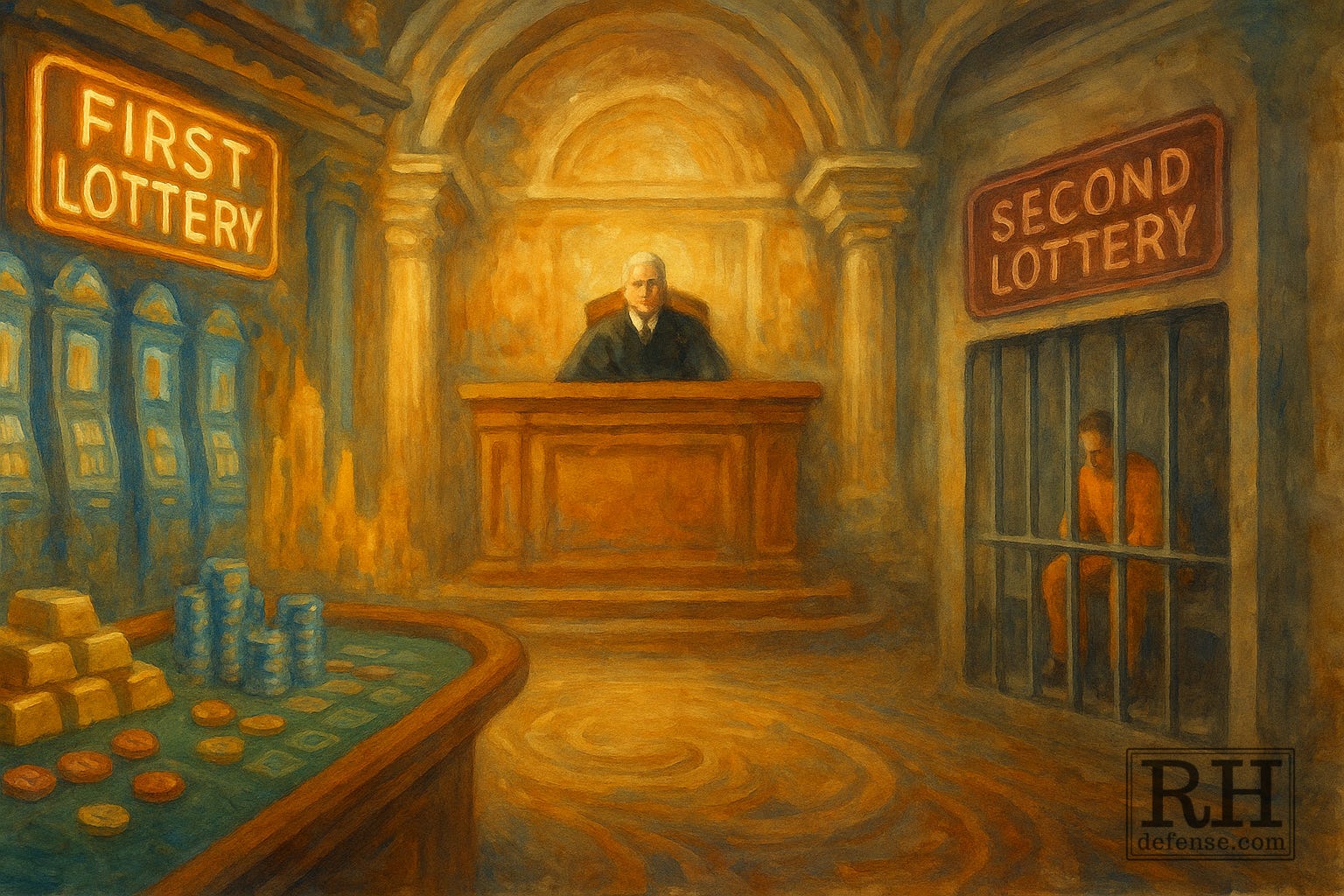
But this is the lottery my clients “win”. A prosecutor’s ambition, a police officer’s hunch, a judge’s schedule — any of these can decide the outcome here.
And while billionaires collect bonuses for “risk,” my clients get decades for it. The same culture that celebrates speculation punishes desperation.
We pretend it’s about guilt or innocence. It isn’t. It’s about odds. The dealt hand holds the odds of being poor, the odds of being noticed, the odds of crossing paths with the wrong cop on the wrong day. Most people don’t realize how often “justice” depends on accidents no one controls: a late lab report, an overworked defender, a judge in a bad mood.
When you see it up close, you stop believing in fairness. You see how bureaucracy wears a mask of logic, how the ritual of hearings and motions gives chaos the appearance of order. You understand that much of “justice” is mere performance by the court jester judge and the supporting characters.
Yet people still believe it’s merit that keeps them safe. Bad things happen to other people because they’ve done something wrong.
That’s the Lottery Illusion at work. It tells the winners of the First Lottery they earned it and everyone else that the winners of the Second Lottery deserved it. It turns luck into virtue and punishment into proof. We defend the rich because we think they won. But not just that, since we believe we have a ticket in that same lottery, we think if they won, we could win. So we want to protect all those winners — including Our Imagined Billionaire Self — from having anything they exploited from those below them on the social ladder “earned” taken away.
We abandon the accused because we think they just lost. We don’t realize they are participants in the same lottery as us and that that lottery is not the First Lottery, the Billionaires’ Lottery, Musk’s Trillionaire Lottery.
Either way, we keep buying tickets, thinking that we’re only buying for the First Lottery. We hold onto completely unjustified hope for that we can win that First Lottery and never experience the Second.
And so we’re cool with the cruelness of the Second Lottery. Because we don’t think the tickets we’re holding are for that game.
But every now and then, someone “unexpected” draws the winning ticket in the Second Lottery. They lose their job, their house, their health. Then they find themselves in court, stunned that the same system they once trusted now treats them like society’s shit. By then it’s too late to notice that the courtroom and the casino share the same design: no windows, bright lights, and the house always wins.
The court borrows the aesthetic of AI — the data, the metrics, the procedural language — to dress up old instincts in new clothes.
— Rick Horowitz, Automation Cosplay: How the Courts Borrow the Aesthetic of AI to Paper Over Human Bias (October 28, 2025)
Retribution reigns in the Second Lottery.
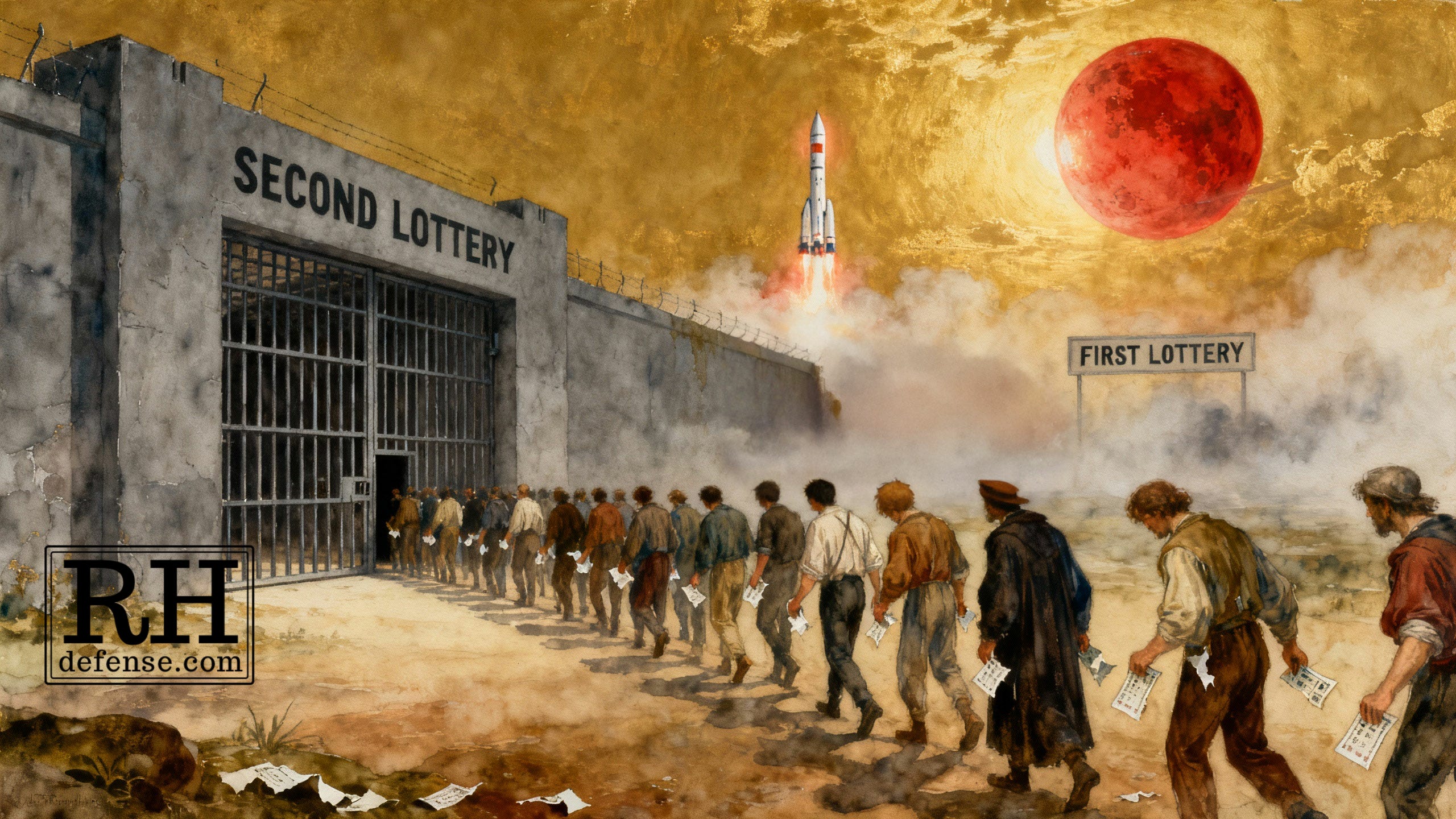
For All But the One Percent, No Ticket is the Best Ticket
And that’s when the shock sets in.
They thought they’d been playing the First Lottery, the Billionaire Lottery — Musk’s Lottery — the one with moon bases, stock options, and the myth of genius. They never imagined they even had a ticket in this Second Lottery. They didn’t even know it was a lottery.
When their number comes up, they call it unfair. They say the deck is stacked, the prosecutors cheat, the judges have their thumbs on the scale. And when their own attorneys tell them, quietly, that this is how the system has always worked, they stop listening. They think their defense attorney is part of the problem.
Because this is the part no one wants to hear.
The system isn’t broken. It’s working exactly as intended. It’s keeping the few who hold tickets to the First Lottery safe — those Less-Than-One-Percenters — and convincing the rest of us that we might still have a chance to be First Lottery participants.
The “First Lottery true believer” never sees it coming. They never realize that, at best, they were always holding a Second Lottery ticket. Because unless you’re part of that richest one percent — and, again, in reality it’s less than one percent — that’s the only ticket you ever could have had.
For people who aren’t one percenters, the best ticket to have is no ticket at all. That would have made them ordinary — spared them the delusion of the First Lottery and the punishment of the Second.
Because there are really only two lotteries. For ordinary people, the best possible outcome is to hold no ticket to either one. It’s a given they’ll never have a ticket to the First Lottery — they’re ordinary. And no one wants a ticket to the Second — because in that game, “winning” means losing.
The Only Way Everyone Wins
In a different context, I wrote:
[P]erhaps because…I am distressed by the kind of world we are building, I find myself thinking a lot about building other worlds. Worlds I might like better. By exposing myself to ideas about how others engage in worldbuilding, I come up with a deeper understanding that (hopefully) informs my own efforts.
— Rick Horowitz, The Afterlife Bus: What Kind of World Should We Build? (September 20, 2021)
Once you understand how the lotteries work, the trick should work its magic: the only real way for everyone to play the First Lottery is to stop pretending the one percent are untouchable — to stop treating wealth as proof of worth and only the already-wealthy worthy of it. The only way to “reform” the criminal injustice system — the Second Lottery — is to stop supporting the existence of the First.
The obscenely rich have built a world for themselves. The rest of us are allowed to be a part of it only if we will actually play our parts. All our parts are supporting roles at best. And once one-percenter attention focuses on us, servile roles.
The One Percenters realize that not everyone is going to go along with this. They built the Second Lottery mostly to deal with that. Then they pulled off a miracle.
They convinced the rest of us that we should hate the Second Lottery “winners”, blame them for our inability to have a small winning ticket in the First Lottery. It reminds me of Derrick Bell’s Space Invaders story, aptly summarized by Andrew Gaertner.
[I]n the Space Traders story, Bell has the corporations come down on the side of keeping Black people here. They claim that the gifts of aliens would undermine their profits and that Black people are necessary as consumers and exploitable workers. This section exposes the role of race in our capitalist system. When offered an end to the “race problem,” corporations refused. It made me see that if Black people magically disappeared, our system would invent new Black people. The problem isn’t Black people. The problem is the exploitative system that demands a permanent underclass of people to fill the scapegoat role.
— Andrew Gaertner, Derrick Bell’s Faces at the Bottom of the Well (December 28, 2022)
This is the world that has been built by the one percent, winners of the First Lottery.
The Lottery Illusion has convinced us that this is the way things should be because anyone who tries can get a ticket and win the First Lottery. As I said at the start of this essay, “That’s the fantasy at the heart of American life.” We don’t even understand that there is a Second Lottery to which a larger number of us have — or can easily obtain — tickets.
What we cannot easily obtain — what we really almost certainly cannot obtain at all — is a ticket to the First Lottery.
But Musk’s trillion-dollar compensation package isn’t ambition; it’s an obscenity. The idea that one person can hoard that much while others die on the street, or in tents, or jail or prison cells should offend us the way injustice in any courtroom does.
If we could look at that and say, simply, enough is enough — you’ve got enough, Mr. Musk; share with the rest of the family — we might finally start rewriting the odds; we might begin to heal the world.
Until then, only the one percent will ever hold a ticket to the First Lottery. Only a sliver of that one percent will ever truly “win”.
And the rest of us will have to be satisfied and hope we never have tickets to the Second Lottery.
Regarding the topic of the article, you really nailed the civic hypnosis angle; it's honestly so insightful how you framed it. What if all that focus on cosmic lottery winners was redirected into, like, actually building up public services and proper funsing for schools, imagine the societal upgrade we'd see?