


I have been a criminal defense attorney in Fresno County for nearly twenty years. As a student, I opened my office with “Rick Horowitz, Independent Law Clerk” on the door and began researching and writing for criminal defense lawyers. Before I became an attorney, I sat second chair in multiple special circumstance murder trials and argued before the Fifth Appellate District Court. And I have been litigating the Humphrey line of cases and related issues since before the original Humphrey decision came down.
On January 6, 2026, I wrote a Daily Journal article with my co-author, colleague, and friend, Eric Schweitzer, of Schweitzer & Davidian, in which we stated that California’s bail problem was not legal uncertainty. The relevant law had been clear since 1849. That’s one year before California officially became a state, part of the United States.
In that article, we said that the California Supreme Court’s bail jurisprudence over the previous decade gave little reason to believe it would endorse a regime permitting detention by pricing freedom out of existence.
We specifically noted:
The Court of Appeal in Kowalczyk attempted to reconcile Article I, sections 12 and 28 in a way that risks normalizing unaffordable bail. The Supreme Court’s grant of review suggests discomfort with that result. The court has not yet issued a final opinion, and it may yet refine its reasoning. But in light of the court’s bail jurisprudence over the last decade, there is little reason to believe it will endorse a regime that permits detention by pricing freedom out of existence.
— Eric H. Schweitzer & Rick Horowitz, Bail Realities and Policy Fictions: The Truth About Affordable Bail, Daily Journal (Jan. 6, 2026)
On February 18, 2026, I created a video and asked this question, “was what was happening in California courtrooms confusion, or resistance?”
On February 21, 2026, I posted another video walking through the original Daily Journal argument in long form.
Then. On April 30. The California Supreme Court answered the question. Unanimously.
And it opened its opinion with the exact same 1849 framing that I had used in the Daily Journal piece.
The entire thesis of my Daily Journal argument was that trial court judges were the busiest of all bees — and the sting was all the more painful to those of us who had dug into the case law — in finding “workarounds” to the entire line of cases descending from Humphrey.
But, as I had predicted, Kowalczyk has foreclosed the workarounds. Unaffordable bail used as detention by any other name is no longer a gray area. And the question I posed in February has been answered.
I’ve been making this argument not just in print, but in trial courts. In a motion filed in Fresno County in February — citing Kowalczyk’s appellate decision as wrongly decided and Brown as the better authority — I argued that unaffordable bail set “knowing full well that it was the equivalent of a pretrial detention order” was constitutionally impermissible. The Supreme Court has now adopted that position.
What Kowalczyk Actually Held
The Supreme Court, in taking up Kowalczyk, limited the parties to two issues and that is the focus of this section.
When I originally started writing, I only had the slip opinion. I’ve hopefully fixed all the citations to match the Lexis version of the opinion currently available. Kowalczyk, No. S277910, 2026 Cal. LEXIS 2206 (Cal. Apr. 30, 2026).
Can Section 12 and Section 28 Be Reconciled?
First, the Court addressed the question of whether Article I, section 12, and Article I, section 28(f)(3) of the California Constitution were in conflict, or could be reconciled. The petitioner argued they were reconcilable — and the Court of Appeal had similarly found this to be the case. The respondent — and it’s interesting to note here that the Attorney General apparently played no part in this case, not even as amicus — argued that the two sections were in conflict and that section 28(f)(3) should override, or repeal, section 12.
Had the court accepted the respondent’s position, bail would be essentially discretionary for all crimes. Judges would have carte blanche to deny bail whenever they thought not doing so could have blowback consequences on them (e.g., for elections). And the default would have flipped from “liberty is the norm” to “pretrial detention is the norm”, which, incidentally, it has been for some time in certain counties.
That’s pretty much what the whole fight over bail has been about. And we will see below that this fight is probably far from over.
Fortunately, for now, the Supreme Court sided with the petitioner on this one. In re Kowalczyk, No. S277910, 2026 Cal. LEXIS 2206, at *20 (Cal. Apr. 30, 2026) (“We agree with petitioner.”)
In order to keep this article as short as I possibly can, I’m not going to spell out all of the Court’s reasoning. You can read the opinion to get those details. I need to note, particularly for non-lawyers, that a section beginning on page 7 of the opinion titled “Overview of Bail Provisions in Our State Constitution” covers the historical development of bail provisions within the constitutional framework. It could be confusing for some readers when I mention (as I will in just a couple paragraphs) a section other than section 12. This is because during the evolution of the framework, things got moved around. Ultimately, though, everything I’m going to say here applies to sections 12 and 28 of the current Constitution even if sometimes I’m citing to other sections for the words found today in those sections and nothing is impaired by the fact that some of the words previously were part of a different section. If that doesn’t make sense or you still have questions, please leave a comment.
Suffice it to say that the Court found sections 12 and 28(f)(3) could be harmonized. They rejected the idea that there was an implied repeal of section 12 when 28(f)(3) was passed by voters.
They went on to state that section 12 reiterated what had been true since 1849: “All persons shall be bailable”. Kowalczyk, 2026 Cal. LEXIS 2206, at *12, quoting Article I, section 7, of the California Constitution of 1849. In other words, “liberty is the norm”. Id. at *5, *48 (quoting In re Humphrey, 11 Cal. 5th 135, 155 (2021)). Section 12 then — and only then — mentions “very limited exceptions” in section 12 subsections to the rule that “pretrial release was guaranteed for all noncapital defendants”. Id. at *12 (citing In re Underwood, 9 Cal. 3d 345, 350 (1973)). The opinion also notes this on page 20:
Section 12 first prescribes a broad right to release on bail and then identifies, in list format, specific exceptions from that right.
— Kowalczyk, 2026 Cal. LEXIS 2206, at *25
The respondent had suggested that the use of “may” in section 28(f)(3) abrogated the restrictions placed upon judges by section 12.
The Court disagreed for numerous reasons. But salient here was a reminder that since 1849, the idea was always to limit the ability of a judge to deny bail, because the default is pretrial release.
[T]he right to release on bail, as currently codified in section 12, has been a constitutional right since our state’s founding. […] Such a right was included in our state’s earliest Constitution “to abrogate the common law rule that bail was a matter of judicial discretion by conferring an absolute right to bail except in a narrow class of cases.”
— Kowalczyk, 2026 Cal. LEXIS 2206, at *23–24 (quoting In re Law, 10 Cal. 3d 21, 25 (1973))
The Court noted that the type of discretion the respondent (prosecutors) wanted “has never been part of our state’s law.” Id. at *24. (By the way, it’s interesting to note that the Court mentions “1849” seven times in the majority opinion. Similarly, the Court also repeatedly notes the primacy of pretrial liberty — with limited exceptions spelled out in section 12 — as opposed to pretrial detention.)
In the end, the “may” of section 28(f)(3) reads as “it could happen that” someone is released on pretrial bail as required by section 12; i.e., pursuant to the conditions of section 12, someone may have the right to bail. In setting bail, section 28 adds some considerations (See Kowalczyk, 2026 Cal. LEXIS 2206, at *18 n.9) but does not broaden the scope of those who may be denied bail beyond those cases delineated in section 12.
Bail Must Not Be “Unreasonable”

You’ll forgive me, I hope, for pointing this out: in the Daily Journal article we suggested that the Supreme Court likely took up the Kowalczyk case because it conflicted with what we considered to be the better analysis of In re Brown, 76 Cal.App.5th 296 (2022).
Well, okay, it wasn’t because of what we thought. Perhaps it would be more clear to say that we thought they took it up for a particularly reason. And, then, as the next paragraph points out, they said that’s why they took it up. Although I see hints of our article in the opinion including certain word choices, I have absolutely no idea if they read it and they most certainly did not cite to it!
It could just be that “great minds think alike.”
The Supreme Court noted the conflicting appellate opinions as a reason for having taken up Kowalczyk and, as we will see — though it did not expressly say this, essentially sided with Brown, just as we had suggested. Kowalczyk, 2026 Cal. LEXIS 2206, at *11, *18–19.
In fact, in the most recent “Humphrey Motion” I filed, I had a section titled “Brown and Kowalczyk Seemingly Conflict; Between Brown and Kowalczyk, the Court Should Follow Brown”. That case is currently before the Fifth District Court of Appeal on my Petition for a Writ of Mandate/Prohibition after bail was (I believe) improperly denied. In a footnote of my Motion, I noted:
While Kowalczyk has not yet been decided by the Supreme Court, it is worth noting Nunez-Dosangos v. Superior Court, 107 Cal. App. 5th 283 (2024), cites Kowalczyk, addresses due process, and took a unfavorable view to pretrial detention.
— from my most recent “Humphrey Motion” in a trial court
I argued that the Appellate Court’s version of Kowalczyk was internally incoherent because setting bail “if there is a valid basis for detention” was either superfluous because detention is already authorized or contradictory because no number could secure release. The Supreme Court reached the same destination by a different route through its footnote 21. Kowalczyk, 2026 Cal. LEXIS 2206, at *37-40 & n.21. If I may embrace a tiny bit of hubris here, I think my reasoning was sharper; the Court’s resolution more cautious.
Anywayser, at page 32 of Kowalczyk, the Court essentially summarizes all that it is going to argue relating to the ongoing controversy initially addressed by Humphrey regarding affordable bail.
Based on our constitutional framework, which prioritizes liberty by mandating that nearly all noncapital criminal defendants have a general right to release on bail, combined with the equal protection and due process principles announced in Humphrey, we conclude that bail determinations (including the amount of bail that is set) must be reasonable under the totality of the circumstances. As a general rule, the right to reasonable bail means that a court may not set bail in an amount that is objectively unattainable for the defendant.
— Kowalczyk, 2026 Cal. LEXIS 2206, at *37 (bold emphasis added; plain italics in original).
Things do get tightened up a little bit.
When it comes to considering monetary bail, the defendant must do more than present conclusory assertions of indigency or an inability to pay. […] But courts cannot use artificially high or objectively unattainable bail as an end run to effectuate pretrial detention where such detention is not authorized by section 12.
— Id. at *37–38
This is a point where I think we might see a new battleground evolving. Because, as the Court noted earlier in its opinion:
This does not mean that bail may only be set in an amount that is easily affordable or convenient to the defendant, or that the court must accept unsupported, conclusory assertions of indigency or an inability to pay. Rather, consistent with our constitutional framework regarding bail determinations and our prior precedent, bail must generally be set in an amount that is reasonably attainable, in order to effectuate the defendant’s constitutional right to release on bail.
— Id. at *7–8
Ultimately, I think all but the most recalcitrant of courts are going to have to recognize that the Supreme Court has essentially reiterated that it is not kidding when it comes to the essential points:
Pretrial release, rather than pretrial detention, is the ruling paradigm; “liberty is the norm”.
Only those “exceptions” to bail supported by section 12 are allowed.
Bail must be “reasonably attainable” (whatever that ends up meaning will probably be subject to some litigation).
Kowalczyk, 2026 Cal. LEXIS 2206, at *48–49.
Kowalczyk is just the latest from the Supreme Court reiterating these points. And it’s a sad fact that we have to keep returning to this. In my mind, the “constitutional framework” is not unclear and never has been — not since 1849 — it’s just, as I said in the Daily Journal being ignored by judges for reasons we’ll get to below.
Seven Justices, Zero Dissents
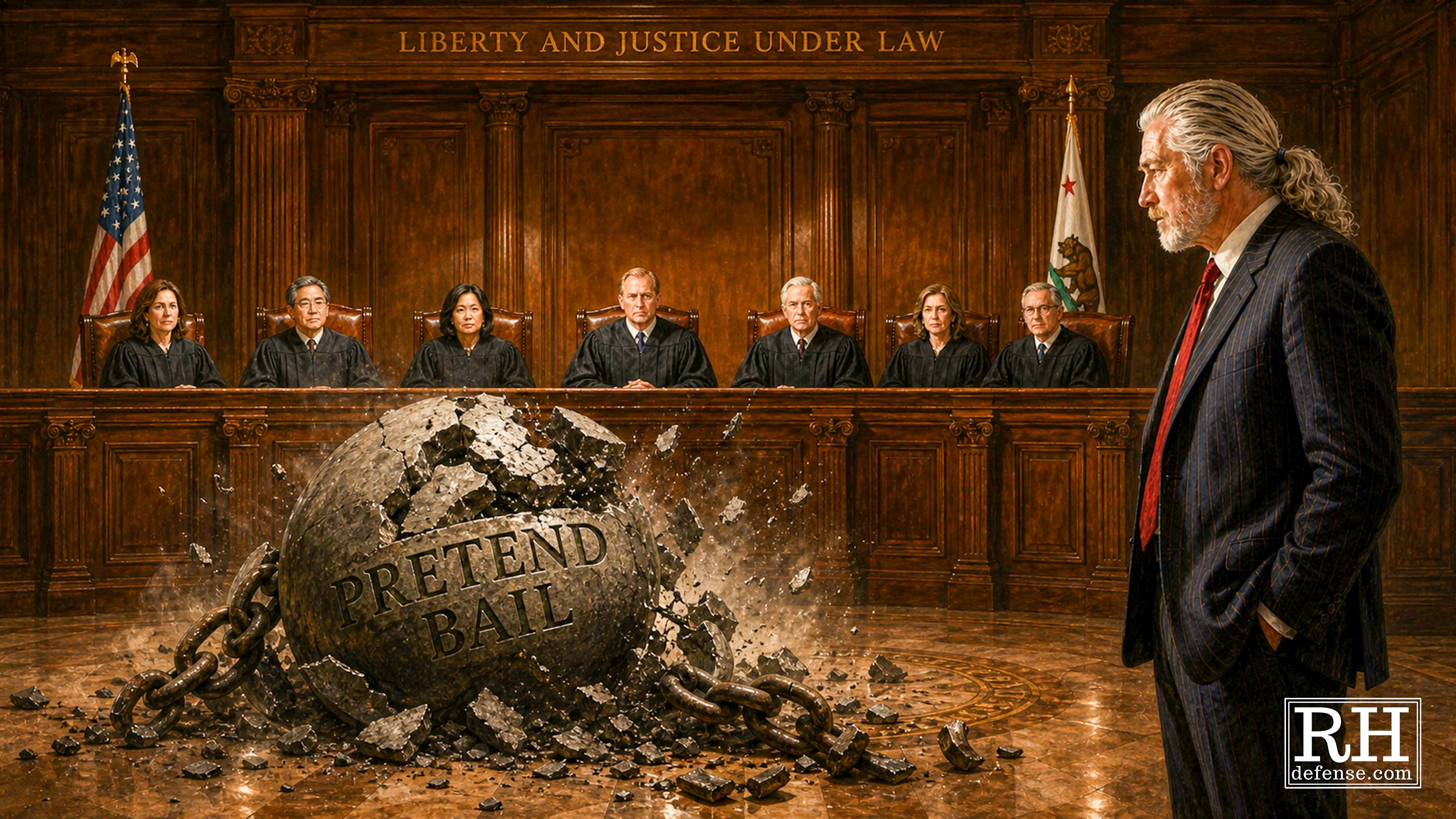
As I said, Kowalczyk is just the latest from Courts of Appeal and, more importantly, the Supreme Court. This is another point that I hammered in my Daily Journal article.
This is why habeas litigation remains necessary and why defense counsel must continue to utilize it whenever trial courts balk at the default. As a reminder: “liberty is the norm, and detention prior to trial…is the carefully limited exception” Yedinak v. Superior Court, 92 Cal. App. 5th 876, 881 (2023). These are not ceremonial words to be intoned by priests in robes waving incense to smoke up the room just before an order of pretrial detention. […] The fact that defense lawyers must repeatedly resort to habeas petitions to secure compliance with settled constitutional law is not evidence that the law is unclear. It is evidence that the law is being ignored.
— Eric H. Schweitzer and Rick Horowitz, Bail realities and policy fictions: The truth about affordable bail (January 6, 2026)
The Supreme Court Justices themselves have never wavered on this point. And in Kowalczyk, Justice Guerrero wrote for a unanimous Court. Justice Groban, joined by Justices Liu and Evans, calls intentionally unattainable bail “the functional equivalent of a pretrial detention order” and names the practice a “fiction”. Kowalczyk, 2026 Cal. LEXIS 2206, at *52–53 (Groban, J., concurring).
Ultimately, the disagreement was never really among the justices. It was between the Constitution and a courthouse culture that had grown comfortable treating money bail as a shortcut around it. Kowalczyk makes explicit that this plays no part in the “constitutional framework”.
Hopefully, this is the end for pretend bail.
The Presumption of Innocence is Not Optional
The constitutional default is liberty. The constitutional presumption is innocence. Kowalczyk relies on both, repeatedly. Kowalczyk, 2026 Cal. LEXIS 2206, at *5, *37, *48–49. Humphrey relies on both.
Harris held:
To hold that a court must assume the truth of the criminal charges in making such a determination would improperly relieve the People of the burden that the constitutional text, so construed, assigns to them. Accordingly, we clarify here that a court does not assume the truth of the criminal charges when evaluating whether to order a defendant held without bail under article I, section 12(b).
— In re Harris, 16 Cal. 5th 292, 320-21 (2024)
Salerno itself, the federal case the District Attorneys leaned on in Kowalczyk, says:
In our society liberty is the norm, and detention prior to trial or without trial is the carefully limited exception.
— United States v. Salerno, 481 U.S. 739, 755 (1987)
But there is a competing attitude. Call it the “arrest-equals-guilt assumption” which has been growing in courthouses, prosecutors’ offices, in legislative debates, and in public opinion. The assumption is that the arrest itself is sufficient evidence of guilt for most practical purposes. But we all should know that it is not. Wrongful arrests, dismissed cases, acquittals (not guilty findings), and exonerations are not outliers. They are a measurable percentage of any criminal docket.
Yet this arrest-equals-guilt attitude colors every stage of a criminal case. Arrests based on jumping to conclusions. Charging decisions made on thin evidence to be cleaned up later. Bail hearings where “public safety” is asserted as if the charge itself proves the danger. Evidentiary hearings where the prosecution’s narrative is treated as established fact. Admissibility rulings that assume the government’s evidence is not only what it appears to be but — when it should not be admitted, but will help to prejudice the case — is necessary. Jury selection where the constant battle for the defense is responding to “we wouldn’t be here if the defendant was innocent”. And trials where the burden of proof is basically inverted — the defense must prove innocence — because everyone in the room (sometimes including the defense lawyer) has internalized the assumption that the defendant “probably” did it.
And “probably” is good enough.
Kowalczyk is another reminder that rights matter. The presumption of innocence matters. And we don’t lock up innocent people before they’ve been found guilty as the norm.
Pretrial liberty is the norm.
And it is both founded upon and furthers the idea that the presumption of innocence matters.
Evading the Norm Based on a Presumption of Guilt Must End
In a February 18 video, The Unrealized Promise of Humphrey: When Bail Reform Meets Judicial Resistance I walked through the UCLA/Berkeley Coming Up Short report which found that pretrial detention increased after Humphrey, that bail amounts did not drop, and that some judges read the ruling as license to deny bail entirely.
The pattern was visible in judicial behavior — a Sacramento County judge warning a defense lawyer that pushing a Humphrey argument might result in bail being taken off the table entirely; in San Joaquin County, the percentage of cases in which bail was set decreased from 30% in 2018 to 18.7% after Humphrey; and a Los Angeles trial court in In re Brown trying to claim Humphrey did not apply to serious felonies and being reversed. Alicia Virani et al., Coming Up Short: The Unrealized Promise of In re Humphrey 17 (UCLA Sch. of Law Bail Practicum & Berkeley Law Pol'y Advocacy Clinic 2022).
As Coming Up Short noted:
[J]udges either misinterpret the Humphrey decision or flatly refuse to follow it.
— Alicia Virani et al., Coming Up Short: The Unrealized Promise of In re Humphrey 23 (UCLA Sch. of Law Bail Practicum & Berkeley Law Pol'y Advocacy Clinic 2022)
I would argue that any “misinterpretation” of Humphrey is deliberate. Part of the flat refusal to follow it.
Why Does This Continue & Why It Matters

Why do judges resist Humphrey? A big part of the reason almost certainly has to do with the overall zeitgeist that presumes guilt, as I mentioned above. But another reason is that it makes things “convenient”. It greases the wheels of what I’ve elsewhere referred to as “conveyor belt justice”.
Justice Groban’s concurrence in Kowalczyk cites the data. Detained defendants accept unfavorable pleas at higher rates with some pleading guilty to crimes they did not commit just so they can get out of custody and return to their homes, their families, and their jobs. Detention causes people to lose their jobs, housing, custody of children, and family stability. Justice Groban cites the CRPC 2022 report, the Workgroup Recommendations, the Petersen study, the Not in It for Justice report, Wiseman’s Yale Law Journal piece. That is a sitting California Supreme Court justice naming the harms with citations.
Even just this past week, I heard a defense attorney say that “custody makes cases easier to resolve”. Yes, I was appropriately horrified. That is true in the same way a thumb screw makes a confession easier to obtain. The prosecution’s case doesn’t improve because of incarceration. But the price of resistance changes. Fighting becomes more expensive by the day. Delay becomes pressure. And we end up with pleas not as fair resolutions, but as surrenders.
This all works because of what I said about the presumption of innocence. Custody works as leverage only because everyone in the system has accepted that the accused is “guilty enough” to be locked up while awaiting trial. But that is not what the Constitution allows. Liberty is the norm. Pretrial detention is the exception.
Kowalczyk reaffirms what the Constitution has always said.
It matters because this is the only thing that gives anyone the right to call this a “Justice System”.
The Next Front
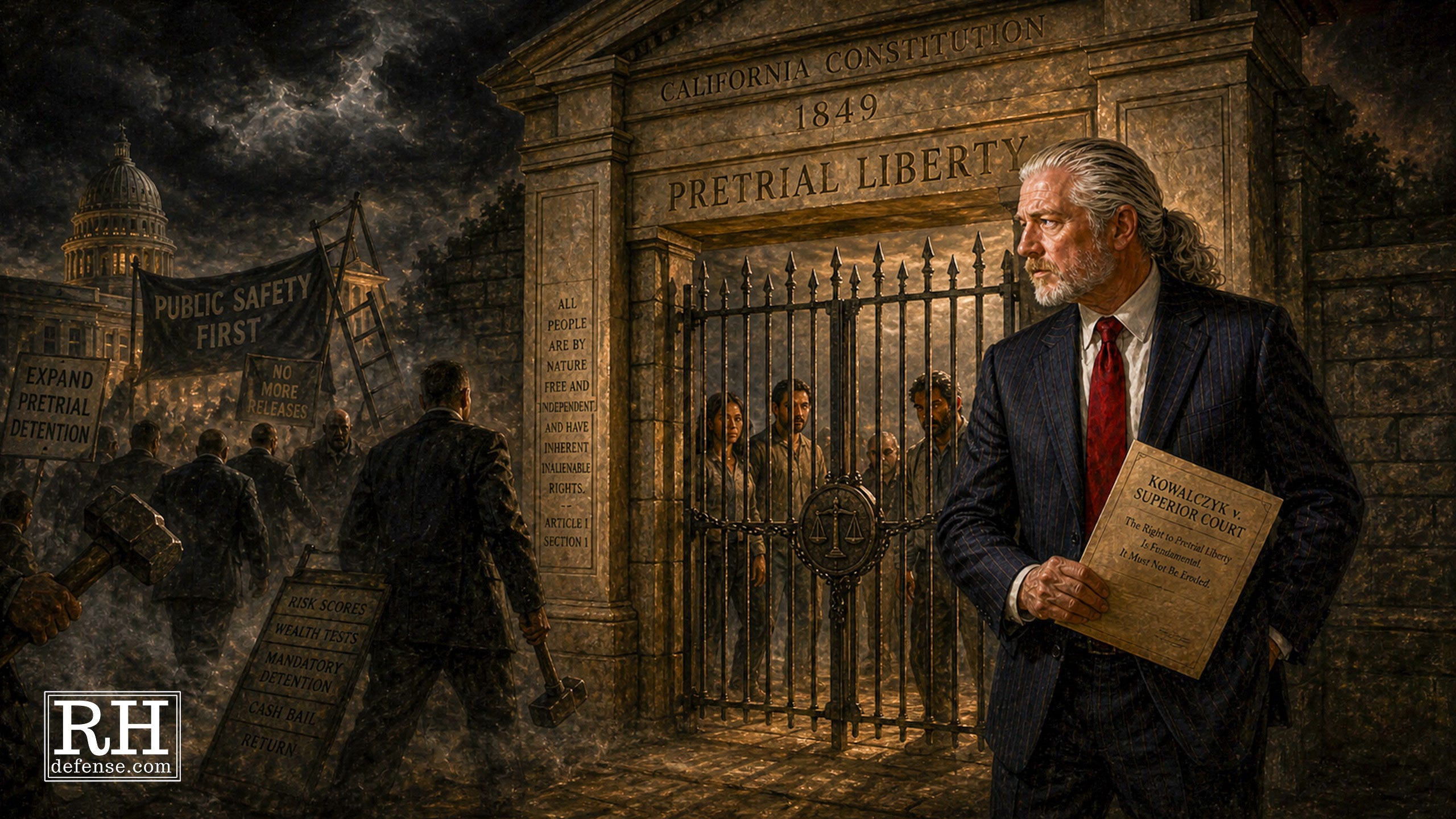
Notwithstanding Kowalczyk, don’t expect going forward that it’s going to be all rainbows and unicorns.
Kowalczyk itself may present as the (hopefully) final nail in the coffin for judges trying to evade the current constitutional framework. But it also presents a way out.
The majority repeatedly states that voters can change the framework if they want. Justice Wiley’s concurrence is essentially an invitation to legislative and executive action.
Justice Groban pushes back substantially. His concurrence walks through the scenarios the District Attorneys raised — domestic abusers, child neglect, fentanyl dealers, financial crimes — and concludes that section 12 plus conditions of pretrial release are sufficient. He does not invite legislative expansion. He defends the framework as it stands.
But the direct invitation of Justice Wiley is bothersome.
Today’s decision invites a legislative and executive response. I hope the invitation is accepted.
— Kowalczyk, 2026 Cal. LEXIS 2206, at *64 (Wiley, J., concurring)
I can’t agree. I understand the desire to keep the thumbscrews of pretrial detention. I understand wanting to hold onto the grease that keeps the conveyor belt of justice efficiently carrying defendants and their families to “resolutions” that have nothing to do with Justice with a capital-J.
The arrest-equals-guilt presumption is the foundation of every “pretrial detention for everyone” argument. In the spirit of Oprah Winfrey’s “giveaway” episode:
You get detention! And you get detention! And you get detention! Everybody gets detention!
Since 1849 — nearly two centuries — California has held otherwise.
The California Constitution has recognized a right to release on bail since 1849. (Cal. Const. of 1849, art. I, § 7.) Our state Constitution continues to guarantee such a right, providing that a defendant “shall be released on bail by sufficient sureties,” subject to specifically delineated exceptions.
— Kowalczyk, 2026 Cal. LEXIS 2206, at *4
If the California Legislature accepts Justice Wiley’s invitation, all the hard and good work that the California Supreme Court and (some) appellate courts have been engaged in since at least Humphrey would come undone.
This would mean more than the end of a nearly-two-century-long era.
It would mean the end of justice.
If you've watched a judge use unaffordable bail as detention by another name, I want to hear about it in the comments.
I predict that once reality sets in, there will be a movement to follow-up on Wiley’s invitation led by by irritated DA’s, Judges and so called victim advocates. I also predict that CACJ and like groups will push back. I’d like to think that the electorate can understand that the Constitution is at stake. But the failure of our schools to inculcate knowledge about such things is alarming. People watch too much TV these days. And social media can sway people tremendously. Put it to a vote, I guess. See how for the brainwashing has permeated our society.
If I received a dollar every time a new acquaintance said, "oh my gosh, how can your husband defend guilty people," I would be rich. I politely tell them (while seething inside), that there is a quaint notion that people are presumed innocent until proven guilty. There is so much about the criminal "justice" system that lay people don't know about. Articles like this need to be shared far and wide!