

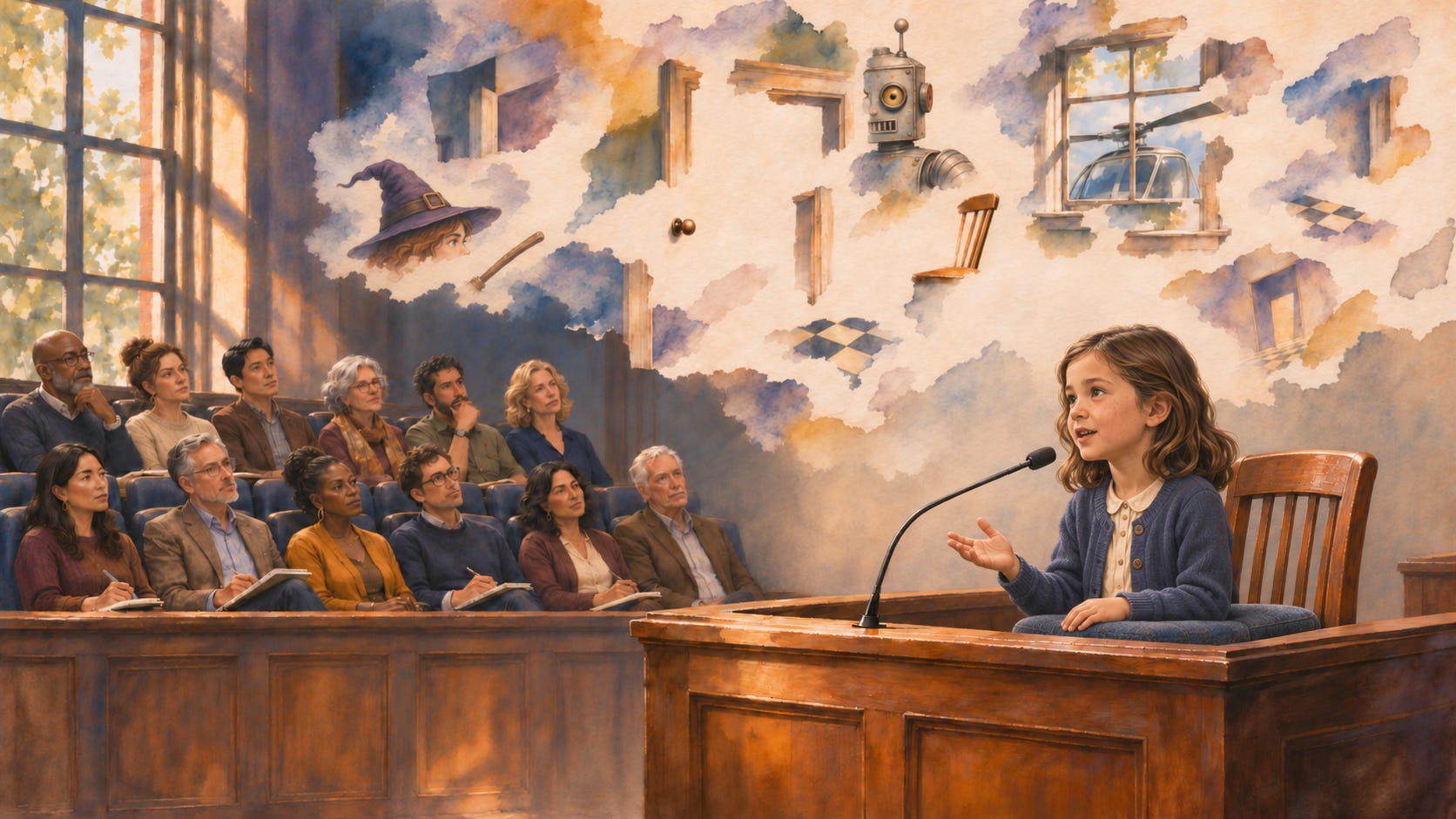
While reading through Substack looking for inspiration for Coffee and a Corndog, I ran across A Pedophile Profile: Russell M Nelson.
Now, I don’t know a thing about Nelson. The article contained much that sounded like it could be true, but it also contained so much obvious bullshit and flat-out lies that I decided to try to research him a little. The best I could find is that members of his family were sued in 2018 for supposedly engaging in child sexual abuse. That case apparently did not name Russell Nelson, Sr. and was ultimately dismissed on statute-of-limitations grounds. So there never was a resolution based on the facts of the case, one way or the other. There were also claims that the “victims” came forward as part of the “Satanic ritual panic” of the 1980s.
So far as I can find, Russell Nelson was never charged with any crimes. When he died in September 2025 at the age of 101 years, he was still apparently serving as President of The Church of Jesus Christ of Latter-Day Saints.
All that said, I’m not writing this essay to defend Nelson. I want to examine the article’s explanation of why its readers should believe them. The Substack article about Nelson — going forward, I’ll refer to “the profile” without using quotes — makes categorical claims about memory, trauma, and psychology. Those claims can be checked. I’ll show they’re false. Or as many criminal defense lawyers could tell you: “They’re bullshit.”
And what people believe about them matters far beyond this particular accusation against one man.
“There Is No Such Thing as False Memories”
I’ll start with something that needs almost no digging to disprove.
There is no such thing as false memories. This theory has been debunked. The American Psychological Association stated that false memories are nonsense and never ratified the theory.
— Relentless Hope, A Pedophile Profile: Russell M Nelson: Too many victims to count (Mar 23, 2026)
This is blatantly false. The American Psychological Association expressly recognizes false memories in its own dictionary. Here’s the relevant part of the definition:
[A false memory is] a distorted recollection of an event or, most severely, recollection of an event that never actually happened. False memories are errors of commission, because details, facts, or events come to mind, often vividly, but the remembrances fail to correspond to prior events. Even when people are highly confident that they are remembering “the truth” of the original situation, experimental evidence shows that they can be wrong.
— American Psychological Association. (n.d.). False memory. In APA dictionary of psychology. Retrieved November 20, 2026, from https://dictionary.apa.org/false-memory
The definition does include the information that “false memory syndrome is not an accepted diagnostic term.” There is a big difference between saying that false memory syndrome is not an accepted diagnostic term and stating that false memories do not exist.
Moreover, the American Psychiatric Association — note the difference in the name — issued a position statement that makes clear the harm that can come from accepting false accusations based on memory.
Research has shown that memory does not always record events accurately. In the presence of severe or prolonged stress, people may suffer significant impairment of the retention, recall and accuracy of memories. Memories can also be altered as a result of suggestions particularly by a trusted person or authority figure. No specific unique symptom profile has been identified that necessarily correlates with abuse experiences. In general, psychotherapy focuses on the patient’s perceived experience, and does not customarily search for proof of veracity of memories. Psychotherapy works with memories, dreams, altered states of consciousness and related material within the larger context of understanding the patient’s current difficulties, accompanied by cautions against premature action by the patient. It is well documented that both dismissing true accounts, and accepting false accounts, can harm patients and possibly others.
— Am. Psychiatric Ass'n, Position Statement on Therapies Focused on Memories of Childhood Physical and Sexual Abuse (July 2013)(note 2013 was a reaffirmation of a statement adopted 13 years earlier)
For readers interested in how this happens — which I hope includes some other lawyers — psychologist Julia Shaw’s The Memory Illusion: Remembering, Forgetting, and the Science of False Memory (affiliate link) offers an accessible introduction. Shaw looks at how recollections can be distorted, how information from other people can be adopted by us into our own accounts, and how people can come to believe they remember events that never occurred. This can feel like remembering. But that is why sincerity alone doesn’t — and can’t — settle accuracy.
There are legitimate scientific questions about how false memories form. The profile’s declaration that they don’t exist erases the subject without addressing it. Doing so by flatly misstating the position of the APA should raise a red flag on this article all by itself.
Or, as we’d say in criminal court if this happened: “Objection! Misstates the evidence.”
Vividness and Detail ≠ Accuracy
Remembering the color of a floor shows that someone can describe a floor. This may be difficult to believe, but that’s something almost everyone of almost any age can do. Knowing whether the description is accurate, where the witness learned the information, and (most importantly) whether it corroborates the alleged act supposedly having taken place on or near that floor are completely different questions.
Talarico and Rubin’s study of memories of hearing about September 11 illustrates the distinction — and my memory of hearing about this study is from about a week ago at the NACDL Sex Crimes Defense Seminar. Participants’ confidence and vividness remained high even as their accounts became less consistent. Obviously, that was not a study of sexual assault; it nevertheless directly undermines the general idea that emotionally powerful, vividly experienced recollections authenticate themselves. In my own life, I’ve been surprised at the times I’ve “clearly remembered” something which just didn’t happen.
Bodily Reaction Is Not a Historical Record
The profile claims that the body remembers.
Details about the room were provided, right down to the color of the floor. How is this possible? Because trauma is stored in the body. When a person is tortured and raped, the nervous system goes into hyper mode.
— Relentless Hope, A Pedophile Profile: Russell M Nelson: Too many victims to count (Mar 23, 2026)
This view was popularized by Bessel van der Kolk’s bestseller, The Body Keeps the Score: Brain, Mind, and Body in the Healing of Trauma (affiliate link). In it, he promotes his idea that overwhelming trauma gets split off from conscious thought and is somehow stored directly in the nervous system. In his view, a person can have no conscious memory of abuse at all yet their body somehow carries it through chronic pain, stomach trouble, or sudden panic attacks until those memories surface later.
That’s not at all how memory works. A memory that is never encoded cannot be retrieved. The brain doesn’t work like some kind of specialized tape recorder, automagically holding onto coherent video images of what happened until you decide, decades later, to turn on the projector.
In fact, even if you accepted — which neuroscientists don’t — that the body somehow remembers things, the profile misrepresents even van der Kolk. In his 1998 peer-reviewed article, “Trauma and Memory” (Psychiatry and Clinical Neurosciences, Vol. 52, Issue S1, pages S97–S109), van der Kolk argues that trauma leaves behind scattered physical sensations — a racing heart, tight muscles, or a wave of terror — rather than neat, chronologically linear stories or high-definition visual recordings of room layouts and floor colors.
More to the core of things, mainstream memory researchers reject the premise that severe trauma is routinely repressed and stored outside conscious awareness in the first place.
As Richard J. McNally put it:
The notion that the mind protects itself by repressing or dissociating memories of trauma, rendering them inaccessible to awareness, is a piece of psychiatric folklore devoid of convincing empirical support.
— Richard J. McNally, Remembering Trauma 275 (2003)
Elizabeth Loftus and others have shown that memory is not recording video data that is later retrieved. Memory is a mental process of reconstruction. This is why the process can so easily go awry: the process of reconstruction is susceptible to reformation. (I almost want to say “tampering,” but tampering sounds deliberate and deliberateness does not need to be a component in creating false memories.)
Bessel van der Kolk himself, in his 1998 paper mentioned above, says that once a person tries to translate those raw sensations into words and a coherent story, normal reconstructive memory errors — of the sort Richard McNally, Elizabeth Loftus, and Daniel Schacter use to dismantle van der Kolk’s model — take over.
Put as simply as I can in layman’s terms, trauma therapists who accept van der Kolk’s theory rely upon fragmented sensations to “help” their clients develop a plausible-sounding story.
Or plausible enough.
Which leads directly to the next issue.
There Is No “Laser Precision”
One of the most damning things about the profile’s claims has to do with the alleged “laser precision.” Anyone who has ever tried to question one of these accusers on a witness stand will have run into the problem of vague stories studded with a few hyper-specific details — the color of a floor, a tarp on a carpet, a brand of punch. There is no precision, laser or otherwise.
Nor could there be for the reasons already given above. Even van der Kolk states this.
Worse still, the profile undercuts its own “laser precision” claim just one paragraph earlier when it describes how the children were supposedly subdued.
According to the post, kids were given combinations of morphine, Rohypnol, ketamine, and psychedelics so they wouldn’t remember what happened. Anyone who has dealt with drug-facilitated assault cases knows what drugs like Rohypnol and ketamine actually do: they knock out the brain’s ability to form new memories in the first place. You don’t get “laser-precision” recall out of a drugged, blacked-out brain. What you get — if anything — are blank spaces filled in years later through guesswork, outside suggestion, and mistaking an imagined picture for a real event.
Sincerely Believed Non-Truths
Here is one of the problems criminal defense lawyers run into in sex cases, especially those involving young children, or memories from “long ago.” Long ago, by the way, can be an elastic idea based on the age of the complaining witness. A 5- or 6-year-old recently “remembering” something that allegedly happened when she was two or three — especially after adults have started asking worried, leading questions — presents a completely different reliability problem than a 17-year-old relating a secret she’s kept since she was 11 or 12.
In the first case, you’re dealing with early childhood memories that fade fast and are easy for worried adults to reshape without meaning to. Worse yet, when an adult claims decades later to have suddenly recovered a crystal-clear memory from age two or three, they’re reaching back past childhood amnesia — to a stage before the brain can even hold onto steady, lifelong stories about our own lives. In the second case — the 17-year-old talking about something from age 11 or 12 — her brain was fully capable of recording what happened, and she never forgot it. She just kept it to herself.
And here is the trap that catches juries, therapists, and Substack readers alike: a false memory doesn’t feel like a lie.
When someone takes the stand — or sits down with an activist blogger — and describes an assault from decades earlier, they aren’t necessarily making things up out of thin air. There’s no wink wink to suggest fabrication. Often, they are weeping, trembling, and entirely convinced they are telling the literal truth.
That is exactly what makes false memories so dangerous in a courtroom. Cross-examination is built to expose liars — people who know the truth and are trying to hide it. Traditional demeanor or behavioral cues — tears, shaking hands, emotional conviction — tell you whether a witness believes what they are saying. They tell you nothing about whether the event they actually believe actually happened. Once a person’s brain has fused a suggestion from a therapist, family member, or friend, a cultural script, or even a fragment of a dream into a vivid mental picture, the brain tags that picture with the same sense of familiarity and emotional weight as a real memory.
Conscientious jurors have to find some other way of evaluating the witness. This, by the way, is at least partly why the defense does not have to prove anything at all — can even remain silent, if they choose — and the prosecution is supposed to prove things beyond a reasonable doubt. If there is a reasonable doubt as to the truth (and I would argue that unless there is some other evidence than only some old alleged memory there will always be a reasonable doubt), the jury is supposed to give the benefit of that doubt to the defendant.
This is how we avoid convicting innocent people.
Which seems like a good place to bring us back to the profile’s claim about vocabulary.
The Lens of the Remembering Eye
No small child could conceive of the gross words and sexual positions that have been described. Five-year old’s do not know what a blowjob is unless they have been shown.
— Relentless Hope, A Pedophile Profile: Russell M Nelson: Too many victims to count (Mar 23, 2026)
This may be true. It proves nothing about where the so-called “memory” the gross words supposedly describe came from. Adults know the words. I write on another Substack — I mentioned it at the start of this article — and the creative nonfiction essays I write there sometimes rely upon older memories. I wrote all those essays as an adult. And when I describe things from my childhood, I will sometimes use words that I would not have known as a child. You can’t know — sometimes I can’t even know and I say so in the essay — whether I’m remembering things accurately, or whether I’m right about the memory at all.
Again, the work of researchers like Loftus, McNally, and others already mentioned has shown us that adults can — without even having nefarious purposes — teach children how to talk about these things. I just came from a Sex Crimes Defense Seminar put on by the National Association of Criminal Defense Lawyers in which one expert spoke about some very (very) disheartening experiments that demonstrated that when parents were told that it was important to be accurate when talking to their children about something that had happened, there was a greater risk of contamination, with children reporting four times as many false details. (Gabrielle F. Principe, Hunter Kirkpatrick & Savannah Langley, A Focus on Accuracy in Misinformed Mothers Puts Young Children at Risk for False Memories, 214 Journal of Experimental Child Psychology 105274 (2022).)
Trying harder to obtain accurate accounts led mothers to exert more control, suggest possibilities, and use biased questioning. And, of course, they’d be using their own words and ways of explaining things. So it wouldn’t be impossible for children to learn something new in this process.
When “Memory” Becomes Proof
The mothers in that study weren’t trying to put false stories in their kids’ heads. They were trying to get the facts right. That’s why I and other criminal defense lawyers were so frightened by the results: good intentions didn’t stop the contamination.
As a friend who went to the conference with me said, “How are we supposed to deal with that?” How are we going to convince jurors that moms trying to get at the truth polluted their own children’s minds? Moms deliberately trying to get at the truth were creating false memories.
The profile doesn’t allow for any of that. In its world, false memories don’t exist, trauma records every detail like a camera, stores it in the body (not the brain), and the body eventually hands over the tape when it feels safe. When you accept those rules, asking hard questions about an accusation starts to look like beating up on a victim.
I run into that attitude in court all the time. Before I even ask my first question on cross-examination, I often have to push past the unspoken feeling that testing a witness’s memory is somehow cruel. Even when during jury selection, I tried to prepare the jury by asking permission to (basically) do my job, I still have to be careful.
But serious accusations deserve to be taken seriously — and taking them seriously means actually checking them, challenging them. It means asking how a memory came together, who talked to the witness along the way, and whether any outside evidence backs up the story. Feeling bad for someone isn’t proof.
In a courtroom, someone’s freedom can turn on that difference. Out here on Substack, (probably) nobody is going to prison, but basic fairness still counts. Saying “I remember” is a reason to start looking for answers — not a reason to stop asking questions.
A very nice distillation of a mountain of research that you have done. I hope this information will provoke thought in many circles to recognize the importance of knowledge in how memories are truly made. There’s no escaping the truth.
A really thought-provoking piece. It’s a great reminder of how fragile human memory can be, and why looking closely at the evidence matters so much.