

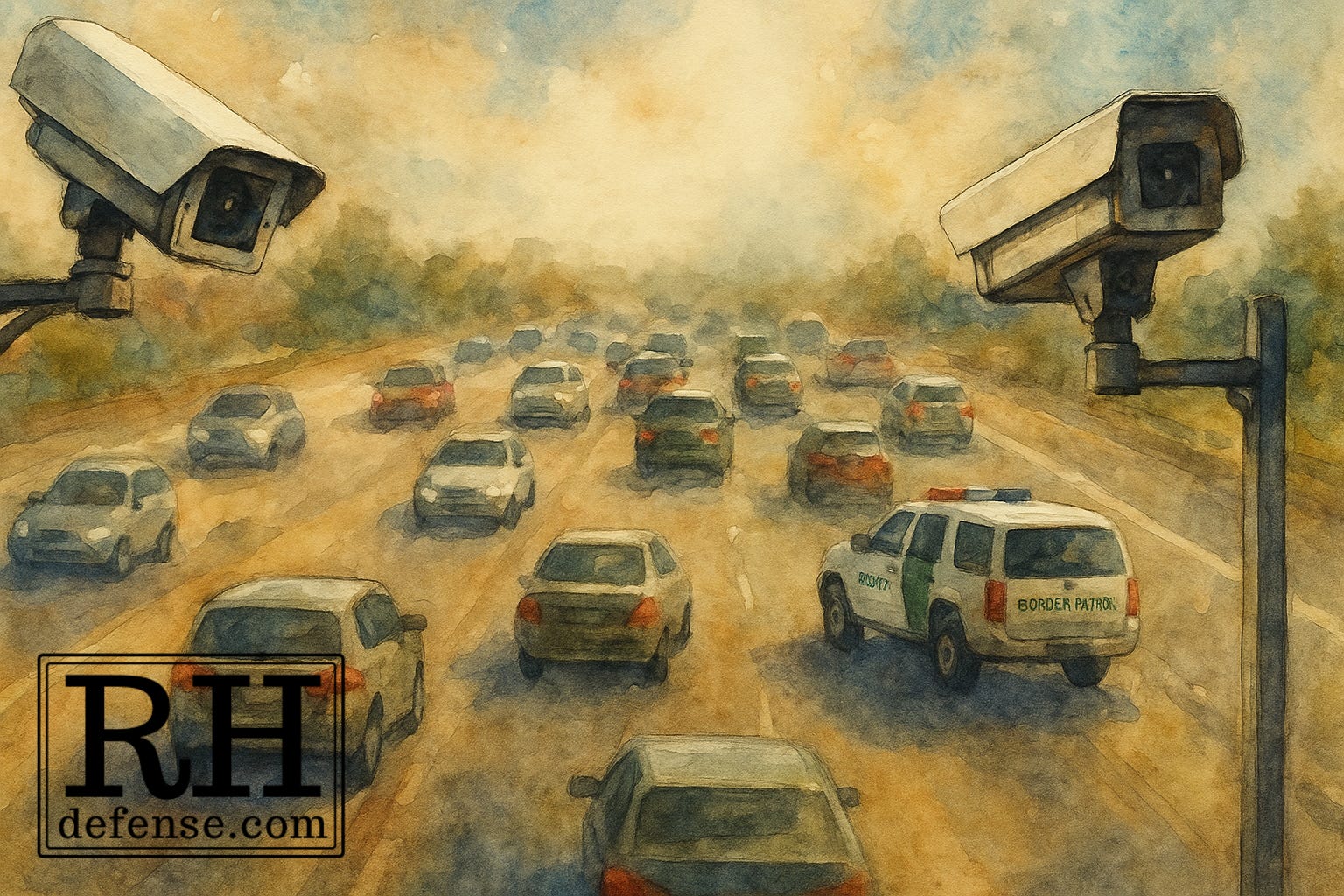
The insurance industry — the ultimate in data-driven professions — is backing away from AI because it can’t be trusted. Actuaries say plainly: this technology is too opaque, unpredictable, and prone to correlated failures to underwrite.
But Border Patrol?
They’re using the same uninsurable tech to decide who looks “suspicious”. And they’re doing it hundreds of miles outside their jurisdiction.
That’s the absurdity. Risk experts won’t touch this tech; law enforcement uses it like a Fish Locator.
And we’re the fish.
The Surveillance System We’re Not Supposed to See
The AP/ABC report reveals Border Patrol is running mass surveillance: license-plate readers, pattern-of-life analytics, and algorithmic “anomaly detection.” No individualized suspicion or border proximity required—none of the traditional limits on federal agents apply.
A camera grabs your plate. Software crunches your travel history. An opaque model decides your “pattern” looks wrong. Then, suddenly, a local cop operating on a Border Patrol hunch — not even a hunch, but something their AI pulled out of its…whatever AIs crap from — pulls you over for a tinted window.
The predictive intelligence program has resulted in people being stopped, searched and in some cases arrested. A network of cameras scans and records vehicle license plate information, and an algorithm flags vehicles deemed suspicious based on where they came from, where they were going and which route they took. Federal agents in turn may then flag local law enforcement.
Suddenly, drivers find themselves pulled over — often for reasons cited such as speeding, failure to signal, the wrong window tint or even a dangling air freshener blocking the view. They are then aggressively questioned and searched, with no inkling that the roads they drove put them on law enforcement’s radar.
— Byron Tau and Garance Burke, Border Patrol is monitoring US drivers and detaining those with ‘suspicious’ travel patterns (November 20, 2025)
I handle many cases where someone is pulled over for “following too closely.” Immediately after, the officer asks, “Do you have any drugs in the car?” Then, “Do you mind if I search?”
A Problem to be Solved
I don’t know how many of my clients arrested in these stops were flagged by Border Patrol. I do know many are Latino.
Most stops in my area happen along the I-5 corridor through Fresno and Kings County, both among the counties I cover in my criminal defense practice.
In 2015, the U.S. Supreme Court held that traffic stops may only last as long as needed for the “mission” of the stop (Rodriguez v. United States, 575 U.S. 348 (2015)).
Here’s how things typically play out for my clients: Two officers ride together — usually a deputy and a detective. Detectives don’t ride along for traffic tickets; this isn’t a traffic detail.
My clients are stopped for the usual pretexts: following too closely, minor speeding, expired tags, or tinted windows.
What’s your take? Ready to be part of the play? Tell me in the comments.
But video footage shows the alleged “following too closely” looks identical to every other car’s spacing. In my most recent cases, the supposed violation was indistinguishable from normal traffic flow — the officers’ words didn’t match reality.
That’s why cops love pretext stops: easy to claim, hard to disprove. Officers often say they turned on lights before the camera started, causing drivers to slow down and and explaining why the camera doesn’t show the alleged violation.
Next, the officer explains the violation and pivots straight to drugs — before checking license or registration. It’s always: “I pulled you over for following too close. Do you have drugs? Have you been smoking marijuana? Do you mind if I search?”
All this occurs in under a minute.
Meanwhile, the license and registration go to the detective — who should be writing the ticket, but rarely is. Instead, the detective stands with the driver for “officer safety” — meaning nobody is doing the traffic work Rodriguez requires.
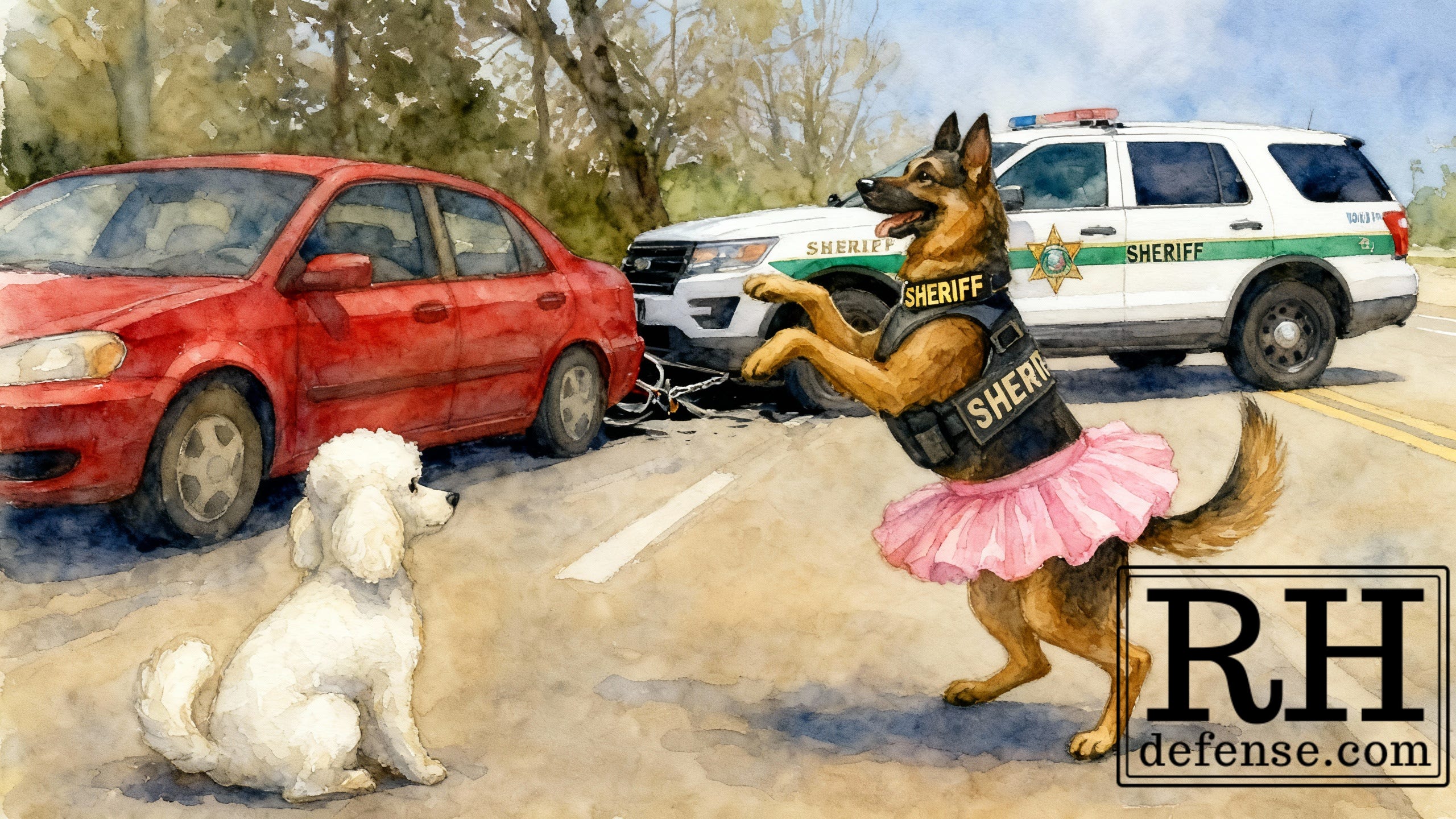
In one case, after the driver refused consent, the officer ordered him and his small dog out of the car. The detective stood by (again, for “officer safety”) while the officer brought out a canine. The officer’s dog wasn’t interested in the car — it wanted my client’s dog.
For over ten minutes, the officer tried to force the canine to engage with the car. When that failed, the officer seemed to signal the dog with a treat, prompting a brief jump onto the rear bumper. Instantly, the dog took the treat and returned to trying to reach my client’s dog.
This is what I wrote about — in another case involving a violation of Rodriguez — in Totality of the Circus Dances: On the Joys of Search & Seizure Motions (October 20, 2020) in the section Bring Out the Dancing Dog!
Anyway, by then, they were about eighteen minutes into the stop. The officer told my client — who objected and challenged whether the dog “alerted” — that he didn’t care. He now claimed probable cause to search.
Meanwhile, the detective still hadn’t started the ticket. He wasn’t even pretending.
Only around the thirty-five minute mark — long after the search and discovery — did he ask whether to add speeding or following too close to the citation. Sure enough, the citation started with marijuana-related entries; the traffic violation appeared at the end.
Doesn’t that show the ticket wasn’t written until long after the drug search?
Rodriguez prohibits this kind of extended detention. The Court stated a stop ends when traffic-related tasks are, or should be, completed.
But here, those tasks began only after the search ended. The “mission” of the stop was a prop; the real mission was investigation.
In another stop, the pattern was the same, but the search was faster because the car’s occupants consented. Again: traffic pretext, immediate drug questioning, license to a detective who never does traffic work, consent request, straight to search. The investigation moved quickly not because officers followed the law, but because the occupants didn’t know it and said yes.
Let this be a reminder: never consent to a car search!
The problem is always the same: the traffic violation is just a disguise. The real reason — a Border Patrol flag, algorithmic alert, or vague suspicion — is never acknowledged.
But the structure of the stop reveals the truth: nobody’s there to write a ticket — they’re there to find drugs. When the officer hands the license to a detective and starts asking about drugs, the Rodriguez analysis should kick into high gear.
Because what we see on I-5 isn’t traffic enforcement; it’s a scripted ritual. Invent a traffic excuse — easy to do — ask about drugs, try for consent, stall for a dog, or create enough “nervous behavior” to escalate.
The ticket is an afterthought — a paper to reconstruct a story that never matched the real purpose.
Rodriguez was supposed to stop this. Instead, it’s become a rulebook for a game cops keep finding ways to play around, or over, or under.
Every court attempt to enforce the Constitution becomes a problem for officers to solve: “How do we get around this new ruling?”
The goal is control. The tension between upholding the Constitution and officers finding ways around it is never-ending.
The New Pseudoscience of Suspicion
This is where AI loops back in — and why the Border Patrol program is so dangerous. It doesn’t override Rodriguez; it works with these tricks to bury Rodriguez under a traffic excuse.
Nothing about a Border Patrol tip — agent or algorithm — creates reasonable suspicion, nor does it allow officers to prolong a stop. Rodriguez still applies. The problem is, Border Patrol helps target Latinos, who in today’s environment are more frightened — and thus more easily manipulated — by police encounters.
But this basis for the stop never appears anywhere in the paperwork.
Local officers pull someone over for “following too closely” or “tinted windows,” not because of anything meaningful, but for a lawful-looking pretext. The AI flag remains invisible — one of the Ghosts in the Machine animating the stop but never appearing in the narrative.
The court, driver, and defense lawyer rarely hear about it—the lawyer only by accident, if at all.
But the officer — tipped by Border Patrol — absolutely hears about it. That AI whisper shapes the whole encounter: the officer pivots to drugs, the detective doesn’t write a ticket, the dog gets called before the citation. AI suspicion drives the stop; the traffic violation is just a cover.
The paradox isn’t that the court would trust AI — it’ll never be told it exists. The paradox is that officers rely on AI as if it’s reliable enough for detention, while risk experts insist it’s too unpredictable to insure.
Yet law enforcement treats AI output as a starting point for suspicion.
That’s the pseudoscience, the danger — not that AI will be taken seriously in court, but on the roadside, where constitutional scrutiny can’t reach unless the defense exposes what really triggered the stop and how the mission was managed — or not managed.
The Real Risk Isn’t the Driver — It’s the System
Ultimately, the biggest threat isn’t the driver — it’s the unconstitutional system deciding whose rights to violate before the lights even come on.
Artificial intelligence picks a car. A detective tags along for a “traffic” stop that’s never about traffic. Rodriguez becomes a problem to solve, not a limit to respect. The driver is trapped in a script written by a machine no one can question.
Meanwhile, those who understand risk — actuaries — want nothing to do with this tech. They’re stepping back while law enforcement steps blindly forward. When the most data-driven profession refuses to insure a tool, no police agency should use it to justify detention.
If AI is too unstable to underwrite, it’s too unstable to justify suspicion. But that’s what’s happening along the I-5 corridor. Just another Hall of Injustice.
And until courts, legislators, or someone with authority stops it, the fish finder stays on.
Shout-out to my good friend and colleague, Eric Schweitzer of Schweitzer & Davidian, who sent me the story and suggested I write a post about it.
Every time I read your articles, Rick, I come away more informed than I was before. I'm often surprised and sickened by what I read, and it makes me very sad and depressed. But it also makes me want to fight and spread the word about what is happening to our society! I'm curious to know how your other readers feel. Comments anyone?!