

The Empathy War. Where empathy has become the battlefield; the battlefield is empathy.
After the assassination of Charlie Kirk, actors and celebrities who expressed even the smallest trace of sorrow were pilloried online. Kristin Chenoweth, Selma Blair, Chris Pratt — each was accused of betraying their own people, “signaling the wrong allegiance simply by mourning.” Others went further: Pete Hegseth promised that military personnel who “made light” of Kirk’s death would be rooted out and punished. In this climate, empathy is no longer a human response; it is a loyalty oath.
This is where performance enters the picture.
Political figures and public strongmen demand the right kind of grief, staged in the right key, and threaten consequences for the wrong kind. Empathy becomes a command performance — unprincipled, policed, hollow.
And yet, for me as a criminal defense lawyer, empathy means something else entirely. I’ve written before about the unbearable meaninglessness of “justice,” about the stacked deck that ensures unfairness, and about tikkun olam — repairing the world by repairing the law itself. The empathy war ties these threads together. In my world, it is not only cultural. It is internal and definitional. I fight it every day in court and inside myself.
First, there is the cultural empathy war: public mourning turned into a litmus test. Second, there is the internal empathy war: defending clients while recognizing the pain of complaining witnesses, even when no crime occurred, and holding space for prosecutors and judges as fellow humans. Finally, there is the definitional empathy war: empathy as a principled practice rather than personal “performance.”
And performance itself has two meanings. There is the faithful performance — the embodiment, the living — of a principled life, and there is, also, the spectacle staged for others. Online, empathy is too often the latter. In court, it must be the former.

The Cultural Empathy War
The cultural battle over empathy has been simmering for years, but the recent assassination of Kirk — and the controversy over contrasting reactions of the Right and the Left — turned it into a full-blown loyalty test. In this world, mourning is no longer about grief: it is about allegiance. Express sorrow for the wrong person, or express sorrow in the wrong way, and you will be accused of betrayal. Refuse performance of the mandated sorrow, you risk punishment.
Grief used to be human. Now it’s tribal signaling.
Take Pete Hegseth’s vow that military personnel who “make light” of Kirk’s death will be rooted out. This isn’t about grief at all. It is about enforcing conformity. The political class has learned that empathy can be conscripted — turned into spectacle, staged grief, proof that one belongs to the right tribe. Empathy, in this mode, is not a human impulse but a coerced act.
(And let’s not forget that it’s also an ideal way to begin purging the troops so only the faithful will be armed and ready by at least 2028. If not sooner.)
We’re not only fighting about laws, policies, or elections anymore. We are fighting about whether empathy itself belongs in public life. This “war on empathy” is not subtle. It is open, gleeful, and often rewarded with applause.
Politicians make jokes at funerals, sheriffs threaten to kill protestors, and governors promise impunity for drivers who mow down demonstrators. Each of these moments is more than cruelty — they’re little siphons, draining empathy right out of the public square.
This is not only a corruption of empathy. It is a corruption of our culture, of law enforcement, and of Law itself. It’s a pattern I’ve seen before. We did the same thing to justice. We drained it. We twisted it. We turned it into a slogan.
I’ve written before that our criminal courts are built on wiggle words — “justice” foremost among them — words that, to the extent they are true, are trivial, and to the extent they sound profound, are false.
“What makes the quest for ‘justice’—this essentially meaningless term—so unbearable is that what it does effectuate is more harm. It is, if you will, the opposite of tikkun olam, or ‘repairing the world.’”
— Rick Horowitz, The Unbearable Meaninglessness of Justice (June 8, 2016)
The same can be said now of empathy in the public square. Once a vital human capacity, it’s rapidly being hollowed out and wielded as a weapon. What should bind us together is instead used to divide.
The Internal Empathy War
If the culture at large has turned empathy into a loyalty test, inside the courtroom the test is quieter. But no less brutal.
For me, the harder battles aren’t on Twitter or cable news. They happen in the middle of a hearing, in a cramped jail interview room, or at three in the morning when I’m trying to square competing truths.
Or, like at 2 a.m. last night, trying to help a wife understand why I can’t (yet) do anything about the fact that the police just minutes before drove off with her husband.
My clients need me to understand them. That doesn’t mean excusing everything they’ve done—or everything they’re accused of doing—but it does mean seeing them as people. People with fears, families, mistakes, and sometimes demons. If I can’t empathize with that humanity, I can’t defend them.
I’ve written before about this basic principle:
“I tell everyone who hires me: I can’t win every case, but I can care for people. I can do my best. And I can be there, both as a lawyer, and as a human being.”
— Rick Horowitz, Finding the Time to Care (November 18, 2022)
But empathy doesn’t stop with clients. In many of my cases, the complaining witness also believes deeply in the story they tell. Even when I am convinced my client is innocent, I know the witness may still feel pain, may still carry scars that feel real. Cross-examining someone who believes a thing that did not happen is not simply a legal exercise; it is threading a needle between defending my client and acknowledging that the witness is not fabricating their suffering.
But in the courtroom, empathy itself can slip into performance. Jurors watch for signals, witnesses dramatize their wounds, judges posture impartiality. Even I am aware that part of my job is performing credibility. The danger is when the performance swallows the principle, leaving nothing genuine behind.
And then there are the prosecutors and judges. It may seem strange to talk about empathy for them, given how often they stand on the other side of my arguments. But they, too, are human actors in this drama. Some are overworked, some are trapped in the machinery of office politics, some are hardened by years of seeing people at their worst. Empathy here doesn’t mean excusing their choices; it means recognizing that without understanding them, I can’t fully anticipate or respond to the moves they make.
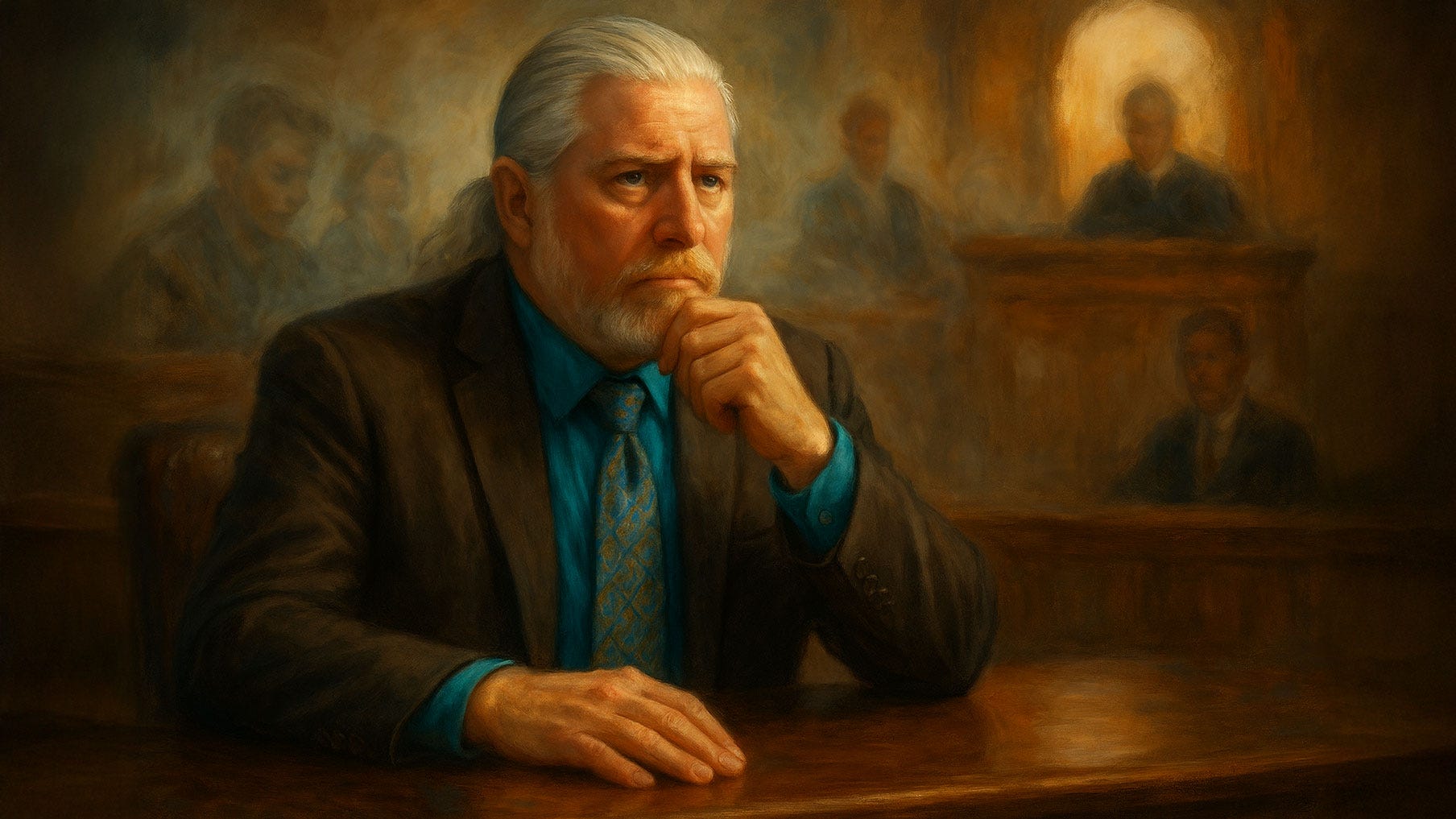
That tension runs through all of criminal defense. It is part of the “stacked deck” every defense lawyer faces:
The system is so skewed, and my clients so screwed, that I frequently feel as though I’m merely the salt in the wound: I make my living off their misery.
— Rick Horowitz, Fighting the Stacked Deck (April 9, 2021)
This is the empathy war I fight daily. Not the cultural one splashed across headlines, but the internal war that requires me to balance my own heart. To keep space open for clients, for witnesses, for adversaries—sometimes all at once—without collapsing into sentimentality or losing the edge of advocacy.
The Definitional Empathy War
Both the cultural and the internal battles point to a deeper struggle: what empathy even means. Words like “justice” and “empathy” don’t just float in the air — they get stretched, hollowed, and twisted until they mean whatever the powerful want them to mean. I’ve written before about how “justice” became exactly that kind of wiggle word:
What makes the quest for “justice”—this essentially meaningless term—so unbearable is that what it does effectuate is more harm. It is, if you will, the opposite of tikkun olam, or “repairing the world.”
— Rick Horowitz, The Unbearable Meaninglessness of Justice (June 8, 2016)
Empathy is undergoing the same fate. It can mean principled practice: actually trying to inhabit the humanity of another, even when inconvenient. Or it can mean performance: a loyalty oath, a show trial of feeling, applause lines for the right audience.
The law is not immune. Consider plea bargaining — a ritual that consumes the vast majority of criminal cases. Even here, empathy is contested. Daniel Greenberg, writing about the role of empathy in plea discussions, describes it this way:
Empathy is a cognitive, emotional, and behavioral process in which the person puts themselves in the other’s shoes. When we empathize, we slow our thought process down and shift from a reactive process to a more deliberative one. In this more deliberative stance, we are likely to see the humanity of the other person, rather than viewing them through a distorted, biased lens.
— Daniel S. Greenberg, Unshackling Plea Bargaining, 82 La. L. Rev. 339 (2021)
Greenberg was writing about prosecutors and defense attorneys, but the definition reaches further. It captures the very fault line I see in the definitional empathy war: empathy as principled practice versus empathy as performance.
This is the definitional empathy war. On one side, empathy as the faithfulness of a principled life — a lived practice of seeing others, even adversaries, as human. On the other, empathy as spectacle staged for an audience, a coerced performance emptied of meaning.
The first kind of empathy repairs the world; the second unravels it.
Repairing What’s Broken
Empathy has been turned into a weapon, justice into a slogan — and yet both remain essential if we are to repair what’s broken.

The cultural empathy war doesn’t stop at the edge of politics. It walks right into the courtroom, shaping juries, shaping prosecutors, shaping the air around every client I defend.
The internal empathy war is what happens when I stand in that same courtroom, trying to hold together the humanity of client, witness, prosecutor, and judge all at once.
And the definitional empathy war is what happens when the words themselves are twisted until they risk losing all meaning.
These are not three separate battles. They are three rings, overlapping, pulling on one another. Lose empathy in the culture, and the courtroom hardens. Lose empathy in the courtroom, and the culture follows suit. And when the definition itself collapses, both law and life suffer.
That is why I return again and again to tikkun olam. To repair the world is not — for me, anyway — abstract. It is a daily fight to preserve empathy where it is most under siege, to insist that justice is more than a wiggle word, to hold fast to humanity even when the system insists on something colder.
Repairing what’s broken begins here. With words. With clients. With courts. With culture. One human being at a time.
But repairing the world can’t be done through staged displays. Empathy as performance corrodes. Empathy as practice heals.
The difference is everything.