

“Radicalization” is the new buzz-word. And not without good reason.
Recently, I’ve been writing about the kind of radicalization that leads unstable people down internet rabbit holes, where violence becomes a way to feel important. In a Facebook comment, I said that these actors latch onto whatever cause validates them. They aren’t masterminds: they’re lonely, angry people looking for a way to matter.
But the more I thought about it — since “radical” and “radicalization” — what it means and how it happens is more and more on my mind, the more I realized that prosecutors in America undergo their own kind of radicalization.
It doesn’t happen in online forums. It happens in offices, courthouses, and campaign cycles. They come in fresh, often idealistic, and quickly absorb a culture that teaches them to win at all costs, to see every accused person as a danger, and to measure their worth by convictions and pleas.
That culture doesn’t create justice. It enhances the requisite advocacy in our adversarial system into a more extreme polarization than the Law intends. And similar to how individuals radicalize themselves through violence to feel important, prosecutors are radicalized by the system to feel validated through virtually always advocating for increased punishment.
Ordinary people — my clients — pay the price.
Sokath, His Eyes Opened
A lawyer-friend once told me she sometimes hated talking to me. Not because of anything personal, but because, in her words, I opened her eyes. I reminded her of “Sokath, His Eyes Opened,” from Star Trek: The Next Generation — the alien metaphor for a moment when someone finally sees what was there all along.

Once you see how the system really works, you can’t unsee it. You can’t look at a judge who acknowledges a mitigation brief but refuses to let themselves be moved by it and still pretend the process is about justice. You can’t watch prosecutors hide discovery and still believe they’re simply “advocates.” You can’t sit in courtrooms where lives are decided in minutes and still tell yourself this is fairness at work.
The beast at Tanagra was real for Captain Picard. The beast of our criminal system is just as real. And too often, defense lawyers are standing at Chenza’s court — the court of silence — where our words barely register. Judges nod, prosecutors smirk, and the machine grinds on.
I have to interject something here. When I write, I’m usually also looking online for more information about what I’m writing or for interesting ways to link ideas.
So I searched for “Chenza court,” and Google’s AI dutifully listed Fresno courthouses before adding: “However, none of these locations have the name ‘Chenza Court.’”
Nope. Not the name. Just the spirit.
Anywayser, that’s the first step toward Sokath regarding prosecutorial radicalization: understanding that the system doesn’t just tilt a little against the accused. It leans so hard that even small acts of resistance — reading a defense brief, disclosing evidence, considering bail fairly — are treated as inconveniences.
Adversarial ≠ Enemy
Back in 2009, I wrote an open letter to prosecutors about discovery abuse. What I said then still fits today.
We’re supposed to have an adversarial system. That means two sides present their best cases, test each other’s evidence, and let judges or juries decide. It doesn’t mean we’re enemies.
Think of tennis: two players on opposite sides of the net, hitting the ball back and forth. Each tries to win by placing the ball where the other can’t return it. But nobody hides the ball, or throws garbage onto the court to trip the other player. If they did, they’d lose the point.

That’s how adversarial advocacy is supposed to work. But in criminal courts, too many prosecutors treat defense lawyers as enemies to be defeated at all costs. They “hide the ball” — withhold discovery, shade the truth, argue as though every accused person is dangerous until proven otherwise. Judges rarely call them on it. And instead of being penalized, they’re rewarded.
This is part of the radicalization I’m talking about. Fresh prosecutors arrive, often idealistic, and quickly learn that “justice” means something very different inside the office than it did in law school. They are praised not for fairness, but for convictions. Not for candor, but for winning. They don’t become enemies by nature. They’re taught to become enemies by culture.
Even the prosecutors who brand themselves as “progressive” are not immune.
After the death of Freddie Gray in Baltimore, State’s Attorney Marilyn Mosby was praised for charging the officers involved. She told protestors she had heard their cries for justice, and for a moment it looked like prosecution could serve as accountability. But what many missed was that, just weeks before Gray’s arrest, Mosby had personally ordered heightened drug enforcement at the very corner where he was taken down. In other words, she both fueled the over-policing that put Gray in that van and later became the face of reform. A 2018 Harvard Law Review Note captured the paradox:
You have three options when presented with a piece of moldy bread. First, you can eat the bread. Perhaps you think that mold is not that harmful to eat. Second, you can cut around the mold spores, trying to eat just the nonmoldy parts. This is an imprecise process, so sometimes you will eat mold that didn’t get removed. And maybe, in your hunger, you’ll be tempted by bits on the edge with just a little mold — you are hungry, after all. Third, you can refuse to eat any of the bread because, to you, a piece of moldy bread is just not salvageable.
“Progressive prosecution” cuts around the mold without discarding the rotten bread.
Worse still, the mold spreads from the top. Elected district attorneys set the tone, and the office culture bends to match. What looks like discretion is really indoctrination: a radicalization handed down from leadership, reinforced by politics, spreading throughout the entire loaf.
When the Law Breaks
Radicalization doesn’t just reshape individuals, or prosecutors. It reshapes the law itself.
I wrote earlier this year about how Trump and his allies have twisted law into a loyalty test — punishing candor, mocking courts, dismantling norms. That isn’t a glitch in the system; it’s what happens when the culture of winning at all costs metastasizes outward from the highest levels of power.
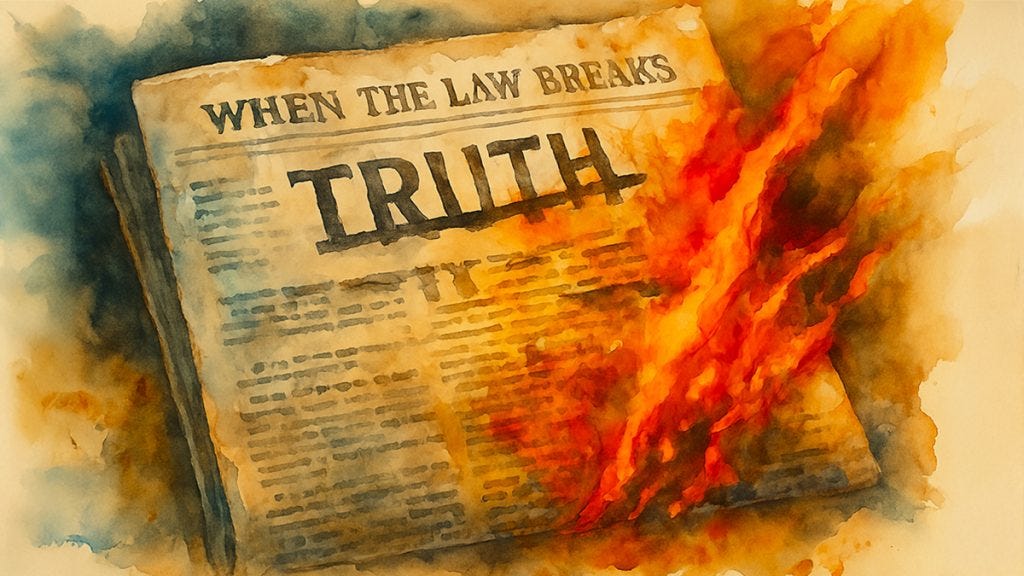
When prosecutors are taught to see every accused person as an enemy, and conviction as the only validation, the shift away from adversarial advocacy becomes part of a larger breakdown. If you believe long enough that hiding discovery or fighting bail is just “part of the job,” it’s not a big leap to believe that the law is whatever serves your side in the moment.
And once the law itself is radicalized — once courts become places where power matters more than principle — the safeguards fall. The Republic falters. The rule of law becomes the rule of men.
As I wrote then: when the law breaks, down comes the democratic Republic — the very basis of our existence as a free democratic Republic.
That’s not just a political worry. In courtrooms where lives are on the line, the break is already here.
That fracture doesn’t stop with prosecutors. It seeps outward, into the judiciary itself. If district attorneys can radicalize their offices, judges risk radicalizing the law. The courts warp into extensions of the same political machinery.
And that, in turn, warps the law.
Politicians in Robes
So it isn’t just prosecutors who are radicalized. Judges are, too.
For decades, the U.S. Supreme Court was viewed as one of the few American institutions above politics. But after Dobbs overturned Roe v. Wade in 2022, that trust collapsed. Surveys show the Court is now seen less as a legal institution than as a political branch — “politicians in robes.”
That shift matters. As Hamilton wrote in Federalist 78, the judiciary has “neither force nor will, but merely judgment.” Courts don’t have an army. They don’t have a police force. They rely on public trust for legitimacy, and when that legitimacy goes, the law loses its hold.
Even among the Court’s own conservative justices, the split is obvious. Justice Alito recently described polarization as a zero-sum fight over “fundamental things that really can’t be compromised.” Justice Roberts, by contrast, tried to reassure his audience that today’s conflict is no worse than Vietnam or the Civil War — rough, yes, but survivable.
The trouble is, both views admit the same point: the Court is no longer seen as neutral. Its decisions are read as victories for one camp or the other. That isn’t judging. That’s politicking.
And when judges at the top normalize politics in robes, it trickles down. Trial judges take cues from them. Prosecutors know they’ll be backed by their enrobed brethren (what would we call female judges? “sistern”? somehow, that just doesn’t sound right). Ordinary people learn that the law is just another battlefield for polarized factions.
That is radicalization at the judicial level: the Law ceases to be a standard and becomes a weapon — and the people it was meant to protect become its targets.
Prosecution and Polarization
If judges are politicians in robes, prosecutors are the front-line politicians in suits.
This is not exactly new. Jed Shugerman published a study on “prosecutor politicians” in 2017.
According to Shugerman, the “prosecutor politician” has emerged as a political force in recent history, having a detrimental impact on our criminal justice system. Shugerman argues that the prosecutor’s office has become a “stepping stone for higher office… with dramatic consequences in American criminal law and mass incarceration.”
— Wendy Sawyer & Alex Clark, New Data: The Rise of the “Prosecutor Politician”, Prison Pol’y Initiative (July 13, 2017)
Steven Arrigg Koh’s work on Prosecution and Polarization also makes the point clearly: prosecutors don’t just reflect polarization — they drive it. The “tough on crime” vs. “progressive prosecutor” divide has turned district attorneys into partisan avatars. Their decisions about charging, bail, and sentencing aren’t just legal judgments. They’re campaign positions, designed to please one side of a polarized electorate and enrage the other.
We’ve seen it nationally in cases like Derek Chauvin or Kyle Rittenhouse, where legal questions became political flashpoints. But here in California, the polarization has been especially stark.
Two of the state’s best-known progressive prosecutors, George Gascón in Los Angeles and Pamela Price in Alameda County, tried to deliver on promises of a different kind of justice. Gascón barred his office from pursuing sweeping sentencing enhancements, from sending juveniles to adult court, and from opposing parole simply to keep people locked up. Price pushed back against racial bias in jury selection and sentencing. Both embodied what the reform movement had called for: prosecutors who sought fairness rather than just punishment.
And then voters turned on them.
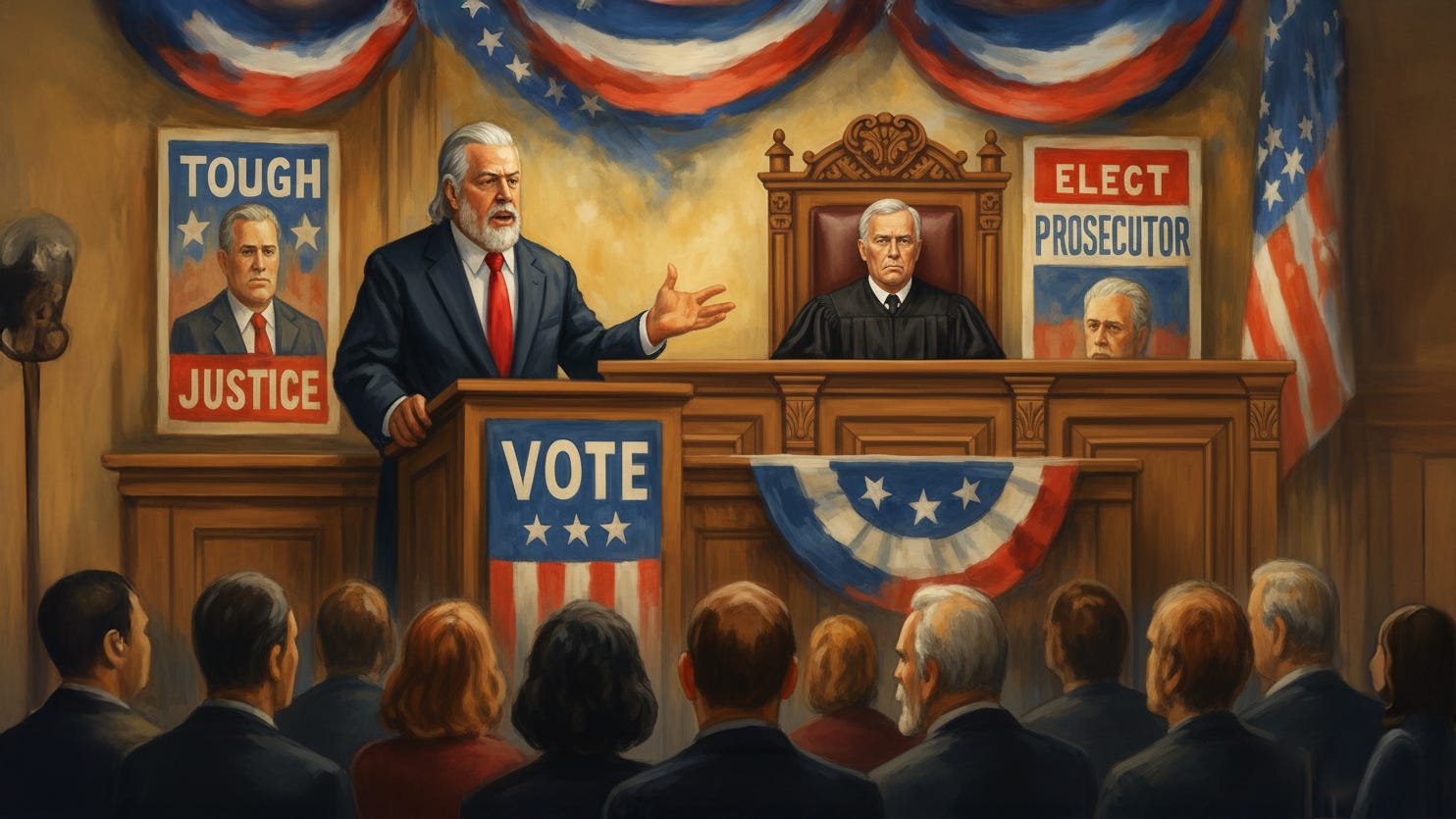
In 2024, Price was recalled and Gascón was trounced in a landslide. Both were replaced by more traditional “law and order” prosecutors. On the same ballot, Californians passed Proposition 36, stiffening penalties for theft and drug crimes.
That swing wasn’t about one or two offices. It punctuated a statewide change in mood away from reform, back toward punishment.
And this is the heart of prosecutorial radicalization: prosecutors are taught that survival depends not on fairness, but on aligning with political winds. Often, it depends on creating those winds themselves. In urban counties, “progressive” DAs may briefly ride a reform wave; in rural counties, radicalized — not simply adversarial — DAs almost always amplify calls for toughness. So they don’t merely ride the winds of public opinion; they whip them up, campaign on them, and then call it justice.
Either way, prosecutors learn quickly that their worth is measured not by justice, but by how effectively they set the public agenda and prove their toughness through punishment.
Justice becomes a partisan game, and ordinary people once again pay the price.
With Eyes Wide Open
In the end, whether it’s the man radicalized alone in his basement or the prosecutor radicalized by the system, the pattern is the same: validation through destruction. One finds it in violence; the other in punishment. Both claim necessity. Both leave wreckage.
And once you’ve walked the path of Sokath, your eyes opened, you can’t unsee it. What looks like justice is too often just another form of radicalization, cloaked in robes or suits, measured in years stolen from ordinary people’s lives.