

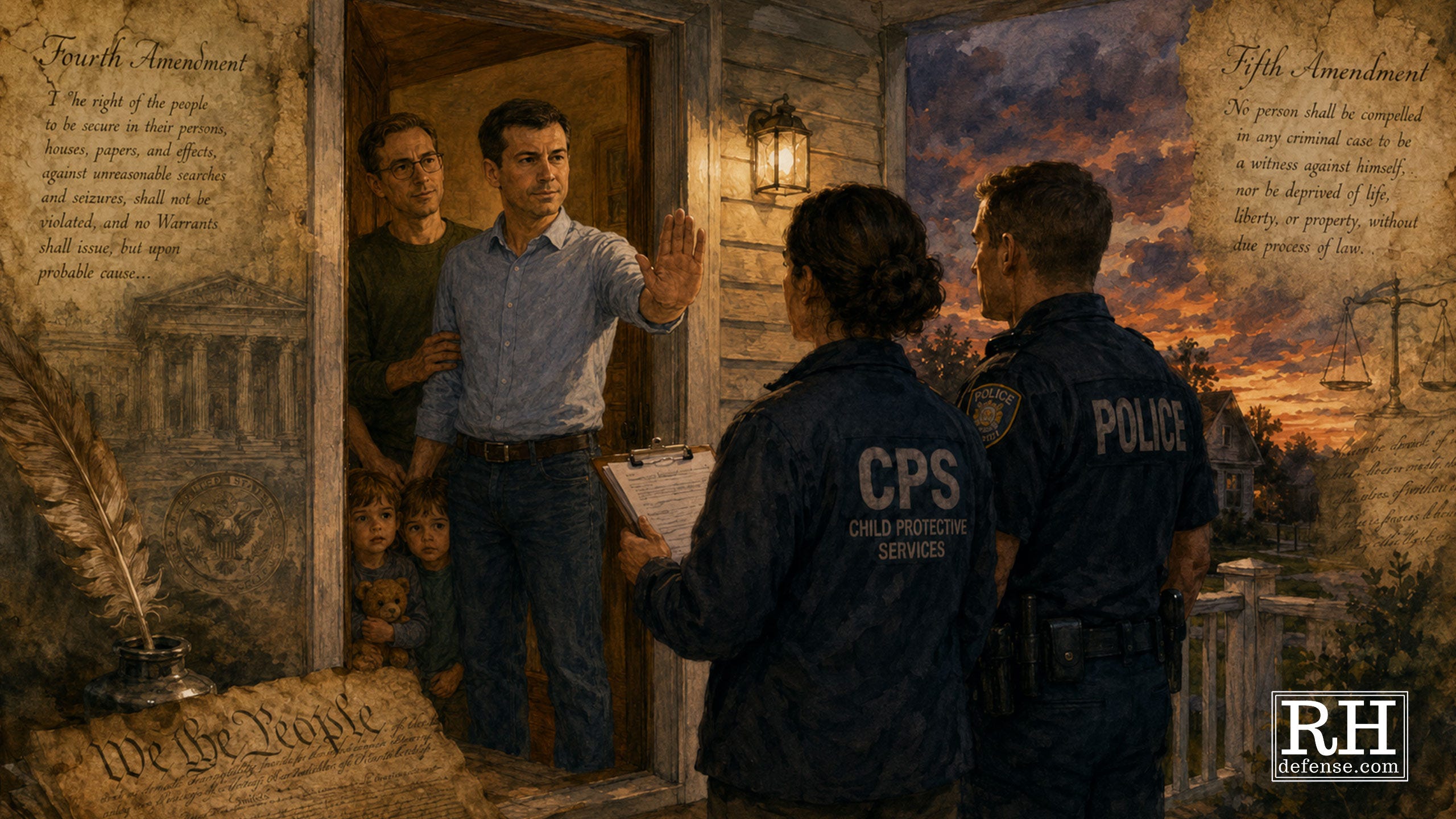
Pete Buttigieg published a piece this week describing what happened when someone called Child Protective Services on him with a fabricated allegation. A police officer and a CPS worker showed up at his door. They told him there had been an allegation involving his four-year-old twins, that a forensic interview of the children had been arranged for the next day, that he could not be present at it, and that until that interview happened, he was not to be alone with his own children. They would not tell him what the allegation was. He was asked whether he had family nearby, or could perhaps stay in a hotel for the night.
He let them in. He consented to the children’s interview. He spent twenty-four hours not knowing what he had been accused of. Only after his children had been questioned, and after he and his husband had been put through what he describes as some of the darkest hours of his life, did the officer reveal the allegation — which turned out to be an anonymous third-hand claim about a conference in a town Buttigieg has never visited. The officer told him on the spot that he believed the report was politically motivated and would not be referred for prosecution.
Buttigieg calls this swatting “but with Child Protective Services instead of a SWAT team” and the analogy is exact. The mechanics are identical: an anonymous false report weaponizes the state’s protective apparatus against someone’s family. They don’t have to be someone famous, like Buttigieg, although if you try to search for articles like the one I just linked, you’ll fight like hell with AI to find one. AI apparently believes — despite having said this isn’t true — that Buttigieg is the only newsworthy person who has ever been “CPS swatted” in the history of the United States. Or maybe even the rest of the world.
Nevertheless, as I pointed out, there’s just one difference between the “swatting” that has become famous and “CPS swatting” and that is the agency that shows up at the door.
I’ve written about this sort of thing in the past. In particular back in the days when bloggers would riff off of and cross-link one another’s posts.
Scott wrote in a way that primed my mind to think about the loss of outrage over an outrageous thing. Police officers, acting on a “very serious” tip from a heroin-addicted delusional woman, had raided an ordinary citizen's home for the crime of having a daughter.
— Rick Horowitz, The Sense of Outrage (May 16, 2017)
I do criminal defense. I don’t practice dependency law. But I read Buttigieg’s piece the way any defense lawyer reads it: why on earth did he consent to anything after police told him they were there to “investigate” his having supposedly committed a crime?
Brief Disclaimer: I practice in California, which is in the Ninth Circuit. What I will say about case and statutory law in this article is based on law from the jurisdiction in which I practice. I am not licensed to practice where Buttigieg lives. The basic constitutional law principles should be the same, more or less, since the Constitution we’re discussing is the (federal) Constitution of the United States. I’m writing about this from the perspective of my jurisdiction because there may be “ordinary” people — I believe Buttigieg’s renown helped him in this situation where it would not help many people — facing similar situations.
What his lawyer should have said
If I had been Pete Buttigieg’s lawyer, I would have told him to tell the officer and the CPS worker to go pound sand. They were not getting near his children without a court order.
The legal basis for that advice is not obscure. It is the law of the United States Constitution as spelled out in the Bill of Rights.
The Ninth Circuit held in Calabretta v. Floyd, 189 F.3d 808 (9th Cir. 1999), that a warrantless entry by a social worker and a police officer into a home — even on a child-abuse allegation — violates the Fourth Amendment. Social workers do not get a categorical exception to the warrant requirement because they call themselves social workers.
Wallis v. Spencer, 202 F.3d 1126 (9th Cir. 2000), extended the same logic to the seizure of children themselves: absent a warrant, a court order, or true exigency — meaning actual imminent danger, not the mere existence of an allegation — removing children from parental custody violates both the Fourth Amendment and the parents’ Fourteenth Amendment due process rights. Rogers v. County of San Joaquin, 487 F.3d 1288 (9th Cir. 2007), reaffirmed it.
Greene v. Camreta, 588 F.3d 1011 (9th Cir. 2009), is the case that comes closest to Buttigieg’s facts on the interview itself — and it’s also the warning. A caseworker and a deputy pulled a nine-year-old out of class and questioned her for two hours with no warrant, no court order, no parental consent, and no exigency. The Ninth Circuit held that that “seizure” — and it clearly counts as a seizure — violated the Fourth Amendment — and then handed the officials qualified immunity anyway, because the law wasn’t “clearly established.” (This is how bad judges continue to support bad police.) They appealed the part they lost, and the Supreme Court vacated that Fourth Amendment ruling as moot without ever reaching the merits, because the child had grown up and moved across the country. So the one appellate opinion that squarely called a warrantless child interview an unconstitutional seizure was stripped of its binding force on a technicality, and in this circuit the question is still formally open.
That gap isn’t a footnote. A fabricated report may be weaponized against a family precisely because there is no clearly established right for the caseworker to violate — which means qualified immunity swallows the suit before it starts. The courts left a hole in the case law where a parent needs a wall. This is why the protection at the kitchen table was never a case citation. It was the word no.
As we will see, Buttigieg may have had his reasons for doing what he did. But almost all of them relate to his fame. You don’t have that.
Which is why I wrote this article: to give you fair warning not to fall into the trap. Because Buttigieg’s situation as a somewhat famous white male with a power structure behind him likely doesn’t apply to you.
So the doctrine is clear: no warrant, no court order, no exigency, no consent — no entry, no interview, no removal. Buttigieg had every one of those refusal points available to him, and he gave each of them away in the first ten minutes on his own deck.
The Fifth Amendment piece is even cleaner. Nothing about a CPS investigation suspends the privilege against self-incrimination. These investigations routinely generate criminal referrals — I know, because I end up getting hired for the criminal defense cases; I may not handle the dependency law side of things, but I am a criminal defense lawyer.
This is why a cop was at Buttigieg’s door alongside the social worker, and not just the social worker alone. The two tracks are not separate. A parent who sits down with CPS and answers questions without counsel is doing exactly what I spend my career telling clients not to do in any other context. The friendly tone and the absence of Miranda warnings do not change the nature of the encounter.
So why did he do it?
On its face, the harder question is why Buttigieg submitted. And why, in my experience, almost everyone in his position does.
Three reasons. None of them are about ignorance of the law. They are, however, often predicated on ignorance of how hard our own government will work to subvert our rights under the law.
We would do well to remember what our Founders knew when they... enshrined our pre-existing rights to be free from such searches as those daily forced upon Submitizens today. Our personal freedoms are not what threatens us the most. What threatens us the most is our failure to recognize just how completely our own government works to undo our constitutional protections.
— Rick Horowitz, Submitizens II (December 24, 2008)
What I’m about to tell you, I have personally observed. I don’t have children myself. But I have friends who do. And I’ve gotten involved after they’ve been contacted by CPS.
This is probably why Buttigieg became a submitizen.
The first is the coercive structure of the visit itself. CPS does not show up and say, “You have the right to refuse.” They show up with a cop, ask “politely”, and let the parent draw the inference that refusal will be treated as consciousness of guilt — and worse, that refusal will accelerate a removal application to a juvenile court judge who is statistically inclined to grant temporary detention on a sworn declaration that the parent asked that their constitutional rights be honored was uncooperative. The price of asserting your constitutional rights is the immediate risk of losing your children for the duration of the investigation. That is an enormous in terrorem effect. The case law does not dissolve it.
The second is timing. Read Buttigieg’s account carefully and you’ll notice that he didn’t have a lawyer at the deck conversation. By the time he had counsel sitting next to him at the kitchen table, the children’s forensic interview had already happened. The decision points any defense lawyer would care about — consenting to entry, consenting to the children’s interview, finding a place to stay overnight — were all made in the driveway, before counsel was even a thought. This is how it works for almost everyone. The visit is unannounced. The questions feel informal. The consent is given before the prospect of a lawyer enters the parent’s mind. The constitutional advice that would matter most is delivered, if at all, after the moment it would have mattered.
The third reason is specific to Buttigieg: tactical calculation. A former Cabinet secretary refusing to let CPS interview his children plays differently in the press than it does in court. He almost certainly weighed the optics of cooperation against the optics of lawyering up and decided that — given the allegation was absurd on its face and he was confident the interview would clear his children — the faster path to a closed file was through the door rather than around it.
You can disagree with that judgment. I think there is a real argument that he traded his children’s psychological well-being for his political reputation, and that the harm he now describes was the predictable cost of that trade. But it was not ignorance. It was a different calculus than the one I would have run for a private client.
Of course, I’m prejudiced: I believe in the Constitution. I believe in the right to remain silent. I believe that the government will overreach. I believe you need to protect yourself.
The structural asymmetry
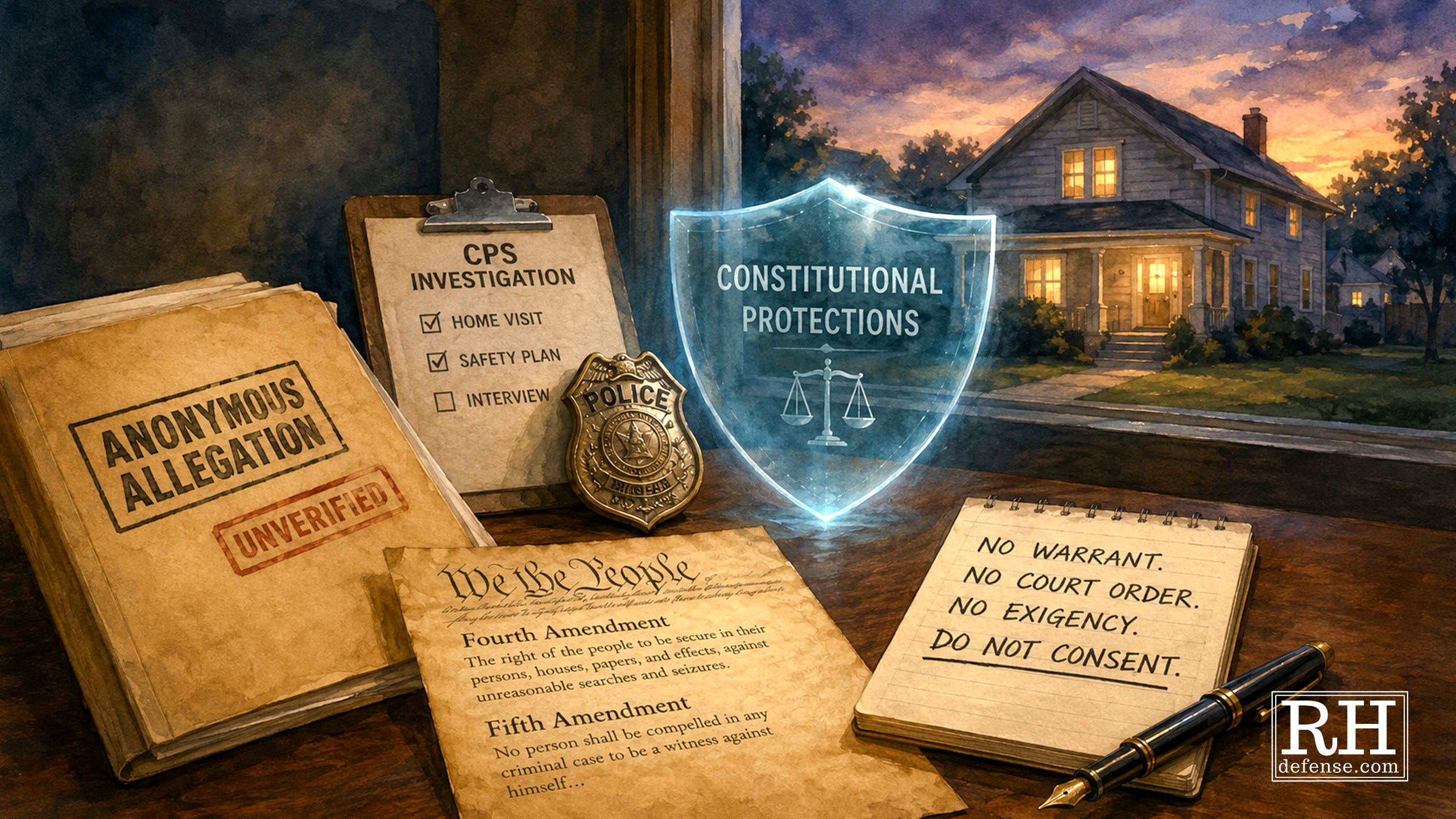
The deeper problem his piece points at, without quite naming, is the structural asymmetry that makes any of this possible in the first place.
California Penal Code § 11172(a) gives mandated reporters absolute immunity from civil and criminal liability for filing a child abuse report.
Non-mandated reporters get only qualified immunity: they lose protection if the report was knowingly false or made with reckless disregard of the truth. Pen. Code § 11172(a); see McMartin v. Children’s Institute Int’l, 212 Cal.App.3d 1393, 1400 (1989); Storch v. Silverman, 186 Cal.App.3d 671, 679–80 (1986).
But the only teeth behind that limit are civil teeth. Section 11172(a) makes a knowingly false reporter “liable for any damages caused” — yet CANRA creates no crime for filing a false report (its criminal penalties punish the failure to report, not the false one), and the limited immunity exists, in the Legislature’s own words, to stop “a vindictive former spouse or neighbor from making a knowingly false report.” Storch v. Silverman, 186 Cal. App. 3d 671, 679-680 (1986); accord McMartin v. Children’s Institute Int’l, 212 Cal.App.3d 1393, 1400 (1989). So a targeted family’s only recourse is to bring a civil suit themselves — proving the reporter’s subjective knowledge of falsity, against a reporter whose identity the statute keeps confidential, often fed in through an anonymous pipeline that makes identification a non-starter to begin with. The system is engineered to maximize the volume of reports and minimize accountability for the false ones.
This is why we (should) require proof beyond a reasonable doubt in criminal cases, rather than just find people guilty based on a reasonable accusation.
— Rick Horowitz, The Blood Draw and the Burden of Proof: How a phlebotomist’s casual question cut to the heart of why the presumption of innocence still matters (November 7, 2025)
That’s exactly the design you would choose if you wanted to build a weapon for political and personal harassment. The Buttigieg incident isn’t an aberration of that system. It’s a feature of it. And it will happen again, with greater frequency, to public figures across the political spectrum and to private citizens nobody except me and a few other criminal defense lawyers will ever write about — because the cost of pulling the trigger is essentially zero and the damage inflicted, even on a fully-refuted allegation, is enormous.
This is the same pattern I see again and again on the criminal side. The substantive constitutional protections are there — even robust — on paper. The procedural structures surrounding them are designed to maximize the rate at which they are given up. A defendant has the right to remain silent, and the entire interrogation playbook is built around getting him not to use it. A homeowner has the right to refuse consent to search, and the request-for-consent script is designed to make refusal feel like an admission of guilt. A parent has the right to refuse a CPS interview of their children, and the visit is engineered to make refusal feel impossible — again, as if refusing alone is proof of guilt, abolishing the presumption of innocence supposedly enshrined in our system and Constitution.
The Constitution survives in the doctrine. But it dies in the driveway.
After 1970, maintaining a straight face was the hardest part of writing opinions about the homes being castles: in 1971, President Richard Nixon began the War on Drugs. The War on Drugs depended on the destruction of the Constitution; it began and continues to this day to destroy our freedoms.
Rick Horowitz, When Law Dies: On the Need to Lift Constitutional Limitations (November 3, 2021)
A practical note
For anyone who reads this and finds themselves on the wrong end of a knock at the door, the move is the same one I would tell any client in any other context where the government wants something from them.
Identify yourself. Identify your counsel if you have one. Decline consent.
Decline consent to enter the home. Decline consent to interview the parent. Where the parent has the authority, decline consent to interview the children. Demand any court order in writing before agreeing to anything. Force CPS to either walk away or go get a warrant.
If they have real exigency, they will act on it. In fact, they might even when they don’t. There’s a potential payday in that move. But if they do not, the file usually closes faster than it would have with cooperation — because the caseworker’s job is to clear cases, and a lawyered-up family with no warrant signals to them to go find an easier target to victimize. The Ninth Circuit doctrine gives you the cover. The harder part is getting the call to a lawyer before the driveway conversation happens.
(I’m not trying to get you to call me. Seriously. I don’t usually handle this type of case. But this is why my phone is on 24/7. Because where you need advice is when police are knocking on the door — not after they already coerced you into giving up your rights. And I have received phone calls from people sitting in the back of police cars or standing outside their homes after being forced out by the police.)
If Pete Buttigieg had called a defense lawyer the moment the officer pulled into his driveway, his children would never have been interviewed, his twenty-four darkest hours would have been twenty minutes of polite refusal at the door, and the anonymous caller would have learned that the weapon they tried to use does not work on people who know how to refuse.
The doctrine was there for him. He just didn’t use it.
I’m not blaming him. I’m just stating the fact.
This gave me a lot to think about. I hadn’t really considered how much can happen before someone even has time to get legal advice, and that’s probably the most unsettling part of the whole story. Thanks for writing about, Rick.
I was a member of HSLDA in Texas for all the years we homeschooled and we were continually told never to let CPS in without a court order.