

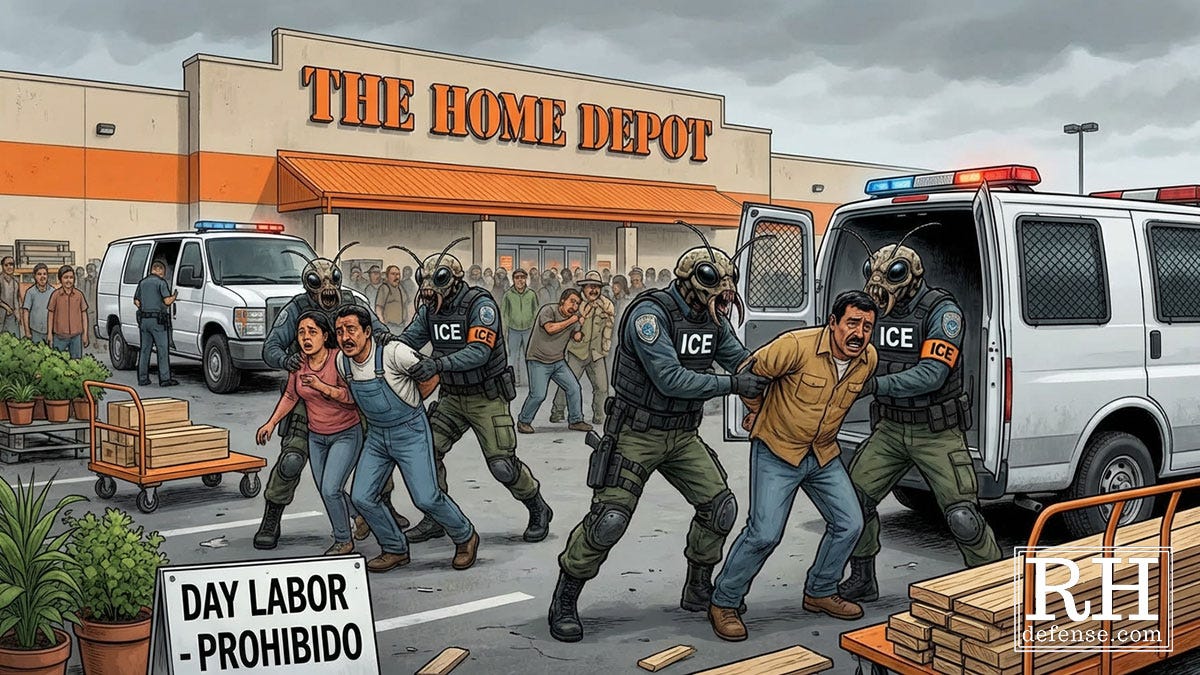
If you want to understand the shape of American authoritarianism in 2025, don’t look to the Capitol or the courts. Look to a Home Depot parking lot in Monrovia, where a man named Carlos Roberto Montoya Valdez ran into freeway traffic and died because armed federal agents descended on a group of day laborers looking for work. His community responded with a simple protest: buy a cheap ice scraper, walk back in, and return it. “Scrape ICE out of their stores,” organizers said.
What they were really saying was simpler: stop hunting us.
The Los Angeles Times captured it clearly:
Home Depot has become ground zero for this cruel, vicious immigration enforcement that’s taking place in our country.
—Pablo Alvarado, NDLON’s co-executive director, quoted in Itzel Luna, Day laborer organizers protest Home Depot, pressuring it to “scrape ICE out of their stores.” (November 22, 2025)
ICE says it’s just enforcing the law. But parasites would say that. They imitate authority while feeding on the host, slipping into every organ of civic life — workplaces, hospitals, schools, courthouses — until the system can’t tell the difference between self-defense and self-destruction.
I’d compare it to an autoimmune disease where the body attacks itself, except it’s not that. ICE is no part of what the United States stands for.
This is what the United States stands for:
Not like the brazen giant of Greek fame,
With conquering limbs astride from land to land;
Here at our sea-washed, sunset gates shall stand
A mighty woman with a torch, whose flame
Is the imprisoned lightning, and her name
Mother of Exiles. From her beacon-hand
Glows world-wide welcome; her mild eyes command
The air-bridged harbor that twin cities frame.

“Keep, ancient lands, your storied pomp!” cries she
With silent lips. “Give me your tired, your poor,
Your huddled masses yearning to breathe free,
The wretched refuse of your teeming shore.
Send these, the homeless, tempest-tost to me,
I lift my lamp beside the golden door!”

— Emma Lazarus, "The New Colossus" in Lehman, David, ed. (2006). The Oxford Book of American Poetry. Oxford University Press. p. 184
ICE is a parasitic infection.
And the uncomfortable truth is this: these tactics aren’t confined to parking lots. They’ve been pushed into places that are supposed to be insulated from government intrusion — hospitals, schools, libraries, newsrooms, even the courtrooms where due process is supposed to matter. And they now operate with the explicit blessing of a racist Supreme Court that has decided race, language, and job type can count as “relevant factors” for suspicion.
That isn’t normal law enforcement.
It’s a government deciding which bodies get treated as presumptively lawful and which get treated as quarry.
A democratic republic can’t survive that distinction for long.
Voting Under Suspicion
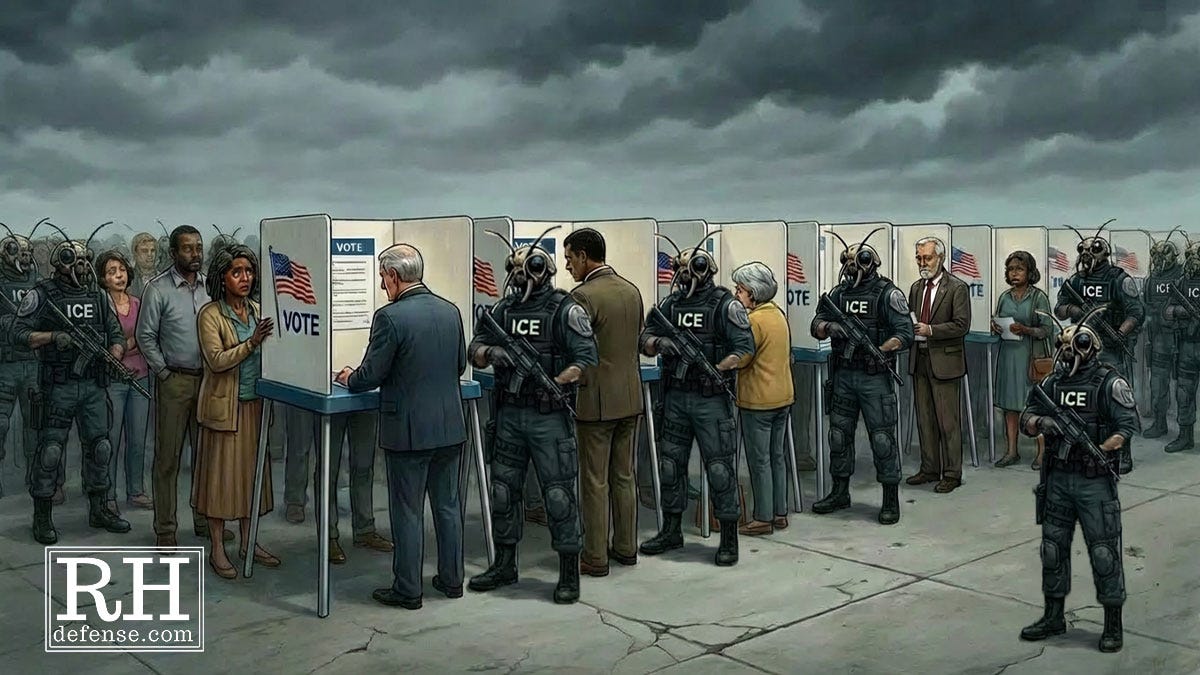
Voting is supposed to be the one place where citizenship settles the question of belonging. Yet in communities targeted by immigration enforcement, even U.S. citizens are rethinking whether it’s safe to show up.
But it’s not because they’re ineligible — as I said, I’m talking about citizens.
It’s because ICE’s racialized policing has taught them that looking a certain way, speaking a certain language, or living in a certain neighborhood can draw unwanted attention from cowardly-but-dangerous masked, armed, federal agents.
As Trump’s deportation campaign escalated, the masks quickly turned officers and agents into a faceless, impersonal, undifferentiated goon squad. It’s a look that has long been associated with authoritarian regimes and secret police, and the basic visual signifiers of American law enforcement—criminals wear masks; cops show their faces—were suddenly inverted.
— Nick Miroff, Why They Mask (November 10, 2025)
Would you show up to vote if one possible consequence — even for U.S. citizens — is kidnapping, disappearance, and deportation by a faceless, impersonal, undifferentiated goon squad?
That’s what it means when the justices tell officers they can use how you look, the language you speak, or the job you do as a shortcut for suspicion. A ruling like that doesn’t stay in the narrow lane of immigration enforcement. It seeps into every public interaction. Latino citizens — many from mixed-status families — know exactly how quickly an encounter can escalate when an officer thinks they “fit the profile.”
The intimidation factor is obvious. A polling place is a government-controlled building staffed by government workers. For people who have already watched ICE agents pull residents off sidewalks and parking lots in their own neighborhoods, standing in line to vote feels like stepping back into the crosshairs. These are citizens with full voting rights who now hesitate because the government has made their physical presence politically dangerous.
Authoritarian systems don’t need to block the ballot box to influence an election. They only need to make certain Americans feel that showing up to vote is unsafe. And racialized policing is an extremely efficient way to do that.
Knowledge Under Siege
Public libraries are supposed to be the safest civic spaces we have — no income requirement, no citizenship test, no bureaucrat deciding who gets to sit at a table and learn. They are the last public square left. And that’s exactly why authoritarians target them.
We’ve already watched Republican legislatures ban books that deal honestly with race, immigration, sexuality, American history, or anything else that might make a person think too deeply about the country they live in. They aren’t even subtle about it.
I once sent a client Kindred, Octavia Butler’s novel about a Black woman who is pulled back through time to save her white ancestor — a book that forces readers to confront the truth of slavery. It was rejected by the jail because it contains scenes of a slave being whipped. In other words, it was banned because it told the truth. (Amazon affiliate link — I may earn a small commission.)
When a government bans literature for depicting reality, it’s not protecting anyone. It’s curating ignorance.
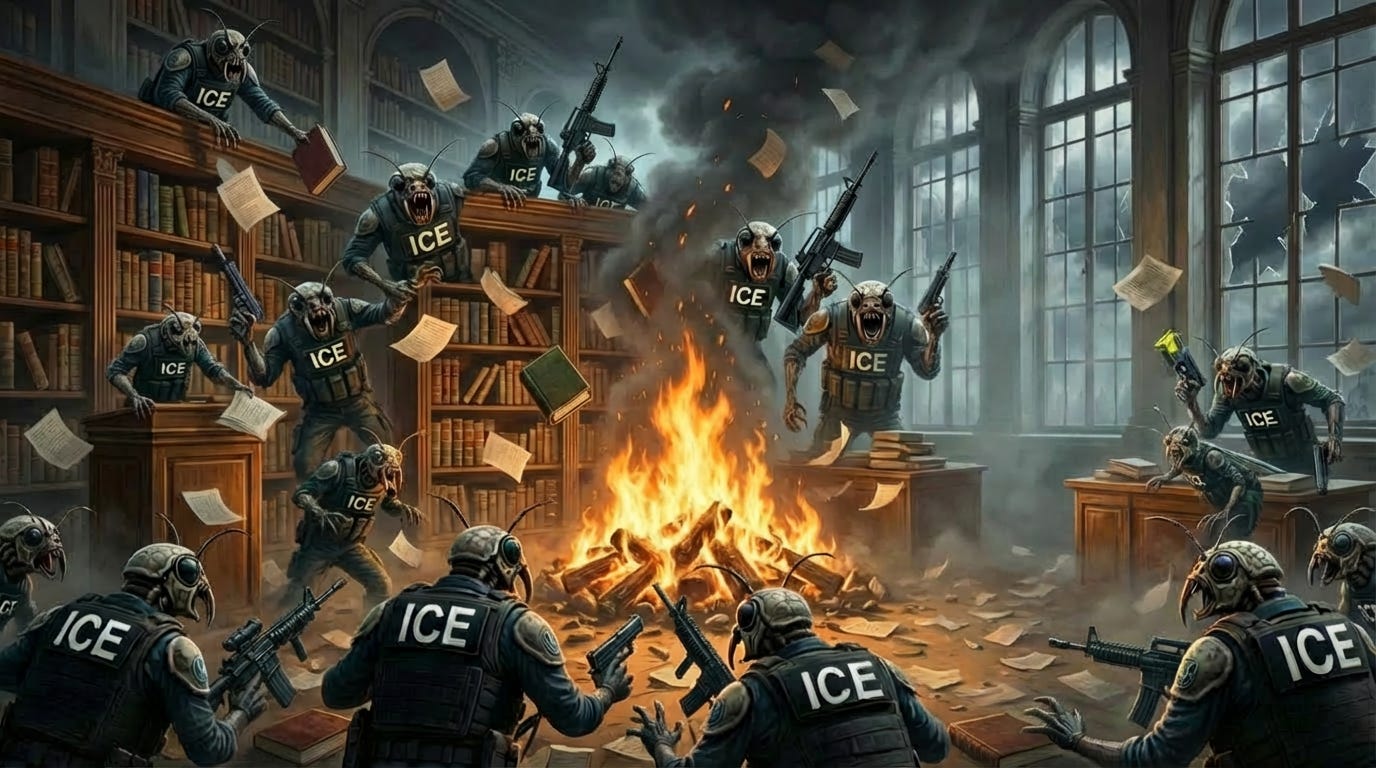
And now, in that same climate, ICE has begun operating near libraries — places where immigrant families go for legal clinics, internet access, ESL classes, and the quiet reassurance that not every government building exists to harm them.
The result is predictable: people stop going. They stop learning. They stop accessing the tools that help them assert their rights.
The parasite analogy becomes literal here: an agency feeding on public trust by destroying the host’s ability to learn, assemble, or access information. A society that intimidates people out of seeking knowledge is a society preparing them for obedience.
A democracy doesn’t burn books or frighten people away from libraries.
A government that needs its people uninformed is not building a future. It’s managing a population.
ICE’s Medical Malpractice
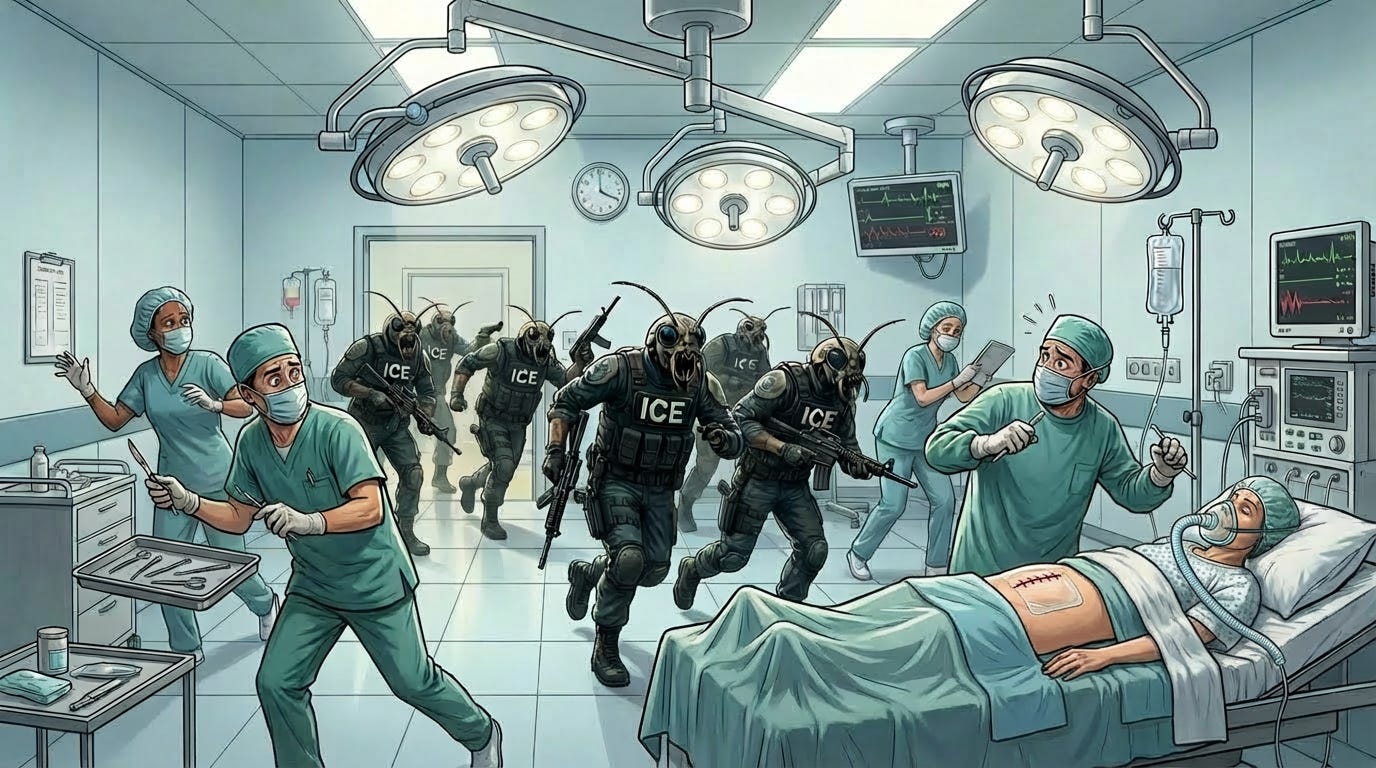
Hospitals are supposed to be the final red line — the place where enforcement stops because life and death don’t belong to the government’s tactical imagination. But that line is gone. We’ve already seen ICE agents staking out emergency rooms, tracking patients to clinics, and arresting people recovering from major surgeries.
In one case, a 10-year-old girl in an ambulance on her way to emergency surgery was taken into custody by ICE.
And then there’s the Chicago case that tells you exactly how far this administration is willing to go. Fifteen days after giving birth by C-section, with her newborn still in the NICU, Nayra Guzmán was surrounded by ICE agents in a parking lot and taken into custody. While her daughter struggled to breathe in intensive care, Guzmán — still healing from a seven-layer surgical incision, still producing breast milk, still managing Type 1 diabetes — was held for 34 hours in a freezing, overcrowded detention facility without adequate food, water, medical care, or even a breast pump.
She remembers the moment the truth set in:
“In that moment, I just felt fear. I thought, ‘The government is going to take custody of my daughter. I’m going to be in detention and I won’t be able to do anything for my daughter.’”
— Mel Leonor Barclay and Shefali Luthra, Her baby was in the NICU. She was in ICE detention. (December 2, 2025)
The details are almost too much to absorb. Her C-section scar was throbbing during the ride to Broadview as an ICE agent drove fast over potholes, ignoring her brother’s pleas to slow down because she was still recovering from major surgery.
“How is it possible that I’m going all the way to Kentucky, in this state, six hours away? My scar is burning. I’m supposed to be resting,” she thought.
— Mel Leonor Barclay and Shefali Luthra, Her baby was in the NICU. She was in ICE detention. (December 2, 2025)
Once inside the facility, agents questioned her about her insulin pump and medication. One of them told her to remove her belly binder — the only thing stabilizing her abdomen after seven layers of tissue had been cut open. When she explained she needed it to manage the pain, she overheard another agent say, “Leave it. They’ll take it at the detention center.”
Her pain, her surgical recovery, her child’s condition — none of it mattered. What mattered was numbers. Quotas. Optics. The appearance of toughness. When a government will cage a postpartum mother and leave her newborn without her, it isn’t enforcing immigration law. It’s enforcing indifference.
This is the same pattern we’ve seen everywhere else: turn places of care into places of fear. Make illness dangerous. Make seeking treatment a risk. Push people back into the shadows by weaponizing their own vulnerability against them.
A society that allows the state to invade its hospitals has already rewritten the boundary between policing and humanity.
And once that boundary moves, it rarely moves back.
School as Surveillance
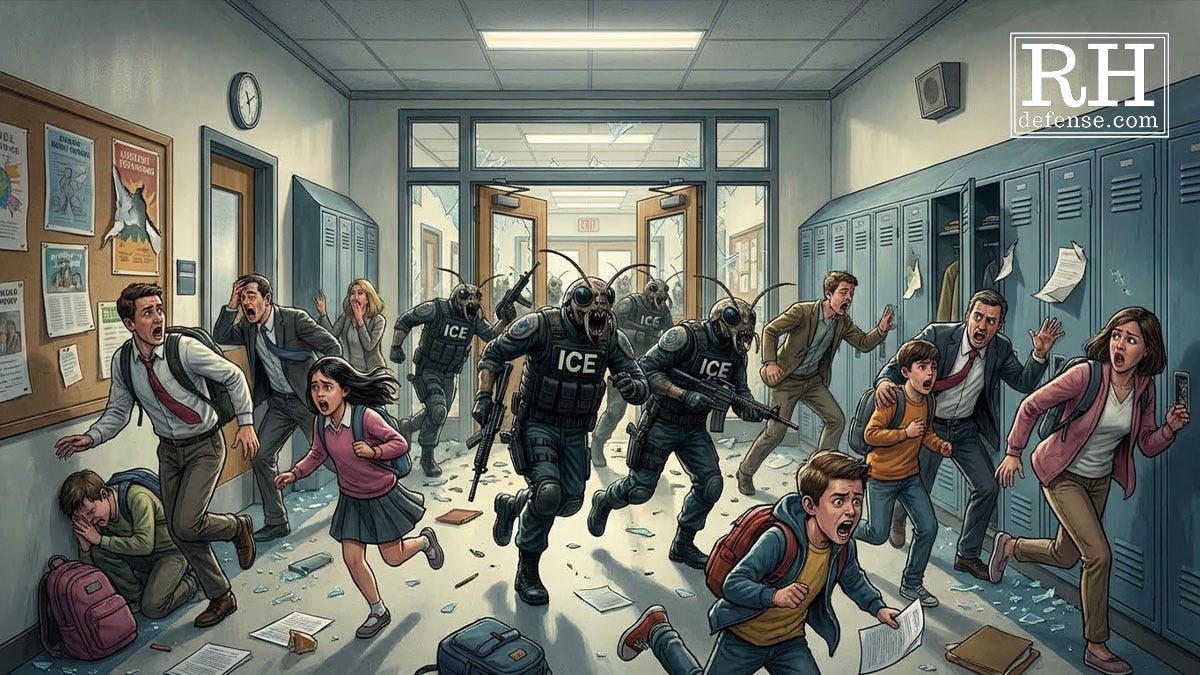
Schools were supposed to be off-limits. Even during the last Trump term, immigration enforcement avoided classrooms because everyone understood what it meant to terrify children on the way to learning. But that norm — like every other guardrail — isn’t a guardrail anymore. It’s a memory.
In the neighborhoods swept by racialized raids, kids don’t walk to school alone. Parents plan escape routes. Attendance drops. Teachers start asking themselves whether calling a parent will put that parent at risk. A school isn’t just a building. It’s infrastructure for democratic life — a place where learning outranks fear. When armed federal agents patrol the blocks around an elementary school, fear wins.
It’s not just “immigrant children” who are terrorized and terrified, either. Children witnessing traumatic events don’t differentiate between “that’s those other kids and their undocumented families”. All they know is they’ve just witnessed violence. Depending on their age, they may not be able to think “I’m safe because I’m a U.S. citizen” — especially when, as noted above, U.S. citizens are not safe.
And the message is the same everywhere ICE shows up: if the government can frighten you as a child, it won’t have to work as hard to control you as an adult. A society that lets its schools become staging grounds for intimidation isn’t protecting children. It’s grooming the next generation for silence.
Newsrooms Under Threat
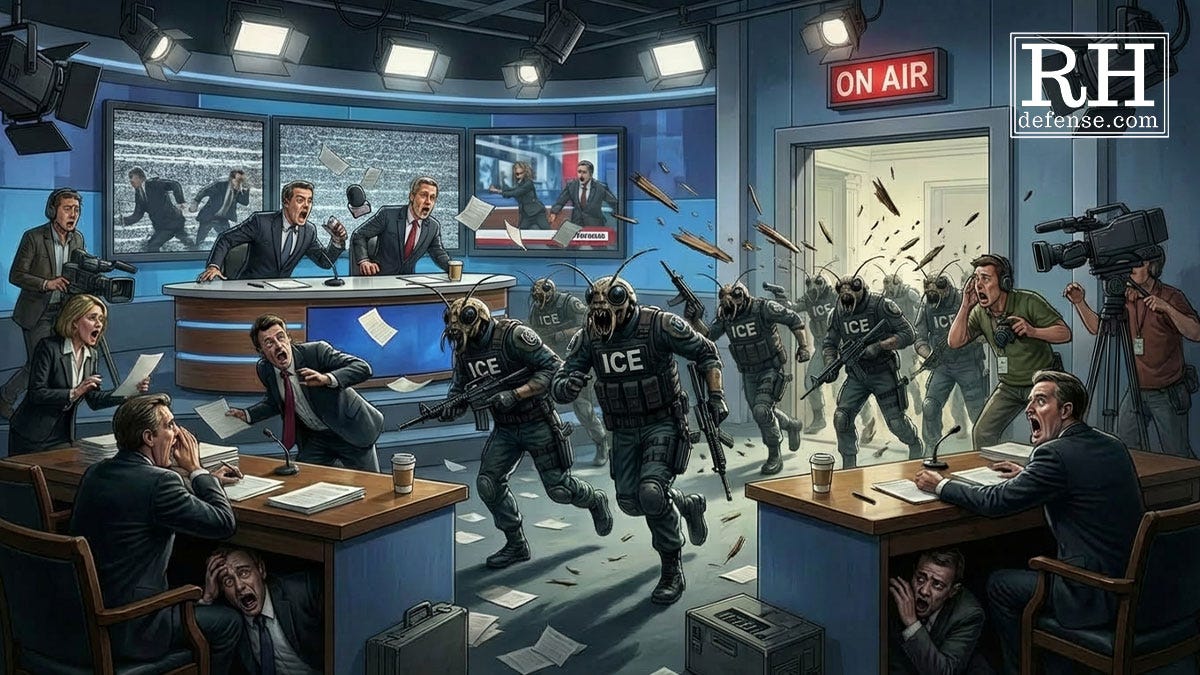
You can tell a lot about a government by how it treats people whose job is to tell the public what that government is doing. This one built an official “Media Offenders” site on a .gov domain — a running blacklist of outlets and individual reporters, sorted into categories like bias, lie, false claim, malpractice, left-wing lunacy. They bragged that they had “dropped a flamethrower on the Fake News Media.” That isn’t media criticism. It’s a target list.
At the same time, Trump has made a sport out of publicly degrading individual reporters, especially women. New York Times reporter Katie Rogers is “a third rate reporter who is ugly, both inside and out.” ABC’s Mary Bruce is “a terrible person” from “a crappy company.” Bloomberg’s Catherine Lucey gets, “Quiet, piggy,” for asking about Jeffrey Epstein. The press secretary’s defense is that this is just “frank and open and honest” — the supposed charm of a president who “never holds back.”
That’s the point. The message to his base is that reporters aren’t watchdogs; they’re pigs, liars, ugly, enemies of the people. Once you’ve taught enough people to see journalists that way, you don’t have to say “don’t believe them.” The insult has already done the work.
And behind the rhetoric, federal agents are putting hands on reporters. The Reporters Committee for Freedom of the Press has documented ICE and DHS officers arresting a journalist covering a protest outside an ICE facility near Chicago, firing a pepper ball at a reporter’s car, and throwing a reporter out of an elevator in New York’s immigration court — hard enough that another journalist standing in the hallway had to be taken away on a stretcher. Many of these agents are masked and in plainclothes, making it nearly impossible to know who is giving orders or who can be held accountable afterward.
Press freedom groups are now asking DHS to adopt an “arrest avoidance” policy for journalists and to issue basic guidance on the First Amendment right to document federal law enforcement in public. The fact that they have to ask tells you how far the slide has gone. A government confident in its own legitimacy doesn’t need to blacklist reporters, humiliate them in public, or rough them up outside detention centers.
In a functioning democracy, the press is part of the immune system — the thing that spots infection early and calls it out. When the state starts treating journalists as enemies to be tagged, shamed, and occasionally assaulted, it isn’t just attacking one profession. It’s disabling the public’s ability to know what’s being done in its name.
Courthouses as Traps
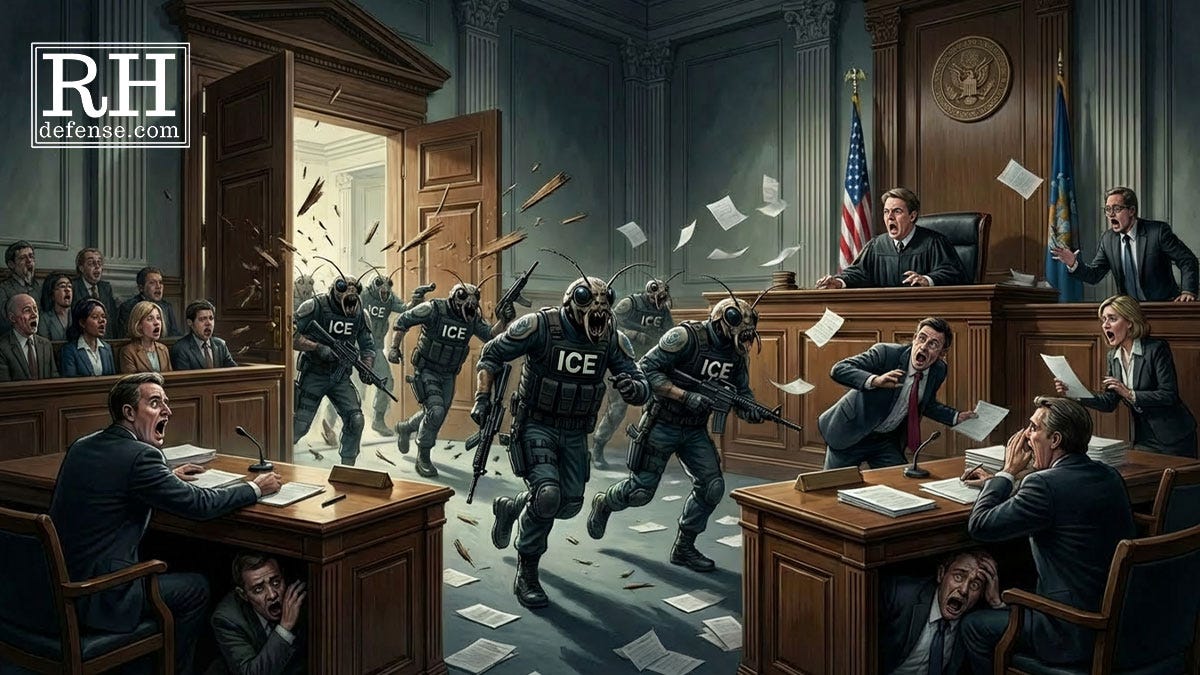
Courthouses are supposed to be the one place where the government steps back and lets the law work.
ICE is now arresting people in and around California courthouses despite state law banning civil immigration arrests of anyone “attending a court proceeding or having legal business in the courthouse.” Fresno, Stanislaus, Glenn, Los Angeles — even inside the Oroville courthouse. Even the court’s executive officer admitted they had never seen ICE operate inside the building before.
The message is simple: compliance is no protection. ICE has seized people moments after a judge decided they should remain free — a direct attack on judicial authority.
And the damage is real. Immigrants coming to file asylum claims, pursue legal status, or simply appear as ordered have been detained and deported without the hearings the law promises them. Some were separated from U.S.-citizen children. One man seeking LGBTQ protection was deported to Ecuador within weeks and is now in hiding.
This isn’t enforcement. It’s deterrence through fear.
And now, thanks to the Court’s new rule, DHS agents can treat appearance, accent, and occupation as built-in excuses to question and detain people — racial profiling written into doctrine and carried out at the courthouse door.
Imagine entering court knowing you might be arrested even if you followed the law — and knowing your accent or job could be enough to mark you.
That isn’t rule of law. It’s a dragnet. And when witnesses, victims, and defendants stay away out of fear, justice collapses.
A courthouse that functions as a trap isn’t delivering justice. It’s staging it.
Navajo Nation Under Siege
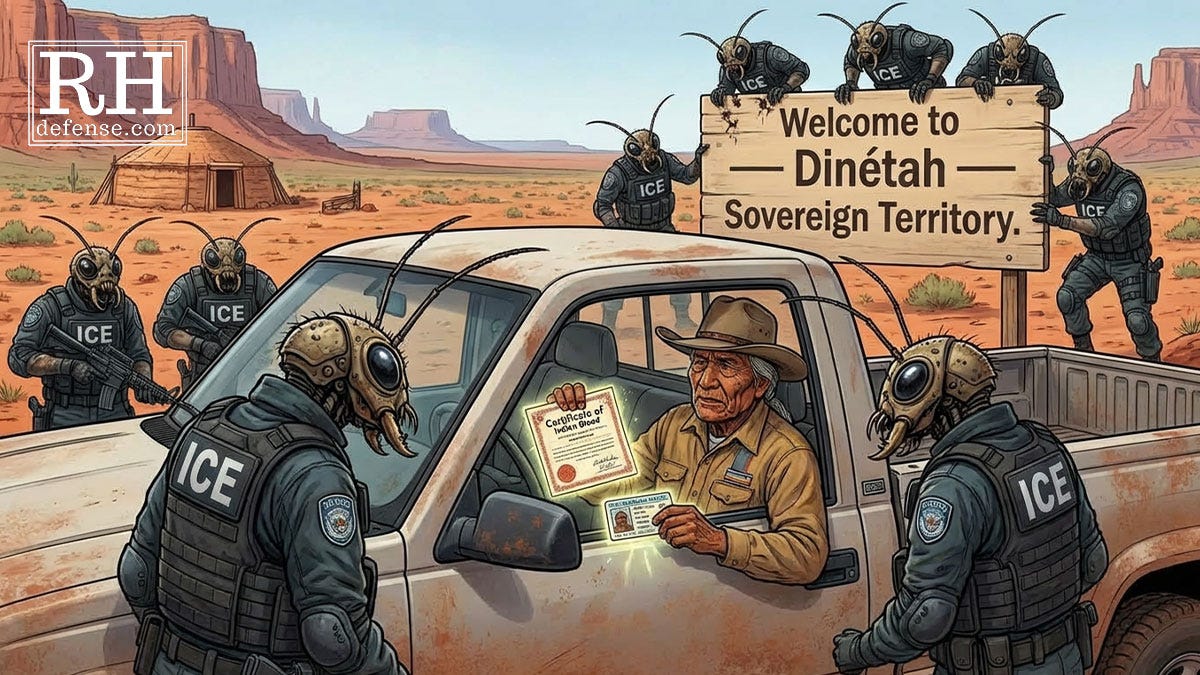
The most telling part of this new deportation regime is who has to prove they belong in the country at all. Navajo citizens — people whose ancestors lived on this land long before there was a United States — are being stopped, questioned, and sometimes detained by ICE in places like Phoenix and other cities across the Southwest because agents can’t be bothered to tell the difference between “brown person” and “undocumented immigrant.”
Navajo Nation President Buu Nygren has already gone on KTNN to talk about “negative and sometimes traumatizing encounters” Diné citizens are having with federal agents. The Office of Vital Records is getting flooded with calls from off-reservation tribal members who’ve been stopped and grilled about their identity. Arizona State Sen. Theresa Hatathlie has described cases where Navajo citizens were detained for hours despite having state IDs and Certificates of Indian Blood. Speaker Crystalyne Curley says the council is hearing the same thing directly from families: ICE knocking on apartment doors, showing up at workplaces, lining people up and demanding papers.
The advice coming out of Window Rock is brutally simple: carry your driver’s license, carry your CIB, be ready to prove who you are on demand. The Navajo Nation has launched “Operation Rainbow Bridge” and posted hotlines and “know your rights” graphics so that Diné relatives in the cities have somewhere to turn when they get swept up in raids aimed at somebody else.
And it isn’t just Navajo. Tribes across Turtle Island are waiving fees for tribal IDs, pushing for “enhanced” machine-readable cards, reimbursing members for passports, and issuing their own guidance on what to do when ICE appears. They’re doing this because they know the pattern: once the law blesses policing by skin tone, speech, and zip code, Indigenous people are the ones who end up constantly having to prove they belong.
This is what profiling looks like when you live on land your nation never ceded. The descendants of the first peoples on this continent are being told to keep their papers ready so they don’t get disappeared by a federal agency that can’t — or won’t — tell citizens from targets.
The Shape of What Comes Next
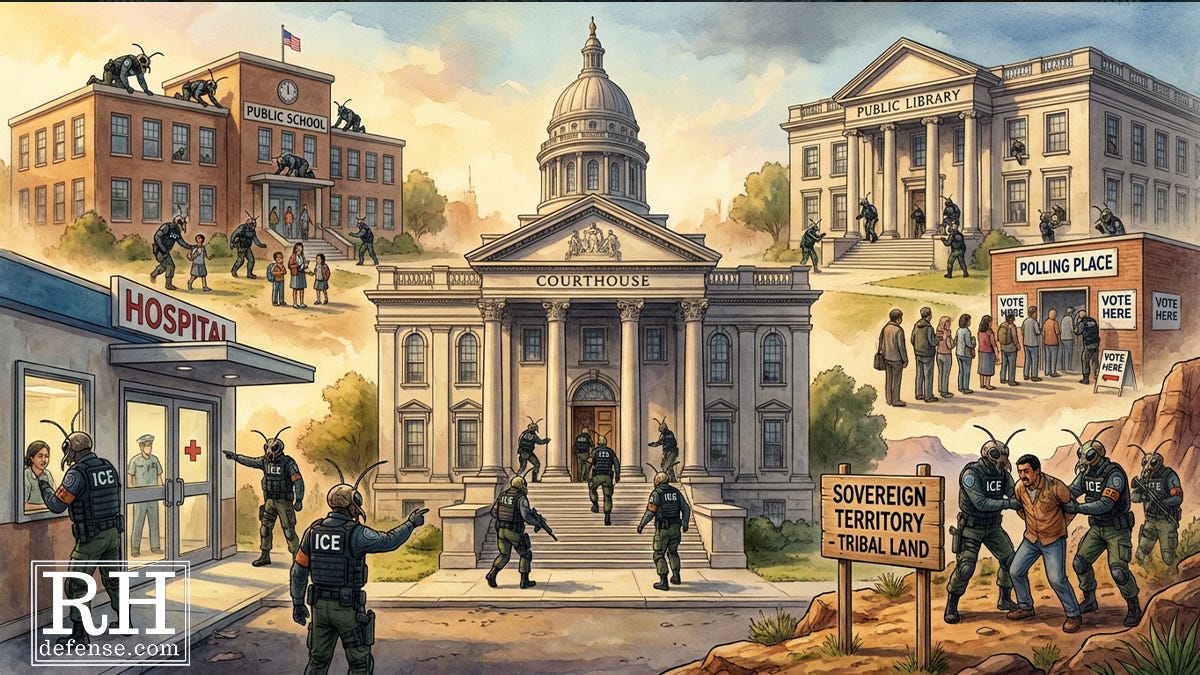
Taken one at a time, each of these stories can be spun as an “anomaly.” A day laborer dead on the freeway after a raid in a Home Depot parking lot. A mother ripped away from her newborn at a hospital. Kids walking past armed agents on the way to school. Reporters shoved, gassed, or blacklisted for doing their jobs. Immigrants snatched from courthouses that were supposed to protect their right to be heard. Navajo citizens carrying their CIBs like shields in case a federal agent decides they don’t look American enough.
Put together, they’re not anomalies. They’re policy.
This is what it looks like when a government decides that certain bodies are inherently suspicious — and then builds an enforcement machine designed to keep those bodies afraid.
And our racist Supreme Court’s ruling is the green light: it tells the machine that looks, language, and labor are enough to mark people as targets.
ICE spreads into every space where people are most vulnerable: when they’re sick, when they’re learning, when they’re voting, when they’re seeking justice, when they’re just trying to get to work or back home to their kids.
The goal isn’t just deportation. It’s demoralization. Make people too scared to vote, too scared to go to the library, too scared to report crimes, too scared to show up for court, too scared to insist on their rights as citizens or human beings, too scared to work, too scared to exist! If you can get enough of the population to live like quarry instead of neighbors, you don’t have to turn the country into a dictatorship on paper. You’ve already hollowed out the parts of democracy that matter.
Interestingly, it’s also demoralizing for many ICE agents.
The rest of us don’t get to stand off to the side and pretend this is someone else’s problem. A state that can treat immigrants, Indigenous people, and journalists this way today can treat anyone this way tomorrow. Once you normalize the idea that some people are fair game — that their families, their bodies, their votes, their stories are expendable — you’ve accepted a country where law is just a costume draped over power.
If you’re reading this, you have some power left. Maybe it’s your vote. Maybe it’s your law license. Maybe it’s a platform, a pulpit, a Nativity scene, a classroom, a union meeting, a tribal council seat, or a kitchen table full of people who still listen to you. Use it. Tell the truth about what’s happening. Push back where you can. Help people learn and assert their rights. Support the organizations and nations doing the front-line work.
Parasites die when the host stops feeding them.
Authoritarian projects die the same way — when enough people refuse to keep supplying their fear.
Thanks for expounding on this subject so thoroughly. One thing that is heavy in my mind is the overt disdain expressed against us immigrants. This administration is the green light for those who had kept their repugnance of us quiet until now. It’s not a safe time to be an immigrant even when one is here legally.