

In my last piece — Trust Me, I’m a Chatbot: How AI Builds Fake Law — I had a section called “Naming the Problem: Confabulation, Bullshit, or Both?” as a pivot point. Today it’s the whole point.

I have some time now, in various blog posts, emails, and conversations with anyone who will listen, been saying that the term “hallucination” as an explanation of mistakes AI makes is itself a mistake.
AI hallucinations aren’t glitches to be patched or programmed out. Hallucinations are the output of a system that’s doing exactly what it was built to do all the time.
And that’s why I believe “hallucination” is actually the wrong term. The correct term is “confabulation”.
“Bullshit” as a Rival Candidate
For reasons similar to mine —though clearly not identical — Joe Slater, along with Michael Townsen Hicks and James Humphries, prefer the term “Bullshit”. As they put it in their paper ChatGPT is bullshit, they understand this in the sense explored by Harry G. Frankfurt’s book On Bullshit (Princeton, 2005).
I haven’t read that book in forever. I went and dug it out of my home library so I can re-read it. (It’s a very small and short book — it started out as an essay in Raritan in 1986 before being published as a tiny hardback in 2005 — 3.5 by 5.5 inches, 67 pages, not small print, for those interested.) In any event, as Hicks, et al, write,
[T]he models are in an important way indifferent to the truth of their outputs.
— Michael Townsen Hicks, James Humphries, and Joe Slater, ChatGPT is bullshit (8 June 2024)
In an email exchange, Joe Slater told me that while he prefers the term “confabulation” to “hallucination”, he still prefers “bullshit” for this and various other reasons.
In his email made two other “small points” which in part inspired me to write this post. I was already writing Trust Me, I’m a Chatbot, so some of my thoughts went into that. Even though this will deviate from my norm of trying to write things with a criminal defense lawyer slant or twist or connection, I want to address some of the points Joe Slater made to me, here, in Naming AI’s “Problem”: Confabulation, Bullshit, or Both?
Joe Slater’s Main Point
I should probably note that Joe Slater is not the first-named author in the triad of authors for ChatGPT is bullshit, as should be clear from the attribution above.
What happened is that, for some reason, I found his email quickly and I sent him a note about my thoughts on the subject. He was kind enough to respond. And in his response he made several points that I thought a great jumping off to another article explaining my arguments in favor of “confabulation” over “hallucination” — and even over “bullshit”.
The first of Joe Slater’s points — and I imagine the key — was already mentioned above: the AI models’ indifference to the truth of their outputs.
As Harry G. Frankfurt put it when differentiating between liars and bullshitters:
Someone who lies and someone who tells the truth are playing on opposite sides, so to speak, in the same game. Each responds to the facts as he understands them, although the response of the one is guided by the authority of the truth, while the response of the other defies that authority and refuses to meet its demands. The bullshitter ignores these demands altogether. He does not reject the authority of the truth, as the liar does, and oppose himself to it. He pays no attention to it at all. By virtue of this, bullshit is a greater enemy of the truth than lies are.
— Harry G. Frankfurt, On Bullshit 60–61 (Princeton Univ. Press 2005)
In that sense, it seems “bullshit” as the candidate term to replace “hallucination” wins. Hands down. The horse race — or run with the bulls — has ended.
Joe Slater likes the word for its bite. I’m not going to quote the entire email exchange. But the gist of it is similar to what I’ve said in the past about the ubiquity of AI, the corrosiveness, and the Emperor having no clothes.
Though this was not brought into the email discussion, it’s at the heart of what Narayanan and Kapoor talk about in AI Snake Oil: What Artificial Intelligence Can Do, What It Can’t, and How to Tell the Difference.
The real danger isn’t just that these systems produce errors — all human systems do that. The danger is the sales pitch. The hype machine tells us the outputs are meaningful, reliable, even authoritative. But as Frankfurt would say, the system is indifferent to truth; and as Narayanan and Kapoor argue, the industry’s gloss depends on that indifference.
My own Trust Me, I’m a Chatbot from yesterday’s Substack talked about how that’s what makes me nervous as a lawyer. Clients bring me screenshots or printouts of “answers” that look official because they come with the gloss of fluency and confidence.
AI Snake Oil shows why we should be skeptical of those promises in every domain. In the legal system, the stakes aren’t just “buyer beware.” They’re liberty, and sometimes life.
If I didn’t twist his thinking too much, it’s for that reason that Joe Slater prefers the term “bullshit” instead of “hallucination”.
“Two Other Small Points”
First, to be fair and transparent, Joe Slater told me he’s not that bothered by the terms people use. Someone who gets it and prefers “confabulation” is fine with him. It’s the uncritical acceptance of the AI snake oil — and, again, he didn’t use that term, but I glean it from what he did say — that concerns him.
I certainly can’t disagree deeply with that.
Small Point Numero Uno
Yet, interestingly, it’s Joe Slater’s “two other small points” that make me prefer “confabulation”. And it’s funny because, by not being different, they’re actually contrary arguments.
Small point number one is that “confabulation” like “hallucination” is a term derived from human psychology. Joe Slater has a concern that this could still mislead a lay user into thinking there’s something like a human brain going on there.
Now, in one sense, I’d have to respond that I’m not sure that we know there isn’t “something like” a human brain going on in AI systems.
The key to this, though, comes in with “what do we mean by ‘something like’”?
This is where I think understanding predictive processing helps. As philosophers like Andy Clark have argued — and as The Philosophy and Science of Predictive Processing (edited by Dina Mendonça, Manuel Curado, and Steven S. Gouveia, 2020) collects from multiple perspectives — the brain is fundamentally a prediction engine. It doesn’t wait passively for input. It constantly anticipates, filling in gaps, updating when errors come back.
And damned if that’s not also true for LLMs! At times, you can’t shut them up. “Would you like me to…?” “Yes, and….” And, since I’m always pointing out the errors when we chat, or discuss things, “You’re right. Thanks for catching that.”
That’s why I prefer “confabulation” for both human memory and machine output. Elizabeth Loftus showed decades ago that people don’t store facts like files in a cabinet; we store fragments and stitch them together. The stitching is confabulation, and it’s happening all the time. Often, it gets things right.

Large language models do something structurally similar. They don’t know truth from falsehood any more than our individual neurons do. They string words based on what’s predicted to come next. Which is why I think this observation from Sui, et al, is exactly right:
“We believe the mental picture that LLMs hallucinate because they are untrustworthy, unfaithful, and ultimately unhumanlike is an oversimplified one. Instead, they confabulate and exhibit narrative-rich behavioral patterns closely resembling the human urge of storytelling — perhaps hallucinations make them more like us than we would like to admit.”
That’s not anthropomorphism. That’s mechanism. Both brains and bots confabulate; the difference is that humans also have consciousness, accountability, and the knowledge that they have skin in the game.
So far as we know, AI doesn’t have that. And it’s hard to imagine how it could given how AIs are currently grown.
Counter-argument to my Argument
Of course, a lot of this assumes that Andy Clark’s representational views are correct along with the top-down/bottom-up fight for a controlled hallucination. Or, as he put it in Part 1, Chapter 1 — with a requisite warning that it is “potentially a little distortive” —
[P]erception is controlled hallucination. Our brains try to guess what is out there, and to the extent that that guessing accommodates the sensory barrage, we perceive the world.
— Andy Clark, Surfing Uncertainty: Prediction, Action, and the Embodied Mind 14 (2016) (italics in original; footnote omitted)
But, then, on the other hand, keep in mind Daniel Williams’s critique.
In the opening chapter of The Philosophy and Science of Predictive Processing, he worries that Clark’s framing — especially when filtered through thinkers like Gladziejewski — ties the whole project too tightly to representationalism. In Williams’s words, predictive processing risks committing us to a representationalist picture of the mind that many philosophers find suspect. His concern is that talk of the brain “guessing what’s out there” makes us think in terms of inner models, when what we may really need are descriptions of dynamic engagement — perception as interaction, not inner map-making.
The dispute here is a replay of older fights — some of which I got to be part of when I was a member of the Society for Philosophy & Psychology back in the early ’90s: Searle vs. Dennett, the Churchlands vs. the folk psychology holdouts, Grice and Davidson on meaning and intentionality.
A Side Reflection on Having a Front Seat to The Old Fights
I remember seeing some of those fights play out in person. While I was a member of the Society for Philosophy & Psychology in the early ’90s, I attended their 1991 meeting at San Francisco State. Paul Churchland was there as a discussant, and I still recall the awe of bumping into him and Patricia in the parking lot the night we arrived.
The following year — whether it was another SPP event or some other gathering at McGill University — I talked with Paul Churchland again. At the time I was reading a draft of Searle’s The Rediscovery of Mind (published in 1992) that I got from one of his TAs, and Paul Churchland quizzed me about the draft. It was a vivid moment of the larger philosophical quarrel made personal.
Back then, I sought out these folk to pick their brains. I was swimming in those arguments at the time.
Alongside the conference debates, I remember a couple of late-night phone calls with Irving Copi, working through a sticky exercise in his Introduction to Logic. It was the Sixth Edition then, still the standard text. This was before email, before search engines. I dialed “Information” — who the heck remembers that service?! — got his number, and called him. To my surprise, he was gracious enough to walk me through the problem with hints until it clicked. It took two phone calls. Copi was very gracious. I’ll never forget it.
My professor, James Slinger, hadn’t known the answer either. We were discussing in class what a difficult problem it was. He was floored when I showed that I had the answer and told him how I got it.
When Copi died in 2002, I felt the loss more keenly than most students would feel about the death of a textbook author. He wasn’t just a name on the spine of my favorite logic book; he was a voice on the phone, helping me reason through a puzzle.
I probably would have become a philosopher, but one of my profs (that same James Slinger mentioned above!) caused me to doubt I could make it.
Around the same time — I was at CSUF from 1989 to 1995 (because I couldn’t make up my mind what to study) — one of my professors, Pedro Amaral, was deep into Wilfrid Sellars. His work was dense — Pedro even co-wrote a piece on Sellars in 1991 — but it stuck with me. Sellars’s point was that there is no “Given,” no pure perception unshaped by theory. Perception is always already interpretation.
That’s the same terrain Clark covers when he calls perception a “controlled hallucination,” and the same ground I’m on when I talk about confabulation. According to these views, none of us — brain or bot — just receive the world raw. We predict, we stitch, we fill in gaps.
These memories have stayed with me because they link the published records of these arguments to my lived reality. For me, theories about representation, intentionality, and meaning weren’t just abstract disputes. They were live ammunition, shaping how philosophers understood themselves, their rivals, and the future of cognitive science.
And they’re the same currents we see in today’s debates over AI — whether we need inner representations and truth conditions, or whether patterns of prediction, error, and repair are enough.
But back to the point of this post.
Small Point Numero Dos
From where I sit, Joe Slater’s second point in his email is easier to address. His concern is that both “confabulation” and “hallucination” are internal processes. Nothing about that is likely to mislead.
“Bullshitting”, on the other hand, is a communicative act. He draws that out in Another reason to call bullshit on AI “hallucinations” (2025).
To put it simply, ‘hallucination’ terminology implies two mistakes: one about what the technology fails to do, and one about what it actually does. We, and plenty of others, have pointed out that hallucinations are perceptual, but chatbots are not perceiving the world. But “hallucination” also omits the aspect of communication, and chatbots are communicating with us.Footnote7 So they are not even doing the right type of thing to count as hallucinating. In these terms, again, saying they are bullshitting fits much better.
Thus, we have more reason to resist the ‘hallucination’ metaphor. It is not just a weak analogy—it actively distorts our understanding of what AI does. Hallucinations are private, passive experiences; AI-generated falsehoods are public, persuasive, and dangerously confident. Calling this ‘bullshit’ is not just more accurate (and more fun)—it also forces us to hold developers and users accountable. After all, when an LLM confidently tells you that the Supreme Court has ruled on a case that never existed, the real problem is not just that it is ‘hallucinating’—it is that someone believed it to be true.
I addressed some of this yesterday in Trust Me, I’m a Chatbot: How AI Builds Fake Law, particularly the part about cases that never existed. (Here’s another I heard about last night, a little closer to home.)
First, I agree that “hallucination” is wrong because it implies perception. I made that very argument back in April 2025 in Ghosts in the Machine: Why Language Models Seem Conscious and again in May 2025:
But as I also explain in that post, “hallucination” is not really the right word. “Hallucination” refers to something which the brain believes it has sensed, even though it’s not real — it’s not really “there” in the outside world.
— Rick Horowitz, Confabulations Cause Hallucinations: AI Lies Fool More Than Our Eyes (May 10, 2025)
But as to “confabulation” (and “hallucination”) being the wrong terms because they’re internal processes, all Joe Slater has done is change seats while watching the same game.
By implication, I guess he thinks “communication” is an external process that makes it somehow different from the internal processes. Let’s give him that.
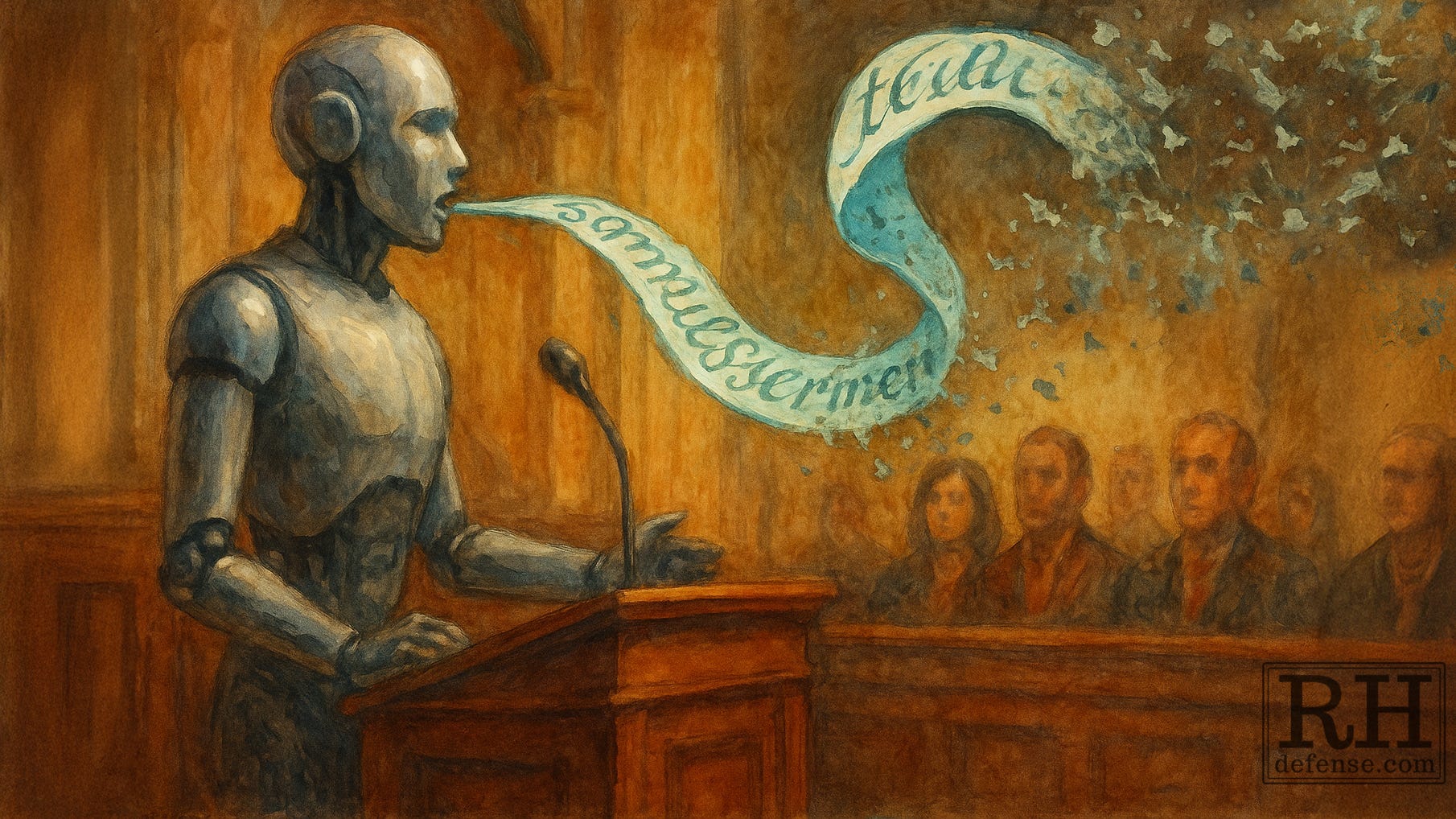
But the communicative act — whether by a human or a bot — was not a case of creatio ex nihilo. (I said in Trust Me, I’m a Chatbot, that clear-talking lawyers don’t use Latin! Well, I’m more of a philosopher today, I guess.) The text (or bot voice) didn’t come from nowhere. It didn’t magically appear. Internal processes wove together those words that constitute the communicative act — whether you want to call it “code”, or “programming”, or “algorithms”, or “weighting”, or whatever else: it was internal to the machine.
Maybe by using “internal” Joe Slater meant that the “speaker” of the communication was self-aware. But that just brings us back to what I said: “hallucination” isn’t the right word because it refers to something perceived. And bots can’t perceive. So far as we know. And I believe we’re right on that count.
That’s why I think Joe’s fix doesn’t quite work. Frankfurt’s “bullshit” requires intentionality. The bullshitter knows what truth is, but chooses to be indifferent to it. That still presumes thought, belief, even strategy. Bots don’t have that. They don’t “know” what truth is, and they certainly don’t “decide” to be indifferent. They just crank out continuations.
“Confabulation” doesn’t carry that baggage. It names the mechanism: filling gaps with plausible-sounding statements. That’s what LLMs/chatbots do, all the time. They “chat” in the root sense of confabulor. And while those sentences may be about something, the bot doesn’t know that. It’s just doing whatever its transformer architecture does — which, as even AI scientists admit, we don’t fully understand.
Why It Matters That “Confabulation” Fits Better
So, as I said, “bullshit” presumes a performer, a communicative agent playing an audience. That’s still anthropomorphic — just with a different hat, or as I said earlier, a view from a different seat. The philosophical term is “intentionality”. It was a big part of all those discussions I got to be part of in the 1990s.
What I’m after is a term that names the mechanism, not the motive. That’s “confabulation”.
The word matters. “Confabulation” comes from the Latin confabulor: “to talk together,” “to chat.” That’s what these systems do — chat — without any sense of when they’re right or wrong. Previously, I said it was confabulare, but that’s the transitive Italian verb, which, according to an Italian-English dictionary I looked at, means “to confabulate, to talk / to chat”. The example “Che cosa avete voi due da confabulare?” meaning “What are you two talking about?” appears there.
But why does it matter?
Because when parsing philosophical issues, words matter. When trying to solve problems, accurately defining the problem is critical to understanding it. AI isn’t bullshitting you, or anyone else. It’s chatting. Or maybe “chattering” would be even better.
My good friend Marcos Dorado would say “yapping”.
This isn't just semantic hairsplitting. Words shape how users, developers, and regulators respond to AI errors. "Hallucination" suggests an intermittent event or condition that might be cured with better training or fine-tuning. "Bullshit" can imply — though I think on this point Joe Slater disagrees — malicious intent that could be addressed through accountability measures. But "confabulation" points to something more fundamental: these systems are narrative engines, not truth engines.
As I said above, this is just how AI works; this confabulatory process informs every level of its programming.
That recognition should change our approach. Instead of expecting developers to "fix" confabulation (impossible, since it's the core function), we might focus on better interfaces that signal uncertainty, training users to verify claims, or designing systems that explicitly distinguish between creative and factual modes. The word matters because it points toward different solutions.
It matters because the computer program — at least with respect to LLMs/chatbots, which is what we’ve been talking about — is relying upon processes we don’t fully comprehend, using mathematics most of us will never understand, to make predictions at which words to string together and present to the screen or (for speaking bots) the device’s speaker.
In short, it’s building a coherent narrative.
And, in the end, that’s exactly what “confabulation” is all about.
Great Article!