

Charlie Kirk is dead. Assassinated. I don’t condone nor do I celebrate it. I’m also not crying crocodile tears over it. Assassination is not how we should deal with people we disagree with. If I implied that were the standard, then I would be saying anyone who disagreed with me would have license to come kill me. And while I can’t always claim to love life, I’m also not really ready to die. (Otherwise, I would have already handled it myself.)
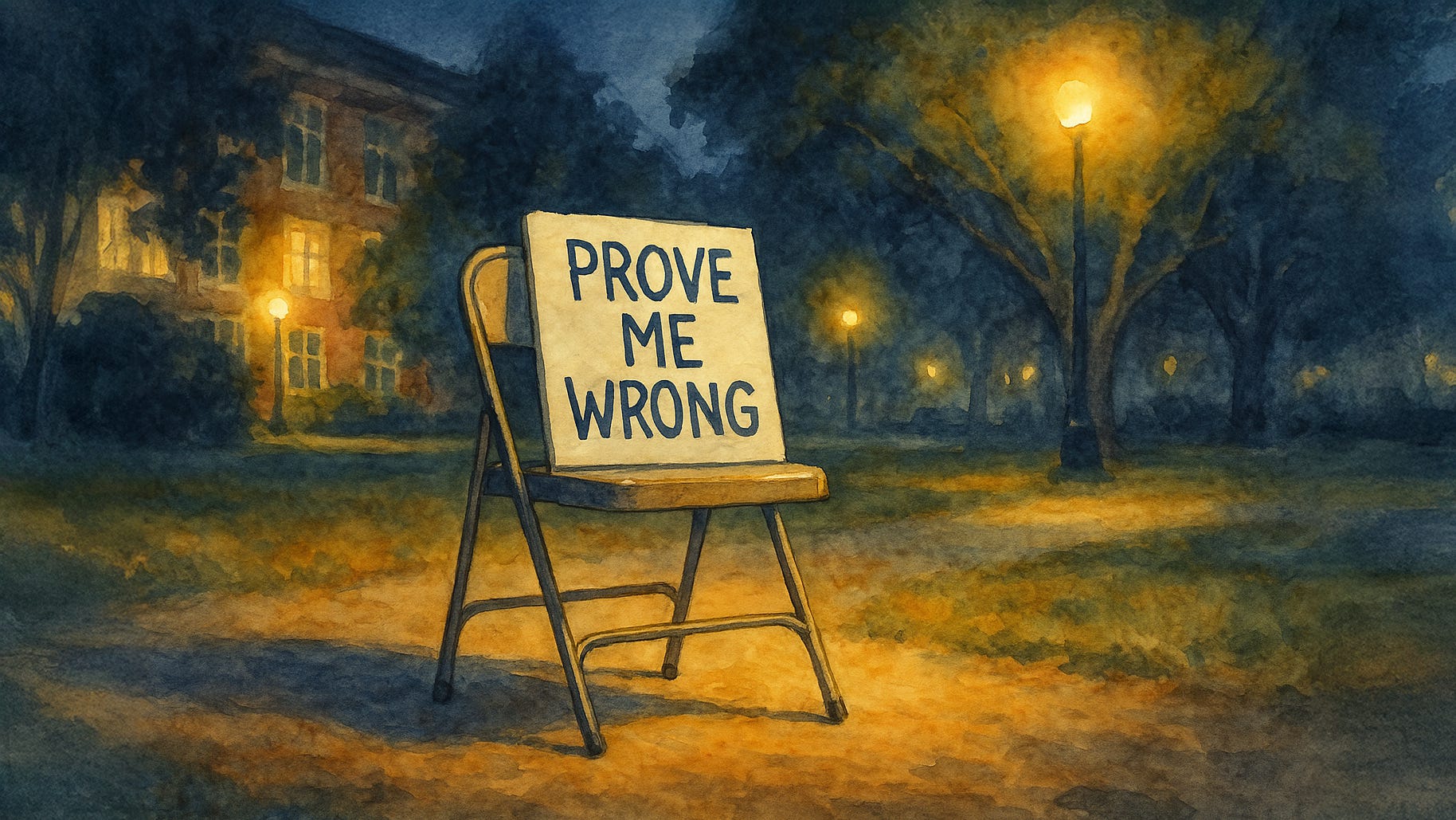
So, let’s also be honest: I’m not going to cry even hummingbird tears for him. Because Kirk’s entire career was built on degrading discourse. His “Prove Me Wrong” routine wasn’t debate. It was theater. It relied on rhetorical tricks — the very kind the earliest philosophers complained about when talking about the Sophists — that substituted spectacle for substance.
Those tricks have consequences.
They’ve helped shape a public square where winning matters more than truth, where the loudest voice drowns out the strongest argument.
Where Donald Trump gets elected President by the bottom half of the voting public.
Maybe. I mean, it depends on what you think Trump meant by this comment.
In any event, Charlie Kirk’s modus operandi matters more to me than his death. I am, after all, a professional arguer. In the courtroom, I frequently am faced with Deputy District Attorney Charlie — or Carlie — Kirk. The prosecutor who has been taught that truth is terrible (or at least irrelevant); compassion is crap; and we’re really just on opposite sides of a debate team, so anything goes in the name of winning.
Nevermind that we’re dealing with people’s lives.
The Burden Shift: “Prove Me Wrong”
In law, the burden of proof matters. The prosecution has it. The defense doesn’t. But Kirk’s entire shtick was flipping that around: “I believe X. Prove me wrong.”
That’s not argument. That’s a dare. And it’s a dare built on bad logic: the person making the claim is the one required to prove it; not the other way ‘round.
But it’s understandable that Kirk got this wrong. We’ve trained a generation (or two, or three) of people to get it wrong. When someone comes into court, and it’s time to pick a jury, the potential jurors don’t expect the prosecution to prove their case: they expect the defense to prove innocence.
But innocence isn’t something you can prove in the same way that you can prove guilt. That’s why the United States doesn’t use the Napoleonic system (except in the Deep South where they love forcing people to prove innocence because they mostly only charge Black people with crimes), like other countries. (I’m looking at you, Mexico, whom I otherwise love.)
Why Innocence Can’t Be Proven
But it’s very difficult to prove a negative in most cases. “Prove you didn’t commit the crime.” Unless you’re one of those YouTube or TikTok “influencers” who has a camera crew following them around 24/7, you just can’t. At best, you can provide fragments of alibi evidence.
But, as they say — well, okay, as I and other logically-minded people say — "the absence of evidence of innocence isn't proof of guilt."
I mean, think about it. There’s no evidence that you’re innocent…. Of anything. Name the crime: there’s no evidence that you’re innocent.
How do I know that? First of all, because I’ve defended a lot of innocent people for whom we could not only not find evidence of innocence, but we never could have. Have you ever watched a television show or a movie in which someone who was innocent is asked by the cops, “So where were you at 1:37 a.m. on Tuesday?” And the response is, “Alone.”
Boom! No evidence of innocence.
So why is it wrong to flip the burden? Because innocence isn’t something you can prove in the same way you can prove guilt. And anyone can accuse anyone of anything. That’s why we require the prosecution to prove guilt. That’s why we put the burden on them, instead of the accused person.
Jurors Get It Wrong, Too
Sadly, jurors often take the Charlie/Carlie Kirk response:
If he’s here, he must’ve done something. Until he proves otherwise, I’m voting “guilty”.
This is so common that defense attorneys spend most of their voir dire before a trial trying to find all the people who think this way and get rid of them.
So when Kirk sat on a folding chair and said “prove me wrong,” he was tapping into that same cultural miseducation: the belief that the challenger, the accused, the Other must do the heavy lifting. It feels natural because it’s familiar. But it’s wrong in law, and it’s wrong in logic.
The Fallacy of the Unfalsifiable Claim
Another problem with Kirk’s “prove me wrong” routine is that the claims themselves were often impossible to disprove. They weren’t tight, testable statements — they were sprawling generalizations.
Think about the classics: “Capitalism is the best system.” “America is not racist.”
How do you “prove” or “disprove” something like that in a five-minute encounter on a college quad? You can’t. At most, you can trade anecdotes, or point to studies that Kirk will immediately dismiss as “biased.” He designed the claims so broad, so squishy, that no amount of contrary evidence could ever count as decisive.
Kirk dealt the debate from a stacked deck.
That’s why Kirk dealt the debate from a stacked deck. An unfalsifiable claim can’t be tested — and if it can’t be tested, it can’t be refuted. Which means the challenger is doomed before they even open their mouth. (As happened in almost every debate, even against the best debaters.)
In law, we’d call that a non-starter. Courts deal in concrete allegations and concrete evidence. “The defendant stole the car” can be tested. “The defendant is a bad person” can’t. (Although that certainly doesn’t stop the prosecution from trying to say so.)
Kirk blurred that line on purpose.
Appeal to Ignorance
There’s another sleight of hand built into Kirk’s “prove me wrong” act. The hidden logic goes something like this: Because you haven’t disproved me, I must be right.
That’s the classic “appeal to ignorance” fallacy. It shifts the conclusion from evidence to silence.
You see this all the time in bad prosecutions: “The defense didn’t prove an alibi, so he must have done it.” Or “She didn’t deny it forcefully enough, so it must be true.” Judges rarely strike that reasoning down because it’s backwards — after all, with people untrained in logic, it works. It wins convictions. The prosecutor isn’t going to jail. The judge isn’t going to jail. So the fact that this is pure bullshit doesn’t upset them.
If it wins convictions, that is what matters.
But the absence of evidence isn’t evidence of guilt.
I wish more jurors understood this.
Anyway, Kirk thrived on that backwards move. If a college sophomore couldn’t marshal encyclopedic data on systemic racism or economic theory in five minutes, Kirk could lean back, fold his arms, and declare victory.
That wasn’t truth-seeking. That was weaponizing the abuse of logic, the deliberate use of logical fallacy, and the normal limits of human conversation. And it worked—not because his points were strong, but because his opponents couldn’t meet an impossible standard.
The Dare Frame
To grab you by the carotid, Kirk’s routine wasn’t even about argument at all. It was about theater. The “prove me wrong” line isn’t a proposition to test — it’s a dare.
And dares aren’t about truth. They’re about bravado. They flip the frame from substance to performance. The issue is no longer whether the claim is true, but whether the challenger has the ability, the speed, the cleverness to take it on.
That’s why it worked so well on a folding chair in a college quad. The audience wasn’t scoring Kirk for logic; they were scoring for swagger. Kirk knew that if he looked confident, unflappable, even amused, even the most prepared kid sweating through what could only be a half-baked response (because how could he anticipate that he would be fighting logical fallacies instead of logic) would look weak — no matter how much better their reasoning was.
It’s the same trick a bad prosecutor uses when they sneer at a witness: “So, you expect us to believe that story?” They’re not disproving anything. They’re daring the jury to stick their necks out and side with the eyewitness who just hurt the prosecutor’s case. And most jurors won’t so that.
A dare is a rigged contest. The one who issues it already has already essentially won, except in very rare circumstances where they haven’t already set things up with the rhetorical ruses. The one who accepts it starts in a hole. That’s why it’s not argument. It’s spectacle. And spectacle, repeated often enough, starts to look like proof.
Trust me: it wins many a trial for the prosecution.
Straw Men and Cheap Shots
If Kirk had a signature move beyond the dare, it was this: never argue with what someone actually said. Twist it. Shrink it. Flatten it into something stupid enough to knock over. Then declare victory.
That’s the straw man argument.
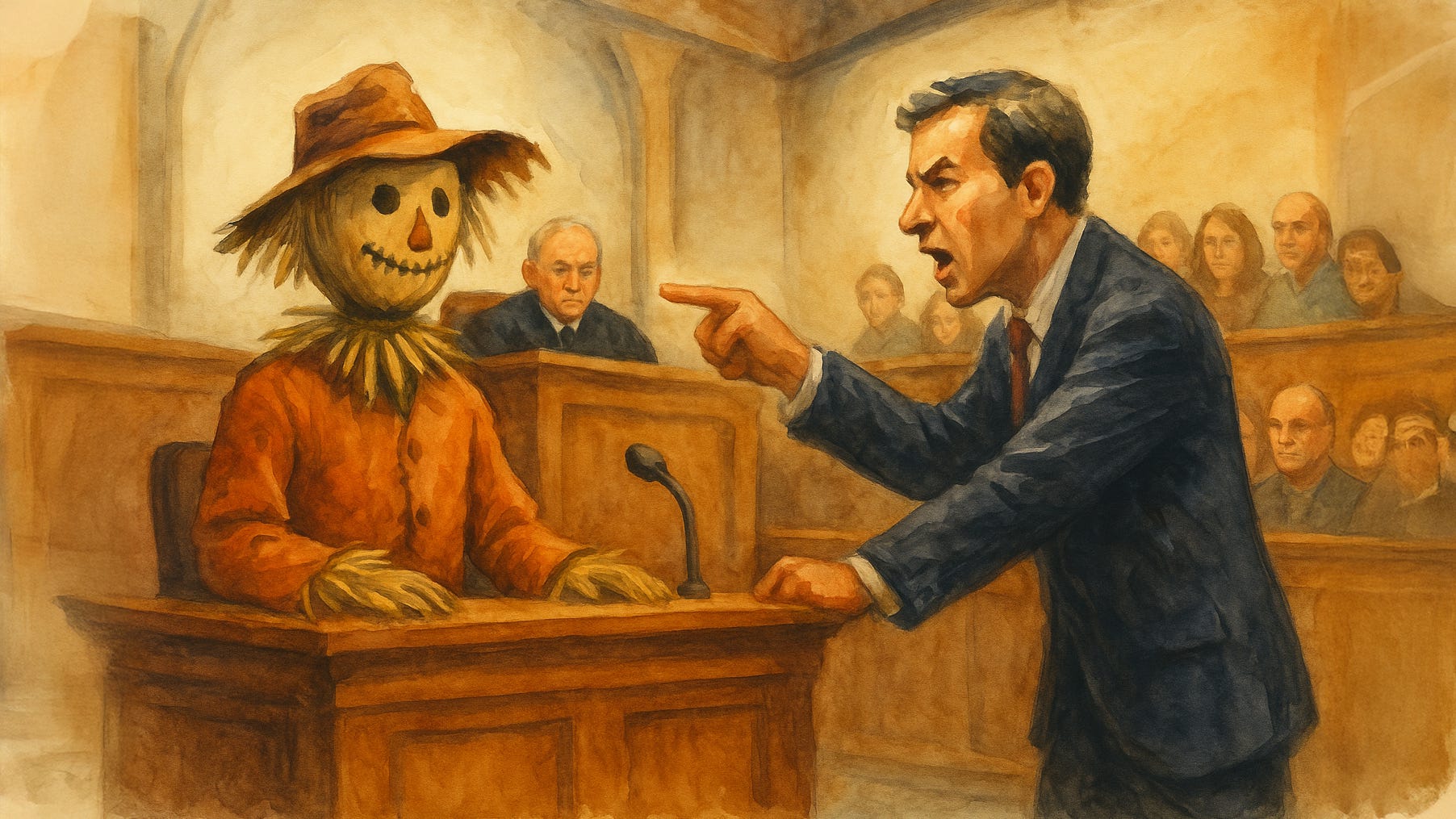
A student might say, “I believe systemic racism still exists.” Kirk’s answer? “So you think every white person is a racist? Prove it.”
Nobody said that. Nobody even came close to saying that. But now the opponent is stuck in the weeds, trying to climb out of a hole Kirk dug for them. And the crowd thinks he’s landed a punch.
It’s the same thing prosecutors do when they tell a jury: “The defense wants you to believe this officer just made the whole thing up.” No — the defense wants you to look at contradictions in the officer’s testimony. The officer wasn’t there. He was making — what the defense claims was — invalid deductions based on incorrect or incomplete evidence. Or, especially, jumping to conclusions with invalid inductions.
The defense is saying, “Please look carefully at all the evidence and this officer’s testimony. Don’t rely on his conclusions. Make your own. From the evidence.”
But by recasting the defense as an absurd all-or-nothing claim — the officer is wrong about everything; he’s a liar; his story is fictional — the prosecutor gets to swing at a weaker target.
He reduced complexity to cartoon binaries. Then he claimed he’d won.
Jurors don’t want to think police officers are liars. (Although more than anyone wants to admit, they are. And I’ve proven that sometimes with their own reports.) Jurors would automagically doubt any defense attorney who said otherwise. (Like I just lost you a second ago — but I don’t care, because this is a Substack. And if you can’t handle the truth, that’s not my issue here, today.)
The point is, in court, that would draw an objection. In the quad, it drew applause. And Kirk knew it.
He was a master at the Sophistical Method of Warped Warfare.
Ridicule as Reasoning
To me, the fishiest part was one of Kirk’s favorite shortcuts to “win” the “debate”.
It wasn’t logic at all. It was laughter.
Why wrestle with complexity when you can score a laugh line? A smirk, a snide remark, a throwaway joke at the opponent’s expense. All of a sudden the argument itself disappears. The audience remembers the punchline, not what the debate was about.
And definitely not that the punchline itself was a red herring.
You see prosecutors do the same thing when they mock a defense witness on cross. The burden of proof is on prosecutors in criminal cases.
Beyond a reasonable doubt.
But a cross-examination after a cross-examination that doesn’t score points is followed by a sarcastic grin, a raised eyebrow, a “Really? That’s your story?” They haven’t proven anything. And they haven’t actually disproved anything the witness said. They’ve just signaled to the jury that it’s time to laugh instead of think.
And jurors, like the college kids gathered around Kirk’s folding table, often take the cue. It’s easier to go along with the sneer than to follow the evidence.
Especially when it doesn’t prove what the Charlies and Carlies at “the People’s” table want it to prove.
But ridicule isn’t reasoning. It’s bullying dressed up as cleverness. While it may persuade those who can’t — or won’t — think. It does so by sinking the opposition through humiliation. And that humiliation creates the illusion of victory.
Kirk knew that. He leaned on ridicule because it worked. Not as proof, but as performance.
Sound familiar? It should. Donald Trump runs the same playbook. He slaps nicknames on opponents, smirks at reporters, and turns serious policy debates into stand-up routines. It’s not persuasion; it’s dominance theater.
And once he’s set the audience laughing, he moves to his next favorite move: the false choice.
False Choices, False Victories
This was a favorite move of Kirk’s as well. With the false dichotomy the wielder of the wishful wand pretends there are only two options, and if the challenger doesn’t pick the “right” one, the wand-wielder wins by default.
It looks like logic, but it’s really sleight of hand.
Take something like, “If you think America has problems, why don’t you move to Cuba?”
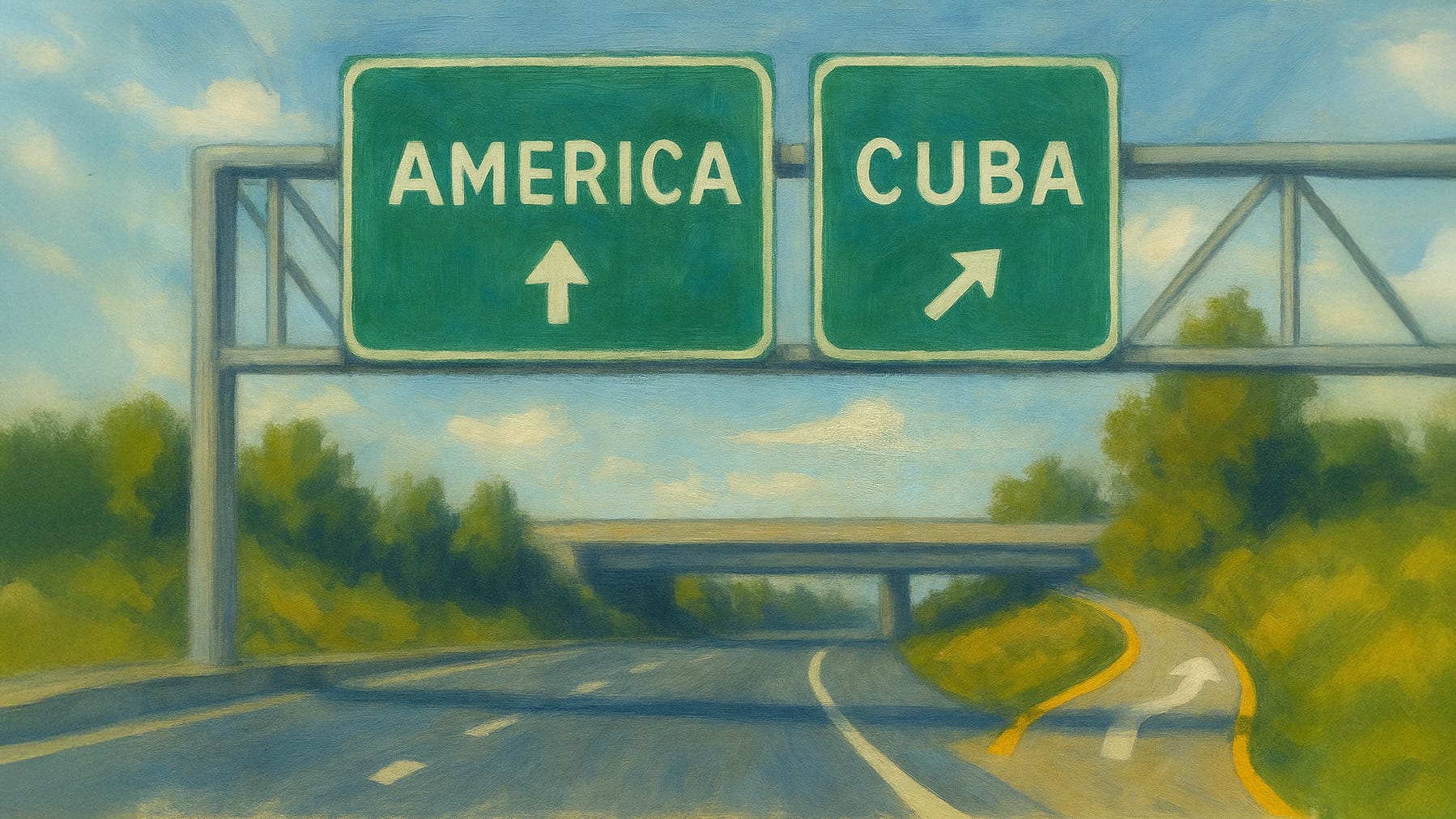
That’s not a real choice. That’s narrowing an infinite range of positions down to two extremes: love everything uncritically, or abandon your country entirely. And if the opponent doesn’t accept either horn of the dilemma, Kirk smirks, spreads his hands, and declares victory.
Prosecutors play the same game with juries: “Either you believe the officer, or you believe this criminal.” As though those are the only two possibilities. As though there couldn’t be mistakes, biases, or partial truths. As though the evidence itself didn’t need scrutiny.
But people — and jurors are people — fall for it. A forced choice feels satisfying. It makes the world simpler. It lets the audience check a mental box and move on. Kirk knew that. He knew most people aren’t trained to spot that the third, or fifth, or sixth option, or more, even existed — that there were more complicated, more nuanced option — where the truth usually lives.
It’s just “my way or the highway”.
He reduced complexity to cartoon binaries. Then he claimed he’d “won”. But he hadn’t won. He’d just tricked the frame, turned the debate into a multiple-choice test where only one answer was allowed to count.
And, as I’ve been saying all along, that’s not argument. That’s rigged theater.
That’s where Kirk lived.
And, ultimately, where he died.
This post has been edited 9/13/2025 to fix some typos.
Another excellent writing by one of the best writers I know. And I know me some writers.
The parallels between the prove me wrong farce and the cheap theatrical way American cases are being prosecuted is 100 percent accurate.
In the future, I’d like to hear Rick’s thoughts on how to best unmask and expose these farcical ploys.
And let’s be clear, Kirk did not invent this pattern. Trump did not invent it. Pirro did not either. It’s been used by false and prophets and swallowed by their sycophants for ages. Tell us Rick: Why are so many people so gullible? How can we expose this sort of thing regardless of who is using it?
These are my questions.
Damn, this is good.